



Related News: EV Market Ends 2025 On A Better Sales Note
EVs Set Market Share Record For Light-Duty Sales
The Alliance for Automotive Innovation's latest data shows 155 electric models are now available in the U.S., but charging infrastructure still lags.
February 11, 2026
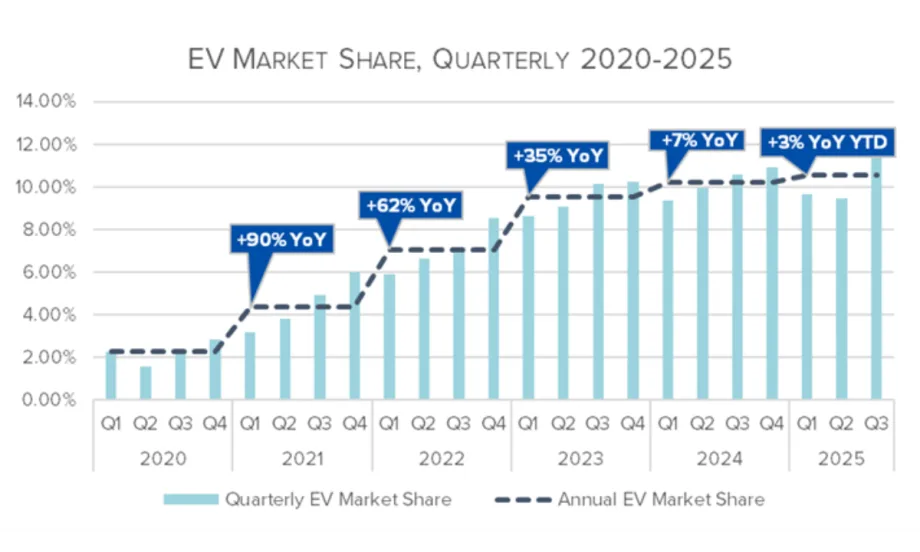
Electric vehicle market share continued its upward trend through Q3 2025, with steady quarterly gains following rapid growth earlier in the decade.
Photo: Alliance for Automotive Innovation
2 min to read
EV sales, market share, and vehicle models increased during 2025, signaling a healthy EV industry, according to the Get Connected Electric Vehicle Report Q3 from the Alliance for Automotive Innovation.
Its report includes a state-by-state analysis of EV sales, registrations, and charging infrastructure across all 50 states.
The quarterly report summarizes key metrics, including EV market share, geographic distribution of registered EVs, charging network growth, and consumer adoption trends in a post-incentive environment.
Here is a sectional breakdown of key statistics, trends, and findings:
Q3 2025 EV Sales and Market Share
EVs accounted for 12.6% of new light-duty vehicle sales in Q3 2025, up from 9.5% in Q2 2025.
EV market share increased by 2 percentage points year-over-year (Q3 2025 vs. Q3 2024).
EV sales volume rose 23% (about 94,000 more vehicles) compared with Q3 2024.
Internal combustion engine vehicle market share declined by 4.6 percentage points year-over-year.
155 electric vehicle models were available for sale in the U.S. in Q3 2025.
Light trucks represented 85% of the EV market, up 6 percentage points from Q2 2025.
Leading States and Registrations
504,131 EVs were registered in the U.S. in Q3 2025 — a 23% increase compared with Q3 2024.
California (31.5%) and Colorado (29.4%) led all states in EV registration share for the quarter.
19 states and the District of Columbia registered EV market shares above 10% in Q3 2025.
Four states/DC posted market shares above 20%:
Washington (24.2%)
District of Columbia (22.2%)
Oregon (20.7%)
Nevada (20.5%)
Total light-duty vehicle sales across all powertrains increased 3.8% year-over-year.
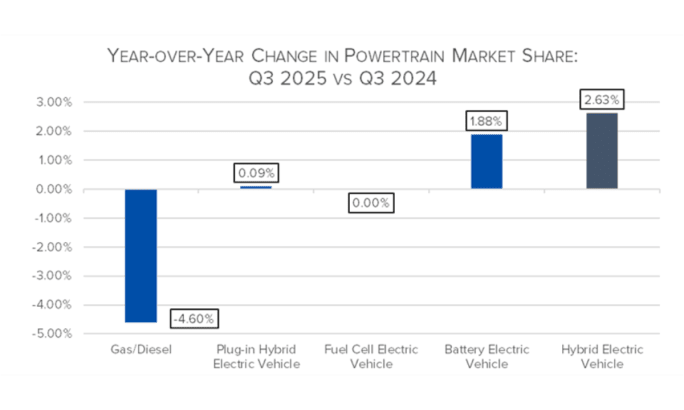
Battery-electric and hybrid vehicles gained market share year over year in Q3 2025, while gas and diesel vehicles continued to decline, according to U.S. light-duty sales data.
Photo: Alliance for Automotive Innovation
Charging Infrastructure Still Lags Growth
Publicly available EV chargers increased 21% through Q3 2025.
A total of 17,073 new public charging ports were added during the quarter.
There are approximately 235,042 publicly available charging outlets in the U.S.
About 7 million EVs are now registered nationwide — roughly 2.4% of vehicles in operation.
The ratio of EVs to public charging ports stands at about 30 EVs per charger.
Non-Tesla fast chargers now outnumber new Tesla installations, reflecting a shift toward broader network diversification.
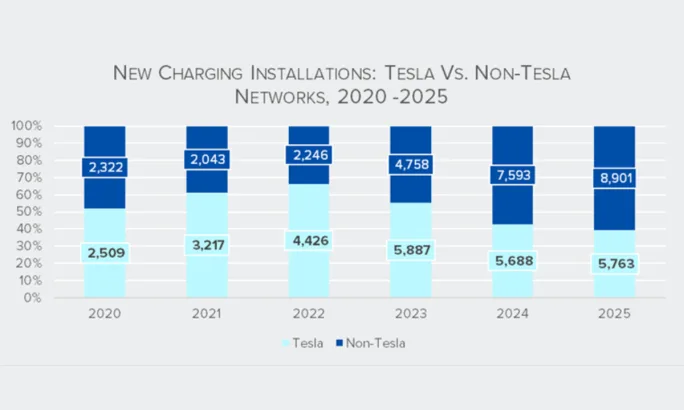
New public charging installations increasingly favor non-Tesla networks, reflecting a shift toward a more diversified U.S. charging landscape from 2020 through 2025.
Photo: Alliance for Automotive Innovation
Consumer Adoption Trends
Consumer adoption remains closely tied to charging access, vehicle range, and incentive availability.
Dealerships continue to play a central role in educating buyers and supporting EV adoption as incentives change.
The full Q3 2025 Get Connected Electric Vehicle Report is available through the Alliance for Automotive Innovation.
More Electric Vehicles
EV Charging Use Is Outpacing Infrastructure Growth
ChargePoint’s 2026 Charging Forward Report points to rising charger use, higher-powered charging, commercial vehicle electrification, and energy-management technology. Here’s what fleets should know.
Read More →
EV Realty Names Henrik Holland President as Charging Platform Expands
The former Prologis Mobility and Shell executive will help expand EV Realty’s truck charging business and move its power-first infrastructure model into autonomous vehicle depots and other fleet sectors.
Read More →
GreenPower Expands New Mexico EV Pilot With Larger Buses, V2G Testing
After logging more than 17,000 electric miles in the first year, New Mexico’s statewide pilot is moving into its second phase with larger vehicles, continued charging evaluations, and more.
Read More →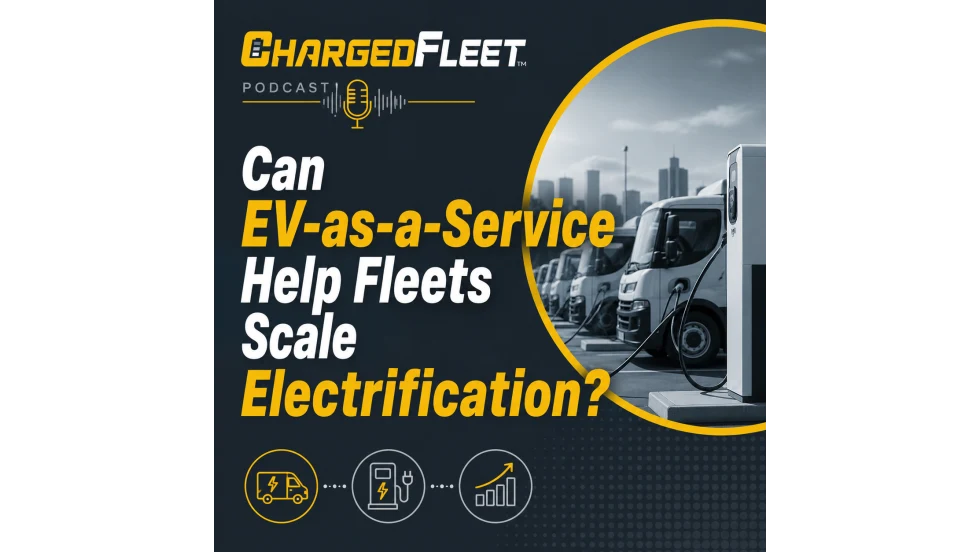
Can EV-as-a-Service Help Fleets Scale Electrification?
Sustainability Partners CEO Adam Cain explains how matching EVs, charging infrastructure, and duty cycles can help fleets scale electrification.
Read More →
How EV-as-a-Service Is Moving Fleets Beyond Pilots
Adam Cain, president and CEO of Sustainability Partners, explains how EV-as-a-service can help fleets scale deployments by addressing duty-cycle requirements and charging challenges.
Read More →
PowerFlex, The Mobility House Join Forces to Advance Fleet Electrification
Two EV charging providers are joining forces to deliver a broader portfolio of energy management and fleet electrification solutions.
Read More →
Ford Retools Louisville Plant for Fathom Electric Truck Production
Ford's $2 billion Louisville Assembly Plant overhaul introduces a three-part assembly process for the Fathom midsize electric truck, with production scheduled to begin in 2027.
Read More →
Merchants Fleet Reports 290M EV Miles as Fleets Navigate Changing Electrification Market
From millions in operating savings to hundreds of millions of EV miles, Merchants Fleet’s latest report reveals what’s working and what’s changing in fleet electrification.
Read More →
California District Commits to Electrify 25% of School Bus Fleet by 2028
One of the nation's largest school bus electrification projects to date demonstrates how grants, charging infrastructure, and public-private partnerships can help fleets transition to EVs at scale.
Read More →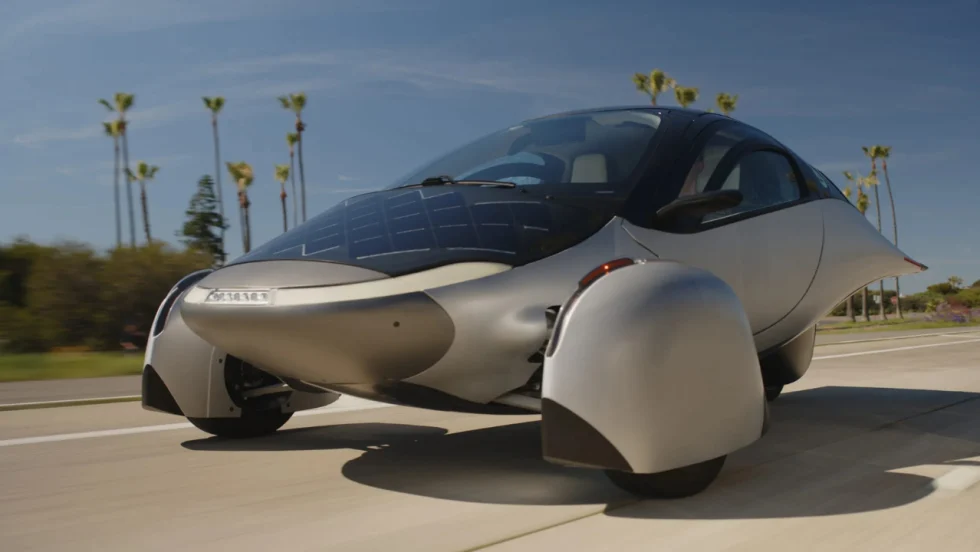
Aptera Orders Bodies and Chassis for Its First 40 Production Vehicles
Aptera Motors Corp. has issued purchase orders for the major structural components of its first 40 vehicles, and body and chassis components are expected to begin arriving in October.
Read More →