



"Challenges remain in remote areas like Montana, where charging infrastructure is sparse. In one case, a driver in Montana returned to an ICE vehicle after a six-month EV trial due to insufficient charging options, though he remained open to EVs in the future."
McKinstry Puts Electric Pickups to the Test as Daily Jobsite Workhorses
By deploying more than 100 electric vehicles — including fully upfitted Silverado EV pickups — in demanding construction and service roles, the Seattle-based builder is showing how electrification can work beyond pilot programs when matched carefully to duty cycles, infrastructure, and driver readiness.
August 19, 2025
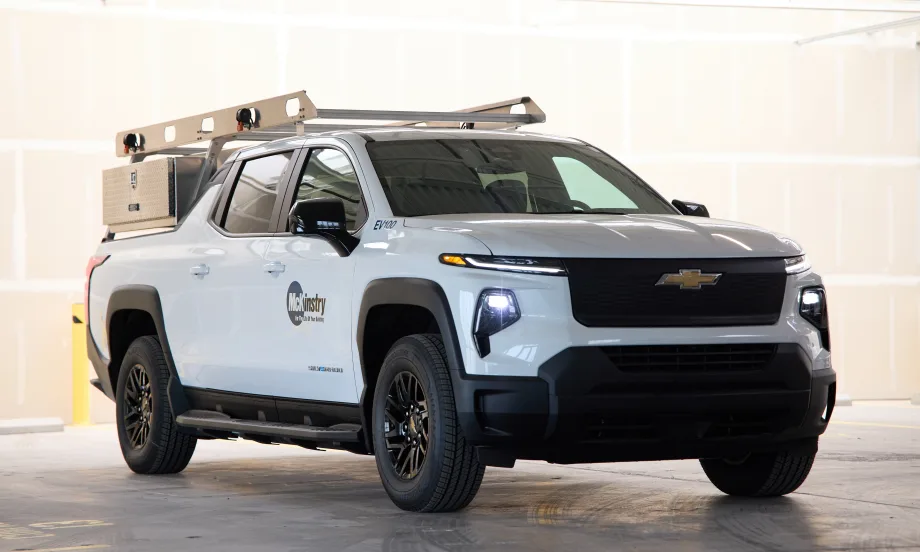
Fully upfitted Chevrolet Silverado EVs at McKinstry are equipped with ladder racks and toolboxes for daily construction and service work.
Photo: McKinstry
6 min to read
Fleets that traditionally use ICE pickups have not yet flocked to electrification en masse. The concerns are valid: e-pickup models’ ranges do not support many duty cycles; public infrastructure is patchwork; depot charging incurs capital expense; and total costs of ownership (TCO) remain uncertain, largely due to heavy depreciation.
Plus, while the environment is a recognized concern, why change an operational model that has worked since automobiles were invented?
Some fleets have tested the waters with a few e-pickups in pilot programs. Larger national fleets have made splashes with purchases of e-pickups and other electric models as part of corporate sustainability goals. In California, counties and municipalities are using e-pickups to comply with the California Air Resources Board’s Advanced Clean Fleets rule — but aren’t putting their capabilities to the true test.
McKinstry is taking a different approach: deploying electric pickups as daily workhorses for construction and service crews, not just for pilots or compliance purposes.
“We have fully upfitted, jobsite-ready EVs out there right now,” said Ryan Winchester, fleet manager. “They’ve got toolboxes, ladder racks, deck slides, everything our crews need.”
Early Pilots to Greater Adoption
Headquartered in Seattle, McKinstry is a builder and energy company with 3,000 employees and operations coast to coast. The company specializes in mechanical and electrical construction, with projects involving energy efficiency, renewables, and decarbonization.
The fleet consists of about 800 vehicles, and it plans to grow to 1,000 as it expands its construction footprint into Texas, Arizona, and Colorado.
The vehicle mix includes light-duty pickups, cargo vans, and even specialized vehicles like rail cars for unique job site needs. The company replaces 125 to 150 vehicles annually, targeting a five-year or 100,000-mile cycle for its ICE (internal combustion engine) vehicles.
McKinstry’s electrification journey began nearly a decade ago, with early pilots revealing both opportunities and challenges. Joseph Hagar, president and CFO, recalled the initial resistance. “When we started, some drivers weren’t thrilled about EVs,” he said. “We heard some choice words, but we focused on education and highlighting the benefits.”
In 2023, the company stepped up its efforts to pilot 10 EVs of various makes and models, including the Rivian R1T, Chevrolet Silverado EV, and Ford E-Transit, and has more recently fleeted some BrightDrop electric vans for deliveries.
However, McKinstry is not yet doing large-scale upfitting of electric vans. “Our feeling is the van market is really set on small package delivery short term within cities; they’re not targeting the mom-and-pop plumber,” said Nick Davidson, net zero program manager at McKinstry. “Until the market is really there, for us it’s a secondary priority.”
The EV Rollout Plan
McKinstry began its EV rollout with a first wave of early adopters — self-described “hand-raisers” — whose duty cycles aligned with EV range capabilities and home charging availability. Subsequent waves have targeted more cautious drivers, with vehicle allocation determined by specific use cases and the readiness of various unions to adopt the technology.
Throughout the process, the company has treated the transition as a change management initiative, focusing on educating drivers about charging practices, range planning, and the operational differences from maintaining an internal combustion engine vehicle.
“We’ve been strategic about replacing ICE vehicles with EVs,” Winchester explained. “We’re not just electrifying for the sake of it; we’re ensuring these vehicles meet the needs of our superintendents and service technicians.”
Today, McKinstry has more than 100 EVs in its fleet and counting.
Upfitting Electric Pickups for Work
The company has settled on the Chevrolet Silverado EV, with a major reason being the EPA-rated range of 492 miles for the Work Truck WT trim equipped with the max range battery pack. The range accommodates trips from Spokane to Seattle or from Seattle to Portland without a mid-trip stop to charge.
The upfits add about 500 lbs., though that only produces a range loss of about 20 miles, Winchester said.
Crews travel to large construction sites, tenant improvement projects, and multi-stop service routes. Fully upfitted trucks carry heavy tools and materials daily. New configurations have been upfitted with custom ladder racks designed to handle pipe and other heavy materials.
McKinstry is working with a company called Torklift to create the first EV Silverado with a liftgate and explore ways to make EV pickups fully usable on job sites.
Getting Infrastructure Right
Infrastructure remains a key consideration, with home charging the preferred option. In some cases, the installation process has required creative problem-solving. “We put a charger into a duplex,” said Winchester. “The hardest part was going through the HOA, but we worked with them and got it done.”
Davidson said the company is expanding Level 2 charging at its own facilities, considering mobile charging options at job sites, and planning to add Level 3 fast chargers to support quick-turnaround deliveries. The company is also exploring solar and battery storage to ensure resilience during power outages, a concern in fire-prone regions like California.
As McKinstry is a signatory to 35 different unions, a notable challenge has been reimbursing drivers for home charging costs in alignment with collective bargaining agreements. “We’ve had to evolve how we track and reimburse kilowatt usage,” Hagar explained, adding that proactive engagement with unions and drivers has kept disruptions minimal.
Operating Costs & the TCO Equation
McKinstry’s team said that EV maintenance costs have been lower compared to ICE vehicles, and downtime for service has also dropped. Winchester added that in practice, EVs need very little service beyond over-the-air module updates. He hasn’t experienced accelerated tire wear that some fleets report.
“Every hour a service tech is down costs us $100 to $150,” Hagar noted. “We’ve seen that downtime drop noticeably.”
Fuel cost savings have been significant, as electricity costs per mile are much lower than pump prices, particularly in the Pacific Northwest, where the price per gallon is high.
Regarding TCO, the true test will come when McKinstry remarkets the EVs to determine overall net lifecycle costs. But the team has a plan based on assumptions:
While EV acquisition costs are higher, early indicators show that McKinstry could extend EV lifecycles beyond the five-year ICE standard and potentially reach 400,000 miles per vehicle, which would greatly aid the depreciation curve.
The first batch of EVs is cresting 60,000 miles, with one close to 100,000. “We’re seeing batteries hold up better than expected,” Hagar said.
Key Takeaways & Lessons Learned
To date, implementing the company’s electrification initiative has been relatively smooth, owing to meticulous planning. Key takeaways from McKinstry’s rollout:
Match the vehicle to the duty cycle: Don’t force EVs where range or infrastructure isn’t ready.
Plan for multiple charging solutions: Home charging is ideal, but supplement with workplace and job site charging for flexibility.
Address policy and reimbursement challenges up front: Engage unions and drivers early to design fair, workable solutions for home charging reimbursement.
Treat EVs as tools: Hagar likens the shift from ICE to EV to moving from corded to cordless power tools — “same job, new energy source.”
McKinstry has also taken on a greater role in educating others outside of its operations. “We manage energy efficiency,” Hagar said. “We help organizations go through their sustainability journey and decarbonize.”
Topics:ElectrificationAlternative Fuels & HybridsElectric TrucksGreen FleetsUpfittingsustainabilityElectric VehiclesOperationsSuppliers
Originally posted on Automotive Fleet
Subscribe to Our Newsletter
More Electric Vehicles

EV Charging Use Is Outpacing Infrastructure Growth
ChargePoint’s 2026 Charging Forward Report points to rising charger use, higher-powered charging, commercial vehicle electrification, and energy-management technology. Here’s what fleets should know.
Read More →
EV Realty Names Henrik Holland President as Charging Platform Expands
The former Prologis Mobility and Shell executive will help expand EV Realty’s truck charging business and move its power-first infrastructure model into autonomous vehicle depots and other fleet sectors.
Read More →
GreenPower Expands New Mexico EV Pilot With Larger Buses, V2G Testing
After logging more than 17,000 electric miles in the first year, New Mexico’s statewide pilot is moving into its second phase with larger vehicles, continued charging evaluations, and more.
Read More →
Can EV-as-a-Service Help Fleets Scale Electrification?
Sustainability Partners CEO Adam Cain explains how matching EVs, charging infrastructure, and duty cycles can help fleets scale electrification.
Read More →
How EV-as-a-Service Is Moving Fleets Beyond Pilots
Adam Cain, president and CEO of Sustainability Partners, explains how EV-as-a-service can help fleets scale deployments by addressing duty-cycle requirements and charging challenges.
Read More →
PowerFlex, The Mobility House Join Forces to Advance Fleet Electrification
Two EV charging providers are joining forces to deliver a broader portfolio of energy management and fleet electrification solutions.
Read More →
Ford Retools Louisville Plant for Fathom Electric Truck Production
Ford's $2 billion Louisville Assembly Plant overhaul introduces a three-part assembly process for the Fathom midsize electric truck, with production scheduled to begin in 2027.
Read More →
Merchants Fleet Reports 290M EV Miles as Fleets Navigate Changing Electrification Market
From millions in operating savings to hundreds of millions of EV miles, Merchants Fleet’s latest report reveals what’s working and what’s changing in fleet electrification.
Read More →
California District Commits to Electrify 25% of School Bus Fleet by 2028
One of the nation's largest school bus electrification projects to date demonstrates how grants, charging infrastructure, and public-private partnerships can help fleets transition to EVs at scale.
Read More →
Aptera Orders Bodies and Chassis for Its First 40 Production Vehicles
Aptera Motors Corp. has issued purchase orders for the major structural components of its first 40 vehicles, and body and chassis components are expected to begin arriving in October.
Read More →