



Blog View:EVs Heading To ICE Parity
Lucid Gravity Centers The Grand EV Debate
Before the automotive world writes off or writes down electric vehicles, it should remember that innovation and technological evolution bring feasibility down to earth.
February 24, 2026
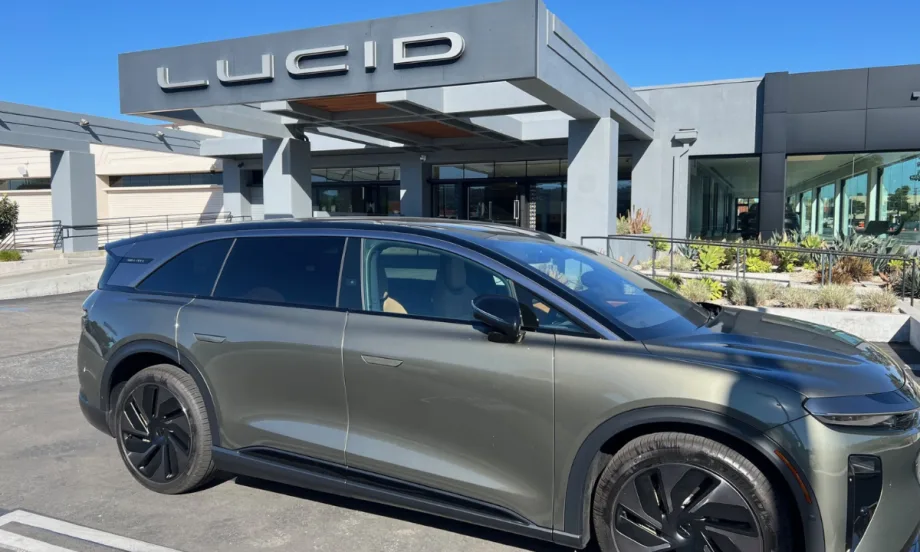
Outwardly, the sleek modular design suggests a CUV but embodies an SUV. Its structure permits you to have it either way.
Photo: Martin Romjue / Charged Fleet
7 min to read
Open enough news apps, and you’ll see the always-on media serving up a barrage of stories about the pending and grisly demise of electric vehicles.
Hertz and Avis have ditched their electric rental cars. The federal government axed primary tax incentives. The Detroit Big 3 have collectively lost $50 billion on EV manufacturing, sales, and investments. EVs are too expensive.
Sales are plunging. Range causes anxiety. Not enough chargers! EV batteries’ hair and pants on fire!
At a time when many Americans fret about abundance, we wallow in filthy-rich negativity.
Are EVs ready to curl up and die, and just give up?
Certainly not in China, Europe, and Canada. For now, step behind the wheel of the 2026 Lucid Gravity Grand Touring for a whirl, and you’ll detect a vigorous pulse and a continuous one if you turn on the seat massagers.
Instead of making you hyperventilate about the state of EVs, the Gravity will give you plenty to breathe easy and deep about.
An EV Template In Motion
A recent test drive of the Lucid Gravity reminds you of how far electric vehicles have ascended the slippery luxury pole, a feat pointing to healthy stamina ahead.
I’ll get the challenges out of the way first: The fully loaded version I drove costs about $95,000. That puts it into the realm of private executive, chauffeured luxury, and high-end rental fleets.
Like many EVs, it’s not for the faint of budget, but when you consider the potential and rapid progress of EV technology and performance, the prices should continue falling in the next few years. We’re seeing that with some non-luxury makes and models.
Think of the Gravity as a supreme template for future EVs, as advances and competition lower prices over time. If you remember the high costs of earlier-era computers, cell phones, and HDTVs relative to the average 1990s-era income, you can see how higher tech and more time spur affordable prices.
Computerized, data-driven EVs are often compared to smartphones. The apt reference for the Gravity is the iPad.
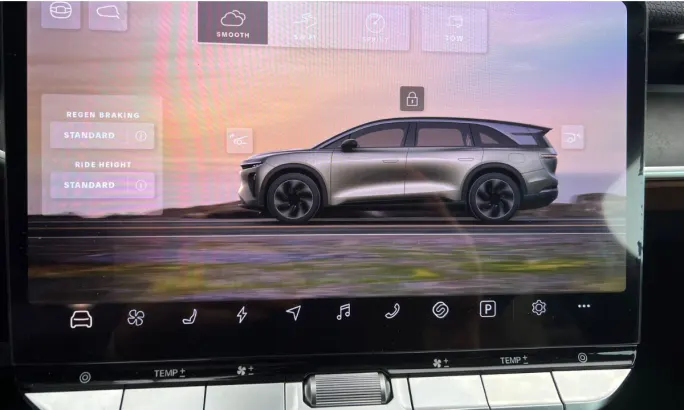
The Lucid Gravity is a highly trackable, programmable, and communicative electric car.
Photo: Martin Romjue / Charged Fleet
An All-Purpose Tech Portal
The Gravity’s iPad-inspired dashboard portal is designed for digital natives, with merciful simplicity for analog adventurists. Bottom line: The 50+ crowd can figure it out. It offers one of the most intuitive and logical iPad dashboard arrangements that technology can provide.
The iPad-style dashboard offers up a complementary menu of visuals, lists, and commands where the user can choose everything from rear-view mirror settings to climate controls, to engine power modes, etc.
My favorite menu item was the five-option seat massager, which shows your captain’s seat on the screen, adorned with circular pressure points that show exactly where you’ll be vibrated. It makes you not want to leave the car.
My second favorite option was the “Sanctuary,” a three-video set of multi-sensory mindfulness images and sounds designed to relax you — but only when the car is parked. That’s a safety measure since the combined pleasures of multi-point massage and in-cabin surround alternate realities could render an active driver catatonic.
For those who miss the obvious, like I did when fumbling around the dashboard for the glove box-opening command, you can simply say, “Hey Lucid,” and a huskier version of Siri will answer your question. But you must be very specific, because unlike Cousin Siri, she is quicker to say, “I don’t know.”
I had to do the same for the hazard lights, which are one of the few flaws on this otherwise techno-marvel of a vehicle. “Miss Lucid” told me the hazard lights control lies in the “upper console” above the center rear-view mirror.
Say what? If I’m feeling hazardous, I want that red button a finger poke away from the steering wheel, not inches from the sunroof.
Designing For Rigor And Curb Appeal
Lest you think all the Lucid action happens on the inside, the external realities seal a solid reputation.
Outwardly, the sleek modular design suggests a CUV but embodies an SUV. Its structure permits you to have it either way. Simply put, when the third-row seats are down, it feels like a spacious CUV. When the seats are up and occupied, the total seven-passenger hauler screams SUV.
[Note: The third-row seats should seat children only. A six-foot adult would suffer muscle spasms.]
21-inch front and 22-inch rear Orion Stealth wheels and tires, coupled with balanced suspension, ensure a smooth ride that grips the road, especially on bumpier, high coastal areas. Its adjustable vehicle height prevents bending down and upward straining typical of a low-slung sports sedan.
Another advantage is the standard versus high regen braking modes, which return range to the motor and minimize braking. Given the added wear on EV brake pads from their weight, regen braking redistributes the burdens of driving. I managed to drive up and down hills without ever tapping the brakes.
An underappreciated feature of EVs is that you no longer need a 10+ cylinder sports car to experience the thrill of an accelerated surge. The spry triplet power modes — Smooth, Sport, and Sprint — leave traditional horsepower galloping like a 1979 VW Rabbit diesel clunker. Instead, the acceleration reminded me that the Gravity is fit to celebrate 2026 as the Chinese Year of the Fire Horse.
Smarter Safety And Charging
Despite all of these attributes of daring, dexterity, and distraction, the Lucid Gravity definitely knows how to slip into schoolmarm mode when it comes to safety.
The standard Gravity features a L2++ system, designed for hands-free driving, lane changes, and highway assistance, with over-the-air updates. It can even self-park where suitable, available to help a teenage driving student nervous about parallel parking.
Safety is a priority, with turning visuals on the dashboard to complement the mirrors and a system of yellow alerts in the mirrors and red lines along the mini-screens that warn you when not to turn. Those signals disciplined me into not cutting off other cars on the L.A. freeways.
While safety is strict on the Gravity, the charging feels more like recess. Lucid charging now gels with Tesla Superchargers and provides full CCS and NACS access. Partnered with the Electrify America charging network, Lucid comes equipped with a CCS charging adapter.
This Lucid Gravity Grand Touring seven-seater model has a slightly smaller battery pack for a max range of about 350 miles, instead of the standard “up to” 450 miles.
Although EV manufacturers recommend 80% as the limit for daily charging, you can toggle the charging limit to 100% anytime via the charging menu under the lightning bolt button on the main display.
How Charging Expands Your Time
That brings me to another EV myth-buster: charging inconveniences and the lament that EV charging takes too much time.
I charged my test vehicle at an Electrify America charging station in the parking lot of a small suburban strip mall.
The only places worth walking to at that time were a grocery store and a nearby neighborhood and park. So, let’s do some fueling math:
If I need about 25-30 minutes to Level 3 charge the 89kWh battery pack from about 20% to 80%, I have enough time to do the following while the Gravity is locked and charging: Grab a coffee at the grocery store, shop for a few items placed in a handbasket, check out, and visit the restroom. Then, I could either go for a quick walk in the neighborhood or sit in the car and scroll on my smartphone. [If you believe the latest studies, most Americans are scrolling for far longer each day than an average EV charging session].
Now compare that to fueling an ICE vehicle: You take about 5-8 minutes to gas up and pay, but then, let’s say, you stop at the grocery store on the way home to get a coffee and buy a few items or run some other errand you were planning anyway.
Time-wise, you come out about the same for the EV and the ICE vehicle. The EV charging session simply incentivizes you to redistribute your routine tasks or activities.
After adding up and sorting out my Luci Gravity experience, I conclude that it can help resolve the reluctance to drive an EV. Its combination of range, safety, comfort, technology, and performance, in many ways, exceeds that of ICE vehicles. Technology vaults it to the top among luxury EVs. And Timothee Chalamet would agree.
When EV fast charging someday becomes a 5–7-minute affair (and it will), EVs will be a no-brainer. And you’ll have to find time to scroll elsewhere.
Subscribe to Our Newsletter
More Electric Vehicles
EV Charging Use Is Outpacing Infrastructure Growth
ChargePoint’s 2026 Charging Forward Report points to rising charger use, higher-powered charging, commercial vehicle electrification, and energy-management technology. Here’s what fleets should know.
Read More →
EV Realty Names Henrik Holland President as Charging Platform Expands
The former Prologis Mobility and Shell executive will help expand EV Realty’s truck charging business and move its power-first infrastructure model into autonomous vehicle depots and other fleet sectors.
Read More →
GreenPower Expands New Mexico EV Pilot With Larger Buses, V2G Testing
After logging more than 17,000 electric miles in the first year, New Mexico’s statewide pilot is moving into its second phase with larger vehicles, continued charging evaluations, and more.
Read More →
Can EV-as-a-Service Help Fleets Scale Electrification?
Sustainability Partners CEO Adam Cain explains how matching EVs, charging infrastructure, and duty cycles can help fleets scale electrification.
Read More →
How EV-as-a-Service Is Moving Fleets Beyond Pilots
Adam Cain, president and CEO of Sustainability Partners, explains how EV-as-a-service can help fleets scale deployments by addressing duty-cycle requirements and charging challenges.
Read More →
PowerFlex, The Mobility House Join Forces to Advance Fleet Electrification
Two EV charging providers are joining forces to deliver a broader portfolio of energy management and fleet electrification solutions.
Read More →
Ford Retools Louisville Plant for Fathom Electric Truck Production
Ford's $2 billion Louisville Assembly Plant overhaul introduces a three-part assembly process for the Fathom midsize electric truck, with production scheduled to begin in 2027.
Read More →
Merchants Fleet Reports 290M EV Miles as Fleets Navigate Changing Electrification Market
From millions in operating savings to hundreds of millions of EV miles, Merchants Fleet’s latest report reveals what’s working and what’s changing in fleet electrification.
Read More →
California District Commits to Electrify 25% of School Bus Fleet by 2028
One of the nation's largest school bus electrification projects to date demonstrates how grants, charging infrastructure, and public-private partnerships can help fleets transition to EVs at scale.
Read More →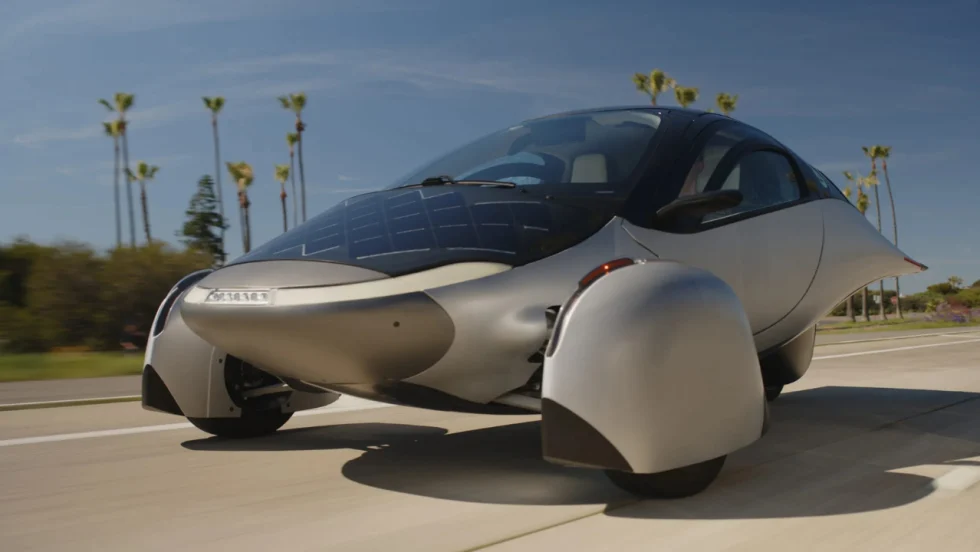
Aptera Orders Bodies and Chassis for Its First 40 Production Vehicles
Aptera Motors Corp. has issued purchase orders for the major structural components of its first 40 vehicles, and body and chassis components are expected to begin arriving in October.
Read More →