


TCO Cost Elements for EVs
Purchase minus incentives
Financing
Maintenance based on mileage
Insurance, including state regulations
Residual values
Infrastructure & EVSE
Vehicle emissions by state & grid

When creating a cost analysis for EVs, many more variables — including non-vehicle-related expenses — must be considered. How do they stack up to ICE vehicles then?
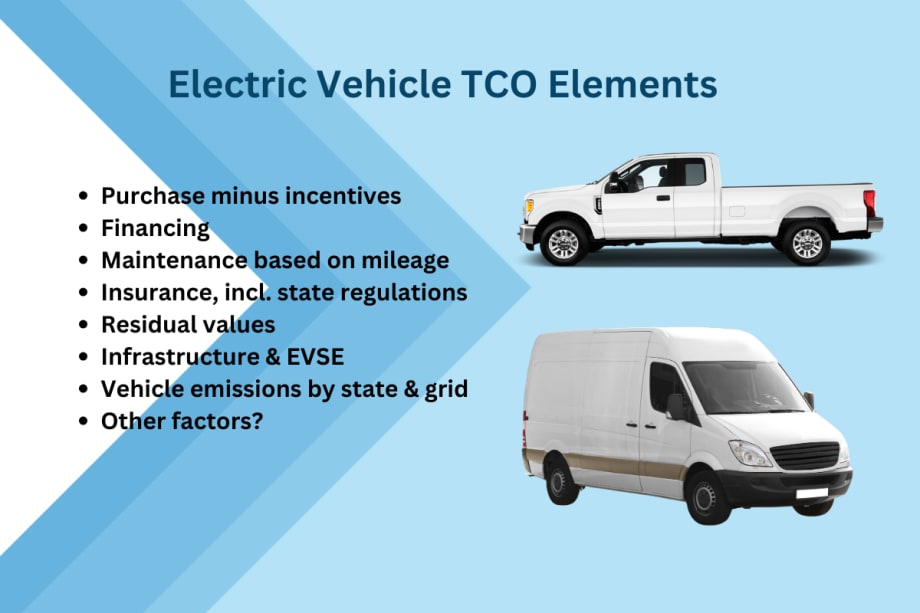
For EVs, non-vehicle-related expenses include infrastructure site preparation, charging equipment (EVSE) costs and ongoing maintenance, and software subscriptions to manage EVSE and vehicles.
Photo: Automotive Fleet
Deciphering true ownership costs for electric fleet vehicles is an evolving science. Remember when we were told that EVs’ higher initial costs than internal combustion engine (ICE) vehicles would be made up through lower vehicle maintenance and electricity costs?
Those lower operating costs have proven to be true, though savings can swing wildly based on various factors. They’re also mitigated by higher insurance costs, more frequent tire changes, and costlier parts repairs.
For EVs, add to the equation non-vehicle-related expenses that involve infrastructure site preparation, charging equipment (EVSE) costs and ongoing maintenance, and software subscriptions to manage EVSE and vehicles.
EV incentives and rebates also play a crucial role in achieving cost parity with ICE vehicles, though they vary widely depending on the use case. And EVs’ residual values and uncertainty in the wholesale market cloud a true TCO analysis.
Richard Hall, head of ZappyRide EV Products at J.D. Power, has been analyzing these challenges too.
“The path to EV adoption is strewn with boulders. Even an initial investigation of the prospects might offer a severe case of sticker shock,” Hall writes, noting the considerably higher initial costs for EVs over ICE vehicles.
However, he sets out to demonstrate how overall TCO can favor EVs, using the aforementioned factors.
First, he describes the essential elements of an EV TCO analysis:
“It should include purchase minus incentives cost, maintenance, operational costs, insurance, residuals, ROI, and infrastructure charges,” he writes.
“Resale values and financing affect TCO, so the analysis must be capable of assessing the residuals of commercial EVs. The financing gap for EVs, especially regarding residuals, is a concern that influences leasing and financing costs.”
Predicted maintenance costs should be calculated based on mileage, considering the higher per-mile service cost for older vehicles.
Insurance is another important cost factor, so the analysis must include it and account for state insurance regulations.
He also asserts that the calculation should include emissions for EVs over their lifetime, and account for the electricity generation process, which varies by state, compared to the straightforward calculation for ICE vehicles.
After the initial costs are tabulated, “To compare properly, one must see cash flow projections of year-by-year costs for both ICE and EV fleets and determine the breakeven point,” he writes.
Hall then breaks down two use cases for commercial vehicles, comparing EV costs to their ICE vehicle counterparts.
The analysis was performed using JD Power’s TCO tool for fleets, powered by ZappyRide. Residual values were calculated using Argonne National Lab’s AFLEET tool (noting that values are based on polynomial formulas, not wholesale data.)
One example involves a fleet of 10 pickup trucks in the Chicago area, each driven 100 miles per day.
The purchase price for obtaining the battery-electric trucks is $79,164 higher than the costs for purchasing equivalent conventional pickups. However, EV subsidies of $19,848 help to defray some of that cost.
He calculates EVSE and EVSE installation to add about $66,000.
However, fuel cost savings over a 10-year period are substantial — $393,000. He calculates that maintenance of the electric trucks is estimated to cost nearly $340,000 less than maintenance for a fleet of 10 conventional trucks.
“The total savings over the decade are a very tidy $677,815,” he writes.
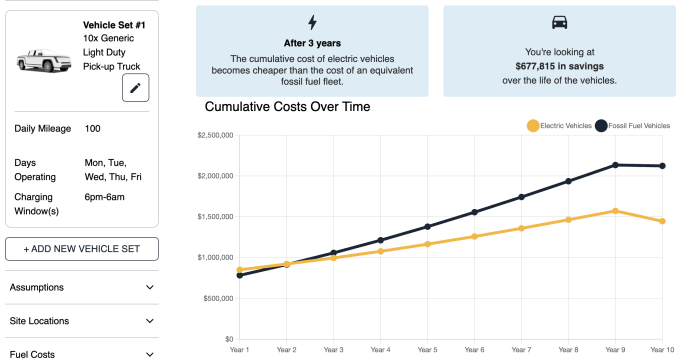
In this analysis of ICE pickup trucks compared to electric pickups with a high daily mileage (100 miles), the EVs eclipse ICE pickups in lower operating costs in year two.
Source: JD Power & Associates
The second example is 100 Class 2b cargo vans in California. In this scenario, the EV fleet is a cost-saver in year one, and the savings keep growing for the 10 years the vans are in the fleet.
The most substantial savings over 10 years come in these areas:
Fuel is $16.2M less for the EVs
Maintenance is $5.7M less for the EVs
California’s Low Carbon Fuel System credits should net $973,300 in savings
He writes that while some aspects of EV ownership in this scenario do cost more, the savings eclipse them.
In this case, Level 2 charging infrastructure costs $661,600. The EVs cost more to acquire by $435,280, although incentives help the business recoup about $100,000 of that cost.
Insurance is also more expensive by $128,824.
According to this analysis, switching from conventional vans to battery-electric-powered vans will save this company $21.8 million over the 10-year period studied.
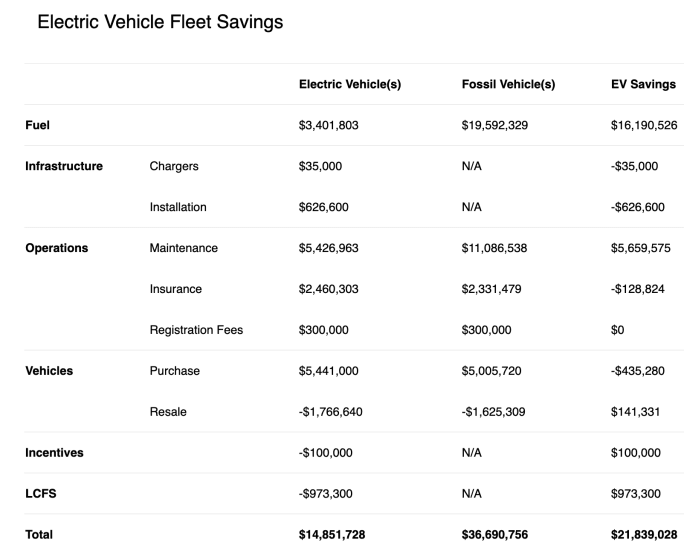
In this example of 100 cargo vans in California over 10 years, expenses for infrastructure and higher purchase costs are counterbalanced by fuel and maintenance savings and LCFS credits.
Source: JD Power & Associates
Hall writes that EVs aren’t always money savers, noting how electric school buses come with a much higher sticker price that is not recouped by fuel and operational savings over 10 years.
Looking at the big picture, “A data-driven approach resulting in numbers that project costs and savings over a specified time horizon is critical to getting it right,” he writes.
For fleets with multiple locations, modeling each location to provide breakeven curves and savings amounts will enable a strategic, phased transition to EVs based on available capital and grid capacity constraints.”
“The decision is left to the organization based on fact-based projections, with a focus on potential savings in both expenses and carbon dioxide emissions.”
What do you think? Is Richard Hall on the right track with his calculations?
My thoughts:
As depreciation — the largest cost element in TCO — is determined by end-of-term residual values, any formula not based on actual sales data will make a true TCO elusive until then. This equation will be well in hand for passenger vehicles before it will for commercial vehicles.
That said, depreciation is much less of a factor in a scenario analyzing commercial vehicles over a 10-year period in fleet, as the residual value of either an electric or fossil-fuel powered unit will be minimal.
This TCO model does not account for costs for EVSE upkeep or ongoing software system management.
Until EVs have enough road miles to see how well their batteries perform later in life, maintenance costs will be hard to pinpoint. The standard eight-year, 100,000-mile battery warranty is the best-determining factor for now.
Given the volatility of the carbon credits market, factoring in LCFS credits could drastically change the cost outcomes.
Email me at chris.brown@bobit.com with any thoughts, and we’ll get Richard Hall to respond.
Originally posted on Automotive Fleet
ChargePoint’s 2026 Charging Forward Report points to rising charger use, higher-powered charging, commercial vehicle electrification, and energy-management technology. Here’s what fleets should know.
Read More →
The former Prologis Mobility and Shell executive will help expand EV Realty’s truck charging business and move its power-first infrastructure model into autonomous vehicle depots and other fleet sectors.
Read More →
After logging more than 17,000 electric miles in the first year, New Mexico’s statewide pilot is moving into its second phase with larger vehicles, continued charging evaluations, and more.
Read More →
Sustainability Partners CEO Adam Cain explains how matching EVs, charging infrastructure, and duty cycles can help fleets scale electrification.
Read More →
Adam Cain, president and CEO of Sustainability Partners, explains how EV-as-a-service can help fleets scale deployments by addressing duty-cycle requirements and charging challenges.
Read More →
Two EV charging providers are joining forces to deliver a broader portfolio of energy management and fleet electrification solutions.
Read More →
Ford's $2 billion Louisville Assembly Plant overhaul introduces a three-part assembly process for the Fathom midsize electric truck, with production scheduled to begin in 2027.
Read More →
From millions in operating savings to hundreds of millions of EV miles, Merchants Fleet’s latest report reveals what’s working and what’s changing in fleet electrification.
Read More →
One of the nation's largest school bus electrification projects to date demonstrates how grants, charging infrastructure, and public-private partnerships can help fleets transition to EVs at scale.
Read More →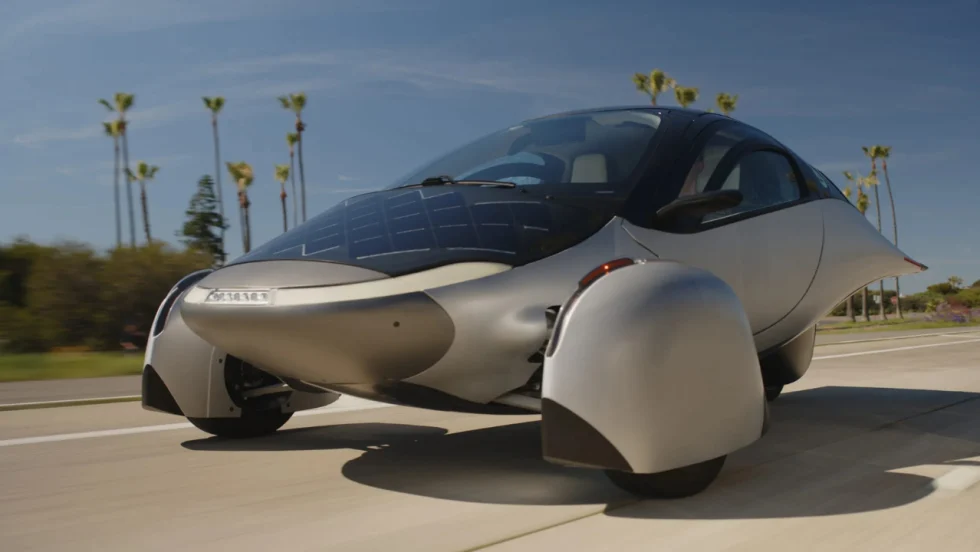
Aptera Motors Corp. has issued purchase orders for the major structural components of its first 40 vehicles, and body and chassis components are expected to begin arriving in October.
Read More →