


Used EV Sales Grow In April
While EV sales declined, used EV sales grew, as tighter inventory and rising prices reflected a more normalized pace for the EV market.

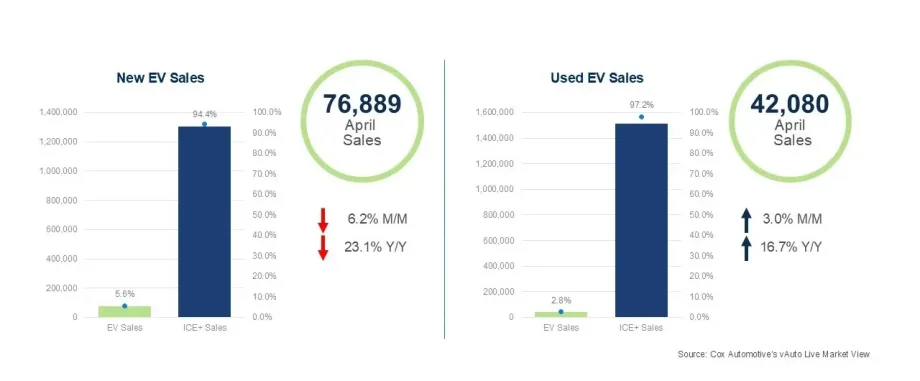
April new EV sales slowed while the used EV market continued gaining momentum, highlighting a shift toward affordability and growing secondary-market inventory.
Cox Automotive
April reflected a more measured pace for the EV market following March’s rebound, according to Cox Automotive.
New EV sales declined year over year and month over month, while used EV sales continued to grow as inventory availability improved and more off-lease vehicles entered the market. Prices increased across both segments, while days’ supply tightened for new and used EVs.
Sales
New EV Sales
New EV sales totaled an estimated 76,889 units in April, down 23.1% year over year and 6.2% month over month. EVs accounted for 5.6% of total new-vehicle sales.
Tesla remained the market leader with 37,550 units sold, followed by Chevrolet, Hyundai, Ford, and Cadillac. Tesla’s EV market share declined slightly to 48.8%.
Most automakers posted month-over-month declines, reflecting broader softness in the new-vehicle market. Ford was a notable exception, with EV sales increasing 23.9% from March.
Used EV Sales
Used EV sales reached 42,080 units in April, up 16.7% year over year and 3% month over month, pushing used EV market share to a record 2.8%.
Tesla led the used EV market with 16,174 units sold through non-Tesla dealerships, followed by Hyundai, Chevrolet, Ford, and BMW.
Cox Automotive said used EV sales growth continued to be supported by improving inventory availability and a growing number of off-lease vehicles entering the secondary market.
Prices
New EV Average Transaction Price
The average transaction price for a new EV in April was $55,211, up 1.4% month over month but down 4.9% year over year.
Incentives averaged $7,640, representing 13.8% of ATP.
Cox Automotive said the monthly ATP increase reflected stronger sales of higher-priced EV models and lower sales volumes among lower-priced brands such as Chevrolet and Toyota. The EV premium over ICE+ vehicles widened modestly to about $6,214 from roughly $5,800 in March.
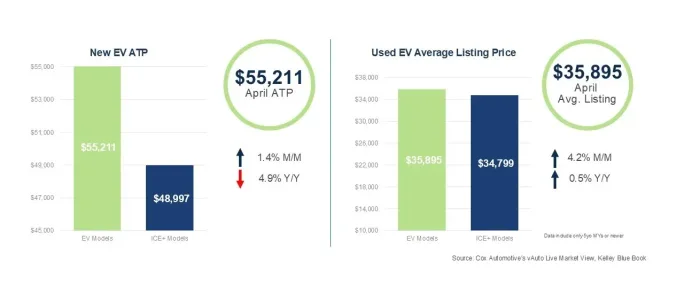
EV prices moved higher in April as tighter inventory and stronger demand for higher-priced models pushed up both new transaction prices and used listing prices.
Cox Automotive
Used EV Listing Price
The average listing price for a used EV was $35,895 in April, up 4.2% month over month and 0.5% year over year. Cox Automotive said it was the first positive year-over-year pricing increase since July 2025.
The increase was broad-based, with 29 brands posting higher listing prices, including Tesla, Chevrolet, Hyundai, and Ford.
The used EV price premium over ICE+ vehicles widened slightly to $1,096.
Supply
New EV Days’ Supply
New EV days’ supply declined to 79 in April following a modest upward revision to March. Inventory remained more than 20% below year-earlier levels and near the lowest readings recorded so far in 2026.
Toyota, Hyundai, Mercedes-Benz, and Subaru maintained relatively lean inventory positions, while Volkswagen, Nissan, and GMC continued to carry elevated inventory levels.
Used EV Days’ Supply
Used EV days’ supply fell to 32 in April, down modestly month over month and 31.8% below year-earlier levels.
Used EV inventory remained tighter than the broader used-vehicle market for a second consecutive month, reflecting faster inventory turnover.
Chevrolet and Nissan posted some of the largest declines in used EV days’ supply, while Tesla, Toyota, and Rivian remained relatively lean at about 28 to 29 days’ supply.
Outlook
Cox Automotive said near-term volatility is likely to continue for new EVs as demand responds to broader new-vehicle market conditions, pricing strategies, inventory levels, and fuel prices.
The company said the used EV market remains comparatively well positioned due to improving inventory availability, expanding model-year coverage, and faster inventory turnover. Cox Automotive expects the used EV segment to remain a growth area through the remainder of the year.
More Electric Vehicles

FedEx Orders 2,000 Harbinger Electric Trucks in $300 Million Deal
The Class 5 and 6 electric trucks are planned for delivery by the end of 2027 and will be deployed in FedEx pickup and delivery operations across the U.S. and Canada.
Read More →
Volvo Trucks’ Electric Range Named International Truck of the Year 2027
The award recognizes Volvo’s global heavy-duty electric lineup, while more than 750 VNR Electric trucks have accumulated nearly 37 million miles in U.S. and Canadian fleet operations.
Read More →
How Republic Services Decides Where Its Next Electric Trucks Can Go
With 250 electric collection trucks now in service, Republic Services is learning that scaling electrification depends less on proving the vehicle and more on whether each site can support what comes next.
Read More →
EV Charging Use Is Outpacing Infrastructure Growth
ChargePoint’s 2026 Charging Forward Report points to rising charger use, higher-powered charging, commercial vehicle electrification, and energy-management technology. Here’s what fleets should know.
Read More →
EV Realty Names Henrik Holland President as Charging Platform Expands
The former Prologis Mobility and Shell executive will help expand EV Realty’s truck charging business and move its power-first infrastructure model into autonomous vehicle depots and other fleet sectors.
Read More →
GreenPower Expands New Mexico EV Pilot With Larger Buses, V2G Testing
After logging more than 17,000 electric miles in the first year, New Mexico’s statewide pilot is moving into its second phase with larger vehicles, continued charging evaluations, and more.
Read More →
Can EV-as-a-Service Help Fleets Scale Electrification?
Sustainability Partners CEO Adam Cain explains how matching EVs, charging infrastructure, and duty cycles can help fleets scale electrification.
Read More →
How EV-as-a-Service Is Moving Fleets Beyond Pilots
Adam Cain, president and CEO of Sustainability Partners, explains how EV-as-a-service can help fleets scale deployments by addressing duty-cycle requirements and charging challenges.
Read More →
PowerFlex, The Mobility House Join Forces to Advance Fleet Electrification
Two EV charging providers are joining forces to deliver a broader portfolio of energy management and fleet electrification solutions.
Read More →
Ford Retools Louisville Plant for Fathom Electric Truck Production
Ford's $2 billion Louisville Assembly Plant overhaul introduces a three-part assembly process for the Fathom midsize electric truck, with production scheduled to begin in 2027.
Read More →