



Want More? Truck Lifecycle Data Index Shows Fuel Savings, Emissions Reduction for Replacements
Fleets Focused on Truck Acquisition Challenges & More
A recent study showed how trends in fuel economy, maintenance, environmental concerns, and procurement strategies have changed since last year.
September 8, 2021
This year, 31% of fleet executives said their biggest motivator for procurement was to right-size the number of trucks in their fleet to align with economic conditions.
Source: Fleet Advantage
3 min to read
Fleet Advantage, a provider of truck fleet business analytics, equipment financing, and lifecycle cost management shared the results of its latest fleet industry benchmarking survey. This most recent study showed how trends in fuel economy, maintenance, environmental concerns, and procurement strategies have changed since last year.
Procurement Strategies & Lease Structure Are Top-of-Mind
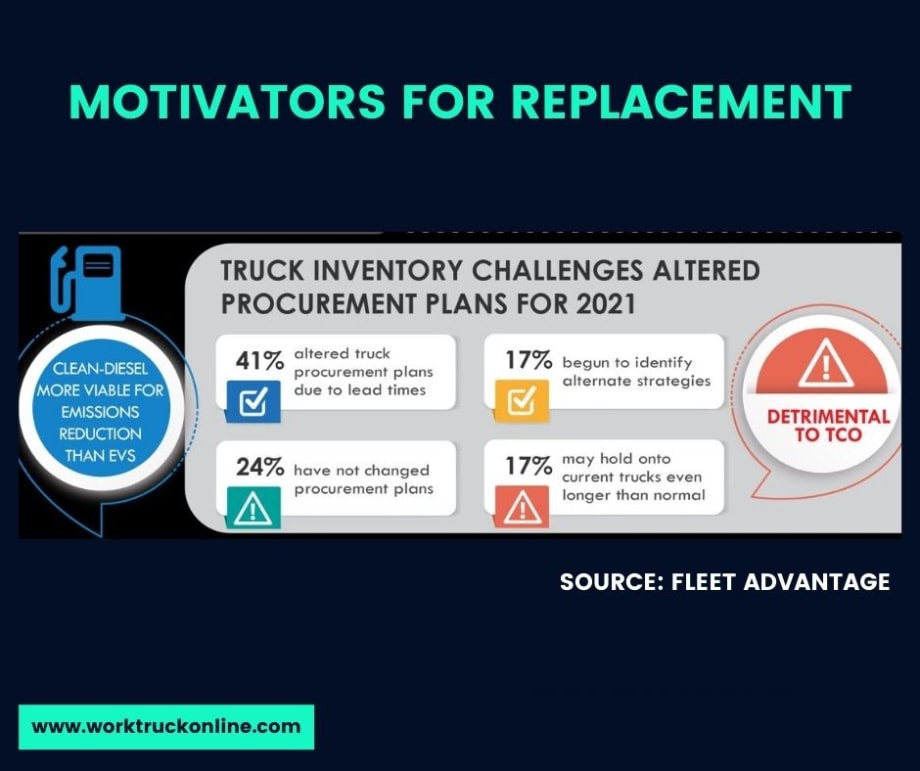
According to this year’s survey, 41% of fleet executives say the supply of new trucks and inventory challenges have altered their truck procurement plans due to lead times. Also, 17% have begun to identify alternate procurement strategies in the acquisition of new trucks. Another 17% say the inventory challenges mean they may hold onto current trucks even longer than normal, which may be detrimental to their Total Cost of Ownership (TCO).
And, 31% of respondents said they are leasing their trucks, significantly up from last year when only 14% of fleet executives said they were leasing. However, lease structure is a major area of concern for many as 28% are in an unbundled lease agreement and “see greater value on flexible fuel and maintenance costs”. This compares to 20% who say they are locked in a full-service lease with some saying they are “trying to escape the contract because of inflexible costs on fuel and maintenance.”
Lastly, 68% stated they are monitoring possible tax policy changes as part of their procurement strategies.
According to this year’s survey, 41% of fleet executives say the supply of new trucks and inventory challenges have altered their truck procurement plans due to lead times.
Source: Fleet Advantage
Biggest Motivators for Truck Replacement
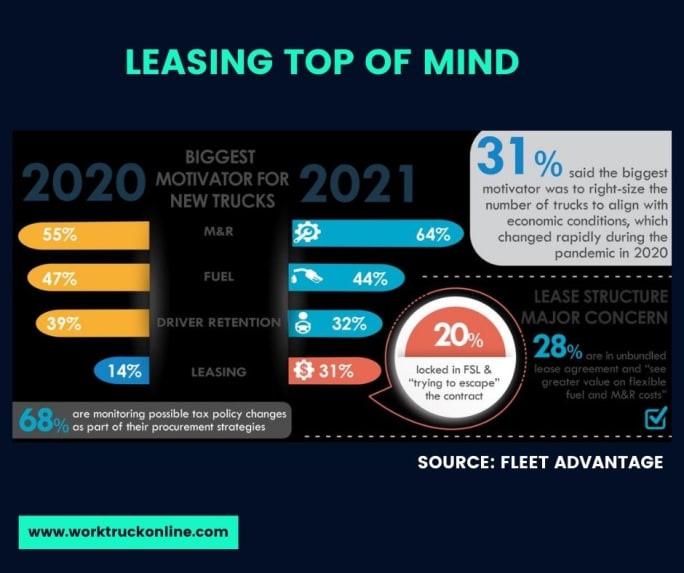
Of respondents, 64% of fleet executives report costs associated with maintenance and repair (M&R), and 44% say improved fuel economy are the leading motivators for truck replacement. This is similar to last year when 55% of fleet executives cited M&R and 47% said improved fuel economy. This is interesting since 17% of fleets are considering holding onto their older, more inefficient trucks even longer than normal because of the current inventory challenges of new trucks as previously mentioned.
A new comment in this year’s survey because of pandemic-related business challenges, 31% of fleet executives said their biggest motivator for procurement was to right-size the number of trucks in their fleet to align with economic conditions, which changed rapidly during the pandemic in 2020. Other motivators included more safety features added by OEMs, the importance of improved corporate image and the conservation of natural resources/lower CO2 emissions through newer clean-diesel engines. This is reinforced in the National Private Truck Council’s (NPTC) 2021 Benchmarking Study which said 89% of fleets are investing in greening initiatives.
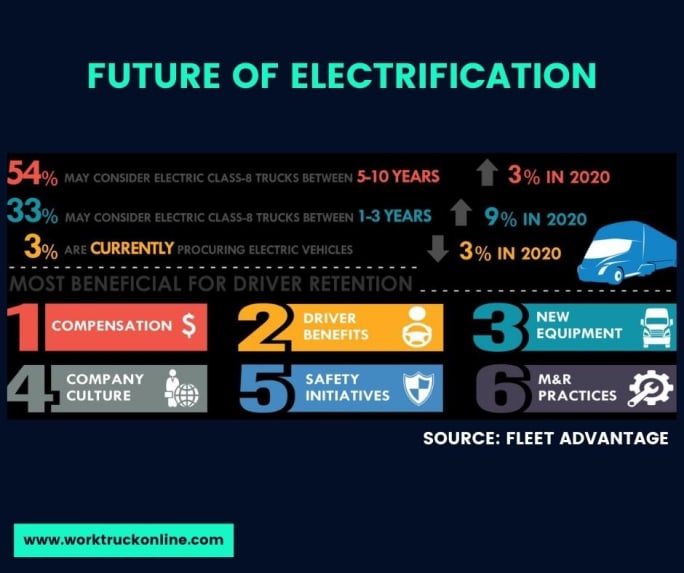
Furthermore, driver retention was the third-largest motivator to replace aging trucks, and in addition to new equipment, compensation and driver benefits were also listed as beneficial for driver retention.
Electrification Remains in the Distance for Fleets
The majority of fleets continue to believe clean-diesel technology remains more viable for emissions reduction than a move to electric vehicles. More than half of fleet respondents (54%) said they may consider electric class-8 trucks for over-the-road between 5-10 years from now, and only 3% of fleet executives are currently procuring electric trucks today. A year ago, 30% of respondents said they do not see electric trucks widely in service for another 10 years. Regarding autonomous trucks, 53% said they don’t see these widely in use for another 10 years (62% last year).
“Our annual benchmarking study provides us and the industry with a close look at the issues that are most important to fleet executives today, and the decisions that are helping to shape their business strategies,” said John Flynn, CEO of Fleet Advantage. “This year’s study shows that procurement strategies, an emphasis on unbundled leasing, specific replacement motivators and a stronger focus on environmental, social, governance (ESG) are all critical for fleets today.”
More than half of fleet respondents (54%) said they may consider electric class-8 trucks for over-the-road between 5-10 years from now.
Source: Fleet Advantage
The full survey results are available from Fleet Advantage.
Topics:Truck MaintenanceIndustry ResearchFleet Advantagefuture trendsElectrificationTruck LeasingOperations
Originally posted on Work Truck Online
More Operations

The EV Breakdown Nobody's Talking About: Why Most Electric Vehicle Roadside Calls Aren't Mechanical Failures
Here's why EV breakdowns are widely misunderstood.
Read More →
Xos White Paper Asserts LA Olympics Will Lack Enough EV Chargers
The commercial EV fleet company recommends some faster and more flexible remedies to relieve the anticipated shortfall.
Read More →
ChargePoint, Optimus Expand Fast-Charging Network Across Southeastern U.S.
ChargePoint will serve as the exclusive solutions provider, delivering hardware, software, and services to support Optimus’ growing charging network.
Read More →
Running A Profitable Electric Rental Fleet
How do you successfully operate an all-electric rental car fleet? Whether you manage a rental fleet or another commercial fleet, this conversation offers practical lessons on deploying, operating, and scaling electric vehicles.
Read More →
Registration Opens for 2026 Fleet Forward Conference
Held on the East Coast for the first time, the Washington, D.C.-area event features expert-led education, a new IIHS Crash Test Experience, and collocation with the NAFA’s Fleet Safety Symposium.
Read More →
Why Charging May Never Be As Easy As Filling Up Gas
A seamless charge depends on a string of independent companies getting it right together, every time. How can electric fleets navigate the challenges to create a successful charging plan?
Read More →
Slate Debuts Colorful, Unique EV Models
A recent media and client event, studded with electric vehicles dressed up on platforms, planted a new position for the manufacturer in the wider EV market. Fleets will find cost-saving advantages.
Read More →
Slate Electric SUV, Pickup Switchable Model Aims For Light-Duty Fleets
Everything about this EV is counterintuitive and understated, making it stand out from the crowd.
Read More →
Polestar Barred from U.S. Market Under Connected Vehicle Rule
The automaker loses its authorization to sell new vehicles in the U.S., starting with the 2027 model year. Polestar owners will retain access to the brand's service network.
Read More →
Uber, Nuro and Lucid Plan Houston Robotaxi Service in 2027
The tripartite venture brings out the combined advantages of electric vehicles, mobility, and autonomy into ground transportation.
Read More →