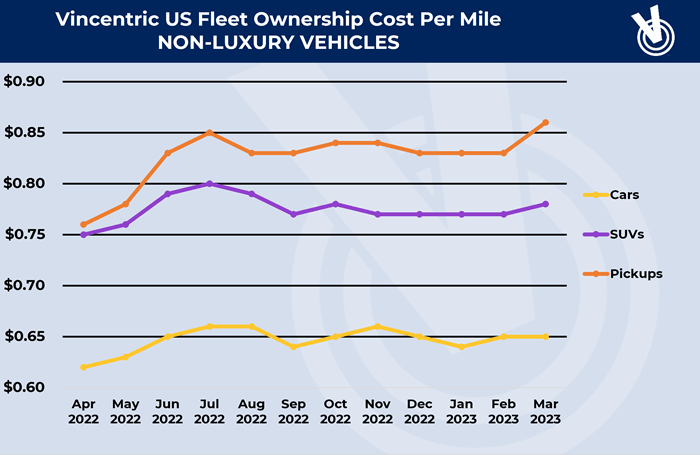
Vincentric data shows that for pickups, total cost per mile increased by 2.73% from January to April 2023, primarily impacted by a 3.74% increase in depreciation costs and a 9.15% increase in financing costs.
Graphic: Vincentric, LLC
2 min to read
Welcome to Fleet Data Depot, which provides snapshots of information, trends, and analysis relevant to the fleet market.
In this edition, the total cost of ownership experts at Vincentric deliver another quarterly update on per-mile ownership costs for fleets over the previous 12 months.
Ad Loading...
The analysis is based on vehicles driven 20,000 miles per year for a three-year window. For the analysis, Vincentric calculated its standard eight cost elements: depreciation, financing, fees and taxes, fuel, insurance, maintenance, opportunity cost, and repairs.
High Fuel Prices Drive Ownership Cost Increase
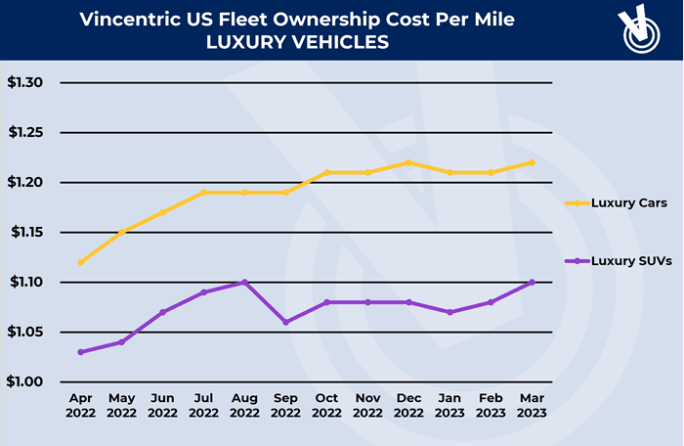
Over this 12-month period, ownership costs spiked in the summer of 2022 due to record-high fuel prices. High fuel prices had a greater impact on pickups and luxury SUVs, as those vehicles are the highest consumers of fuel in these segments.
Following that summer peak, costs moderated in the car, pickup, and SUV segments. However, luxury car costs have been rising steadily over this time.
Luxury cars and SUVs have been on an upward cost of ownership trend to start 2023.
Graphic: Vincentric, LLC
New Vehicle Transaction Prices Hit Record Highs
Moderating fuel costs over the last eight months were offset by increasing new vehicle costs. Average new vehicle transaction prices hit a record high of $49,507 in December but have decreased steadily in January ($49,388) February ($48,558) and March ($48,008) to start 2023.
As depreciation is always the largest expense (with fuel second), increases in new vehicle prices will have the greatest effect on ownership costs of any of the eight cost elements. Inflation has increased commodity prices on parts, particularly tires, which has had a smaller but measurable effect on maintenance costs.
Ad Loading...
High Financing Costs Hit Pickup Segment
For pickups specifically, total cost per mile increased by 2.73% from January to April 2023, primarily impacted by a 3.74% increase in depreciation costs and a 9.15% increase in financing costs.
Note that fuel costs for pickups decreased from last quarter by 6.5%.
On the wholesale side, used values saw four straight months of increases over the last four months according to Cox Automotive data, mostly due to tight supply. Decreasing new prices and a strong wholesale market have been good for depreciation, and thus average ownership costs, over this period.
Wholesale prices, while still buoyant, may be in for a slight decline ahead, according to Cox Automotive’s Jonathan Smoke, which would put further pressure on depreciation if new vehicle costs stay high.
Vincentric notes that addition of new vehicles into the database and subtraction of the oldest model year (MY20) vehicles can cause fluctuations in the data.
The former Prologis Mobility and Shell executive will help expand EV Realty’s truck charging business and move its power-first infrastructure model into autonomous vehicle depots and other fleet sectors.
After logging more than 17,000 electric miles in the first year, New Mexico’s statewide pilot is moving into its second phase with larger vehicles, continued charging evaluations, and more.
Adam Cain, president and CEO of Sustainability Partners, explains how EV-as-a-service can help fleets scale deployments by addressing duty-cycle requirements and charging challenges.
Ford's $2 billion Louisville Assembly Plant overhaul introduces a three-part assembly process for the Fathom midsize electric truck, with production scheduled to begin in 2027.
From millions in operating savings to hundreds of millions of EV miles, Merchants Fleet’s latest report reveals what’s working and what’s changing in fleet electrification.
One of the nation's largest school bus electrification projects to date demonstrates how grants, charging infrastructure, and public-private partnerships can help fleets transition to EVs at scale.
Aptera Motors Corp. has issued purchase orders for the major structural components of its first 40 vehicles, and body and chassis components are expected to begin arriving in October.