



Related Article: Deep Dive on EV Data Shows Realities of Medium-Duty Fleet Electrification
Mastering the Details To Create Reliable EV Charging
Two experienced fleet managers walk through the long lists and many months of procedures needed to connect electric vehicles to the best power sources.
December 20, 2021

Among factors to consider when planning charging infrastructure: How many hours a day do the EVs need to charge on a Level 2 versus Level 3 charger? How flexible is the fleet charging strategy? Should chargers be dedicated or shared?
Photo: Martin Romjue / Bobit
7 min to read
Simplicity defines the second nature of electric vehicles. They’re easier to drive, maintain, and monitor than internal combustion engine vehicles.
Not so with the charging equipment and networks that keep them powered and ready to roll. It can get complicated.
EVs require an entire new framework for facilities, electrical supply and conduits, and charging arrangements. The sooner fleet managers can learn the process, the better the results.
Two experienced fleet and facility managers who’ve-been-there-done-that each presented a clear, direct reality check on the planning and resources needed to install the right charging infrastructure for a fleet. They spoke on Nov. 12 during the Fleet Forward Conference in San Jose.
David Renschler, fleet division manager for the public works department in the City of Fairfield, Calif., oversees an operation of 60 transit buses and 690 other vehicles including police and fire, public works, and off-road equipment. Doug Bond, deputy director of the building maintenance department for the County of Alameda, which lies in the East San Francisco Bay region and includes the City of Oakland, oversees 121 county buildings and 5.4 million square feet of office space.
First Steps and Realities
Renschler started with Lesson No. 1: “The last thing you want to do is go out and buy some chargers and then buy some vehicles and hope it all works,” Renschler said. The key to a successful program is a lot of collaboration. You're not going to do it alone. You will need a lot of partners and you’ll have to deal with many different agencies and departments.”
Among the macro-questions: What is the fleet breakdown of light-, medium-, or heavy-duty vehicles? Will an operation need dedicated and/or shared chargers? Will there be public access in addition to regular fleet usage?
Renschler advised fleet managers they will also need a good consultant, who in turn has reliable sub-consultants, since no one consultant knows everything. “This is a new industry. Make sure you do plenty of research.”
As is the case with electric vehicles themselves, data is the ultimate decision maker. “You want good data to make good business decisions.”
Renschler pointed out 15 states and Washington, D.C. have all signed memorandums of understanding with the California Air Resources Board (CARB) to work together on advancing battery electric and hydrogen fuel cell electric vehicles. It shows how fleet managers must collaborate with different stakeholders, allies, and regulators. “The fleet management division, or a fleet manager, is going to be in the center of all of this,” he said. “Whether it's purchasing, engineering, planning department, architects, technical training for your staff, you will need to work also with partners.”
One basic requirement is figuring out how to start charging for electricity as a vehicle fuel, since it’s not free. Telematics systems on fleet vehicles cannot just cover mileage, but should gather data on run times, burn rates, weight classes, parking, and charging accesses. Fleet systems must track energy input and output per vehicle type and usage cycle to accurately calculate consumption and costs and overall efficiency.
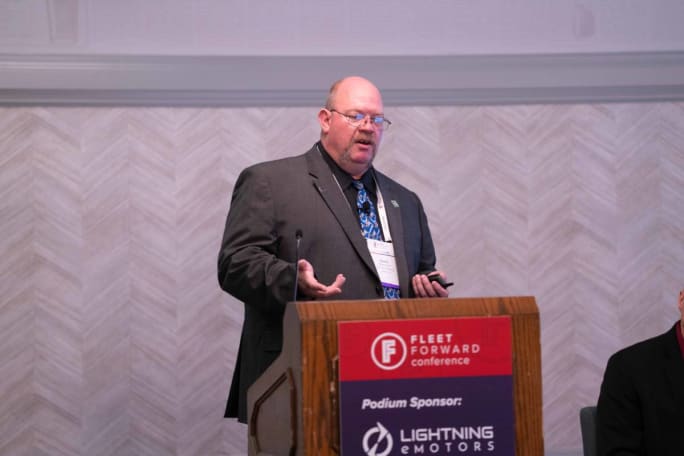
David Renschler, fleet division manager for the public works department in the City of Fairfield, Calif., told a session audience at Fleet Forward Conference that the key to a successful program is to collaborate with many partners because you can't go it alone.
Photo: Ross Stewart, RMS3Digital
Questions for Specs
Renschler then recited a list of questions and variables that can easily arise and must be considered:
“You also have to look at your current specs,” Renschler said. “What are the specs of the electric vehicles on the market at the time you're getting ready to bid out? You have to project out what those expected increase in costs are. Can it charge on a level two or DC fast charger? Does it need both? Can it share a charger? Does it have to have a dedicated charger?”
He added, “What's the efficiency per 100 miles? If we use the level two charger, what is the kilowatt rating we can charge? What's the maximum on a DC fast charge for that chassis? Or that manufacturer? What is the wait? We need that information to figure out what type of charger we're going to buy. Do we buy a 19-kilowatt level two charger? What if the vehicle can only take a seven-kilowatt charger?”
Renschler’s fleet operation looked at optimized and maximum charging infrastructure to estimate needs and costs: “How many extra transformers do we have to put in? What could we do to future-proof our infrastructure and chargers? Does the power utility have enough power available in the street to supply my facility? If it doesn’t, will you need to find a new yard or facility and move?”
Among other factors and questions: How many hours a day do the EVs need to charge on a Level 2 versus Level 3 charger and how flexible is the charging strategy? Will some emergency vehicles need their own dedicated chargers to respond to emergencies at any time?
Setting Up the Repair Shop
On the transit side, the challenge for Fairfield was to upgrade a maintenance shop with properly trained technicians to handle the EVs. Shops will need modifications and technicians may need to be cross-trained. But you can’t close a shop so the entire staff can get trained quickly.
Electric buses require their own set of inspections and safety procedures, including distances between electric equipment, charging outlets, and metal infrastructure inside the shop, Renschler explained. That may mean raising the roof of the shop to allow for proper lift heights and scaffolding.
“Make sure you develop standard operating procedures (SOP)s,” Renschler said. “SOPs are extremely important so you can make sure everybody's following the same rules.”
Technicians will require varying job classifications, depending on who handles high voltage, high-amp equipment and repairs. That means navigating training, certifications, pay scales, human resources, and unions, he said. Expect setting aside about 200 hours of training per technician.
Do you have enough power? How many kilowatt hours will you need to charge all your vehicles either on at that moment, or per day, or per minute? Will you have enough space? Renschler asked.
“There's a lot of this stuff you need in the shop for OSHA as well as what you must have for a battery lab. We’re going to be doing the warranty work for the OEM and we’ll break battery packs down to the module level. We won’t go down to the cellular level, but we'll go to the module level and do inhouse warranty repairs and build back the OEM.”
In illustrating the power requirements of electric vehicles, Renschler compared how charging 50 transit buses at peak electricity demand requires three megawatts of power, compared to two megawatts needed to power the Transamerica building in downtown San Francisco for one day. Fifty Class 8 trucks need 9 megawatts of power for full charging, the same as the Empire State Building needs in one day.
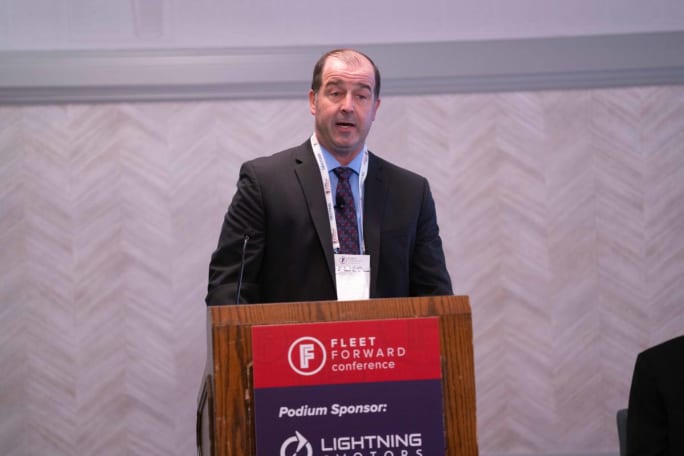
Doug Bond, deputy director of the building maintenance department for the County of Alameda, explained how retrofitting an older building or outfitting a newer one requires a designed plan for electrical panels and charging capacities so that expected power usage can be accurately assessed and confirmed.
Photo: Ross Stewart, RMS3Digital
Facilities Finish the Electric Equation
Bond explained how Alameda County has 61 EV charging stations with a total of 111 charging ports, one DC fast charger, and 79 plug-in vehicles.
Just as EVs can determine the architecture of electrical charging and facilities, existing buildings come with their own limits and attributes, Bond said.
Alameda County, for example, has 121 county owned buildings, with most of those buildings more than 40 years old with aging electrical systems. Some buildings will need to be modified to handle extra electrical demand for EVs. In one example, demand peaks in the morning when vehicles are plugged in and then declines as they become fully charged.
Retrofitting an older building or outfitting a newer one requires a designed plan for electrical panels and charging capacities so expected power usage can be accurately assessed and confirmed, Bond said. You have to make sure enough power will be coming into a building to match the particular demand requirements of the types and numbers of EVs.
With one building, the county retained an architectural and engineering firm to send an electrical engineer to see if the location was suitable, Bond said.
Factors to consider when installing charging stations: Site assessment, location of charging stations and conduits, architectural and engineering design, power supply availability, construction, procurement, ongoing maintenance and repairs, landlord/lease terms, local permitting regulations, and public access v. assigned charging.
Plan on the time required for electrical engineering assessments and procurement approvals. Installation will require load tests at peak demand to see if more power is needed, such as a transformer or power line upgrades.
Once approved, construction procurement can involve multiple government agencies, codes, and reviews to ensure the bidding process matches guidelines and rules. Contracting must comply with rules while ensuring fair competition for bids. The processes, approvals, selections, and vetting can take up to 18 months before the construction begins.
Subscribe to Our Newsletter
More Charging
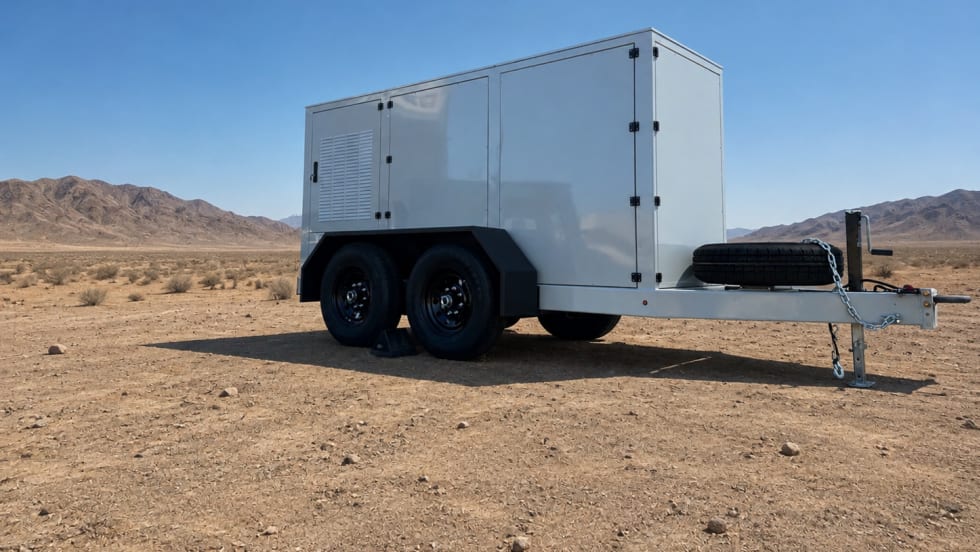
Xos Mobile Charging Hub Surpasses 1 GWh of Energy Delivered
As fleets electrify, charging capacity does not always arrive on the same timeline as the vehicles. Operating data from one Xos Hub shows how mobile, grid-independent charging can support vehicles when permanent infrastructure or utility upgrades aren't available.
Read More →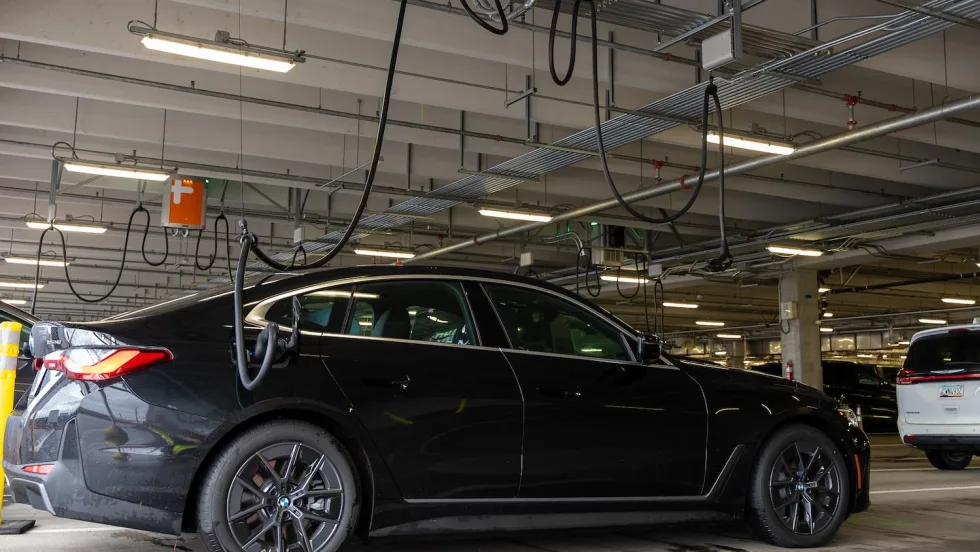
ChargePoint Adds Overhead EV Fast Charging at Portland International Airport
The installation can charge up to 20 rental vehicles simultaneously and uses overhead equipment to preserve ground-level space at the airport's Quick Turnaround Facility.
Read More →
Octopus Energy Launches Public EV Charging App in U.S.
Octopus Charge allows EV drivers to locate and access public charging stations through a single app, building on the company's Electroverse platform in Europe.
Read More →
Schneider Electric Launches Level 2 Home EV Charger With Integrated Load Management
Schneider Charge uses integrated SmartAmp technology to adjust charging output based on household electrical demand and is available with NACS or J1772 connectors.
Read More →
Why EV Charging Reliability Is More Complicated Than It Looks
GridLink CEO Josh Silets explains what causes EV chargers to fail, why fleet operators often struggle to identify the source, and what questions they should ask charging vendors.
Read More →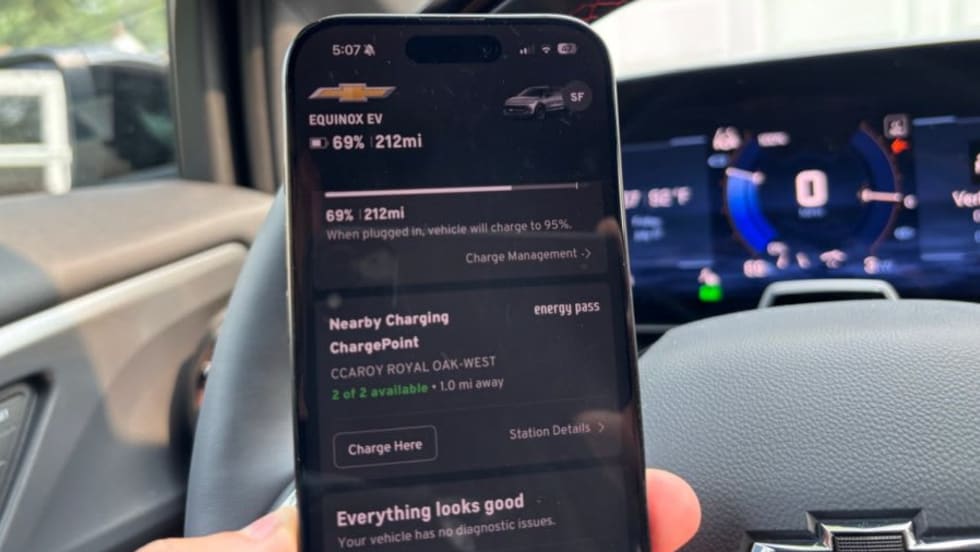
GM Adds ChargePoint Network to Energy Pass Platform
The integration gives GM EV drivers access to additional DC fast chargers and Level 2 stations through a single app while expanding the automaker's public charging ecosystem.
Read More →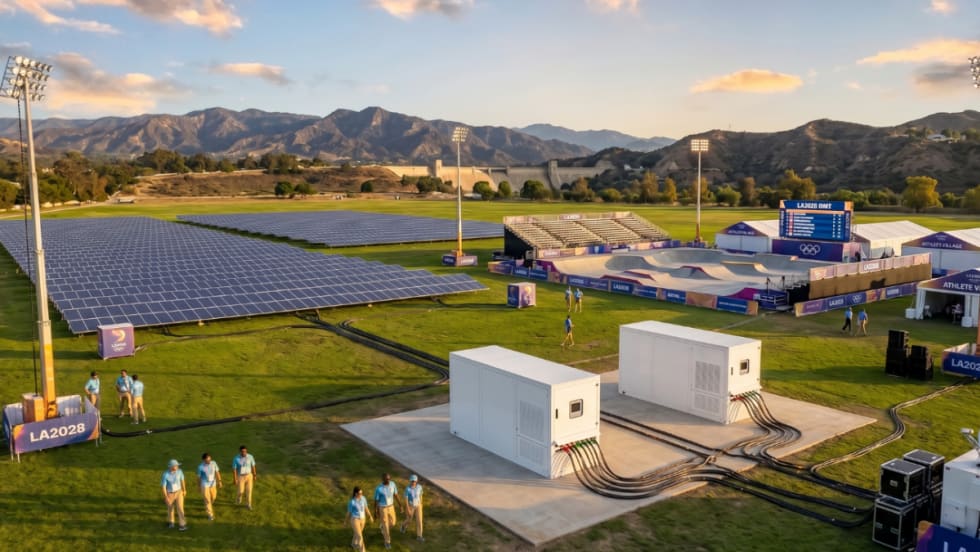
Xos White Paper Asserts LA Olympics Will Lack Enough EV Chargers
The commercial EV fleet company recommends some faster and more flexible remedies to relieve the anticipated shortfall.
Read More →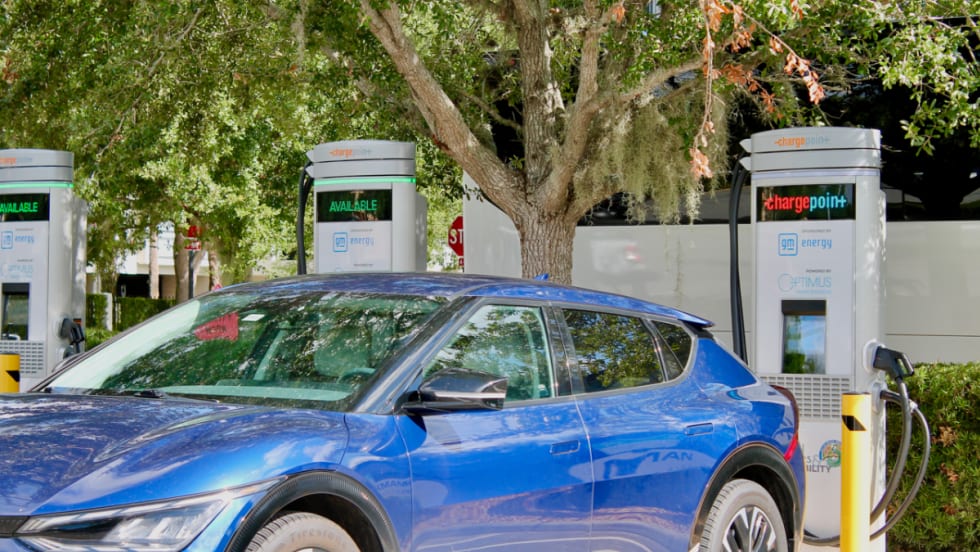
ChargePoint, Optimus Expand Fast-Charging Network Across Southeastern U.S.
ChargePoint will serve as the exclusive solutions provider, delivering hardware, software, and services to support Optimus’ growing charging network.
Read More →
Running A Profitable Electric Rental Fleet
How do you successfully operate an all-electric rental car fleet? Whether you manage a rental fleet or another commercial fleet, this conversation offers practical lessons on deploying, operating, and scaling electric vehicles.
Read More →
Why Charging May Never Be As Easy As Filling Up Gas
A seamless charge depends on a string of independent companies getting it right together, every time. How can electric fleets navigate the challenges to create a successful charging plan?
Read More →