Technology can provide actionable, immediate information to drivers to allow for personalized coaching opportunities.
Photo: Verizon Connect
11 min to read
The snow was deep, and the driver was stranded. His truck was utterly stuck. He tried and tried to dig out to no avail. He was in a remote location without cell service, and the snow was coming down hard. One day went by, then two. Finally, he found a location with limited cell service and called his field service manager (FSM). Using his last known GPS coordinates, obtained from the telematics device in his truck, his FSM located him and headed out to help.
The FSM made it there, but the road conditions were impassable, and the two got stuck again. GPS coordinates helped them lead a tow truck to their location. But then, unbelievably, the tow truck also got stuck. After using the GPS coordinates a third time, a search and rescue team was sent to help, and both the driver and FSM were returned home safely thereafter.
Ad Loading...
“While no injuries were reported, the outcome could have been much worse,” said Ananth Rani, CEO, and co-founder of Azuga. “Thanks to their real-time telematics data, the company was not only able to locate both the driver and FSM multiple times, but they were also able to share this data with public safety and emergency personnel to ensure the safe return of their employees.”
Another driver faced a more routine challenge: reluctance to wear a seat belt. Using video telematics, the company he worked for identified when he was (or in this case wasn’t) wearing a seat belt. After multiple coaching efforts, the driver finally gave in and began wearing his seat belt — a change that ultimately saved his life.
“Less than one week later, this driver rolled his truck but was able to walk away unharmed because he was wearing his seatbelt,” said Del Lisk, vice president of safety services for Lytx Inc. “Without video telematics and coaching, this driver would have been unbelted during the rollover and likely would have sustained serious injuries.”
A third driver was known for being very responsive to dispatch. And then one day, a message went out — and no response. Another message. Nothing. A third message and still no response. That’s when dispatchers got worried. They used telematics data to identify the driver’s exact location and sent emergency services to check on him. It was a smart choice: Upon arriving, first responders found he had gone into a diabetic coma. They saved his life.
These are just a few instances of how telematics benefits the safety of drivers; there are many more.
Ad Loading...
“The safety benefits of telematics are wide-reaching,” said Marco Encinas, product manager of global platforms for Teletrac Navman. “According to data from the forthcoming 2019 Telematics Benchmark report, 31% of respondents who use telematics cite improved driver behavior, and 20% report improved driver safety as the top benefits of telematics. As a result of using telematics, 42% of fleets saw fewer accidents, up from 26% in 2018.”
The benefits of telematics extend beyond drivers as well.
“A focus on safety is good for drivers and great for businesses,” Rani said. “A safety-centric culture not only helps businesses avoid accidents but helps ensure customers are serviced safely and reliably. Poor safety habits by fleet drivers result in more incidents that interrupt the service to a customer, resulting in lost revenue.”
More than ever, fleets can employ telematics to improve the safety of their own drivers — and yield improvements for their fleets, too.
There has been an evolution of safety data that has influenced the metrics that some organizations use. The data available today has allowed for more detailed driver safety scorecards.
Photo: GPS Insight
Metrics You Can Track
Telematics devices collect multitudes of data, so leveraging them for safety purposes all starts with identifying the right metrics to track. These will change from fleet to fleet, but generally, driver behaviors commonly tracked include:
Hard cornering.
Rapid acceleration.
Harsh braking.
Speeding.
Seat belt usage.
Ad Loading...
Bill Griffiths, VP of Global Consulting & Client Services at Chevin, said each of these metrics has an associated benefit.
“Harsh cornering presents the ability to train drivers to reduce the risk of collision,” he explained. “Harsh braking teaches drivers to avoid skidding, improve control of the vehicle, and reduce the risk of tire blowouts, brake problems and failing parts, such as brake discs. And speeding makes it possible to monitor and improve safety for both the driver and the public.”
Collectively, these metrics help paint a picture of driver behavior so fleets can gain visibility into individual driver habits as well as trends occurring across the fleet.
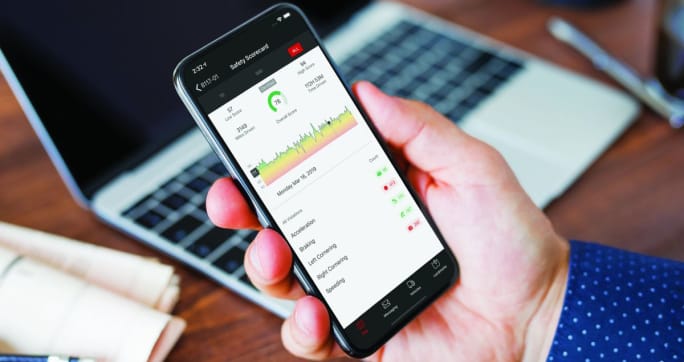
“This data takes the guesswork out of a driver’s safety record and provides fleet managers the data behind the strengths and weaknesses of any driver at a given time,” said Kevin Aries, product management and product success lead for Verizon Connect. “Moreover, the technology provides actionable information for personalized coaching and can also show driver improvement. This paves the way for safer driving behavior and in turn, better business outcomes.”
Typically, data related to safe driving practices are consolidated into a driver scorecard, which tallies scores for specific driving practices, then totals them for an overall driver rating.
Ad Loading...
“Reviewing all of this information can quickly make you feel like you’re drowning in data,” said Frank Schneider, director of product management for CalAmp. “An overall driver score that reflects how safe a driver is behaving eliminates the need for wading through a ton of details and makes it easier to manage and coach a driver where needed.”
Sherry Calkins, vice president, strategic partners for Geotab, said one fleet started to see an increase in the cost of claims and non-injury-related crashes. So, they took a deep dive into the data and learned the company was focused on the wrong metrics in their driver scorecards.
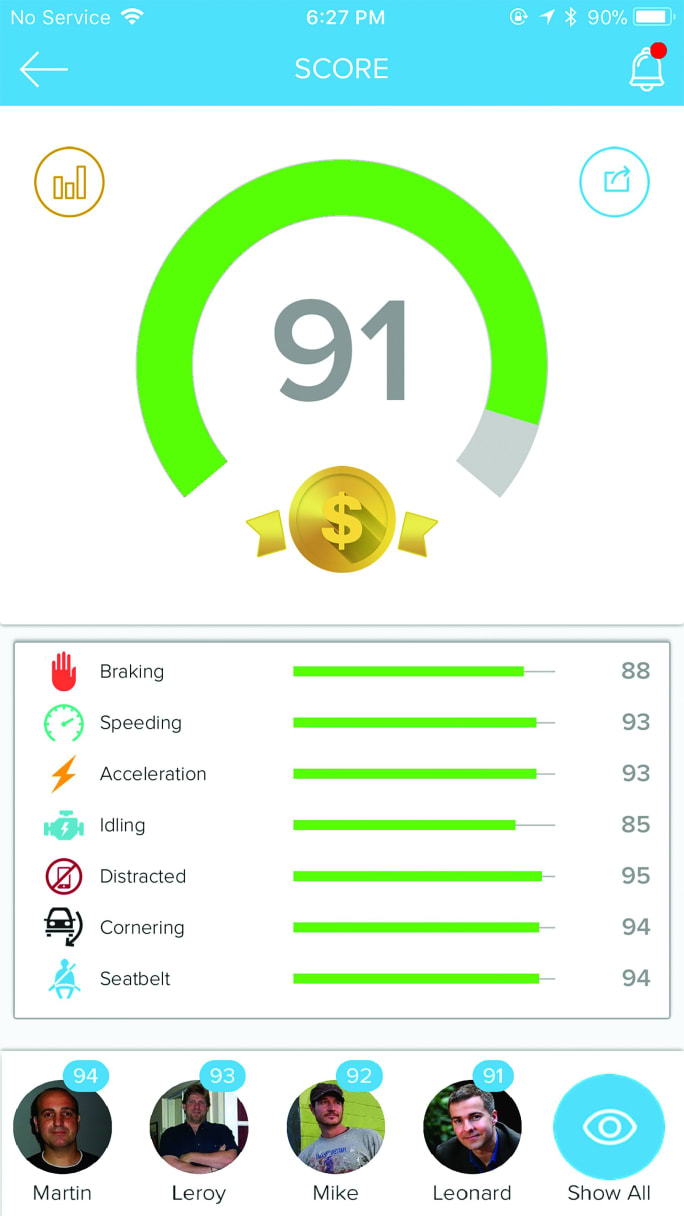
Using a scorecarding system can help drivers better see where improvement is needed as well as compete with other drivers for top driver safety scores. Apps allow drivers to see key info any time.
Photo: Azuga
“What they found was they were not putting enough emphasis on speeding events and in particular, off-highway speeding,” Calkins said. “The real-time, in-cab driver feedback was set up to only send an alert if speeding at high rates of speed on highways, which did lower crashes, but they found an increase in low-speed, off-highway crashes. By setting alerts for all speeding exceptions, this immediately reduced the claims and ensured nearly 100% compliance with driving at posted road speeds both on- and off-highway.”
Jenny Shiner, communications manager, GPS Insight, said there had been an evolution of safety data that has influenced the metrics organizations use. First was a necessary awareness of how drivers were operating vehicles in the field. Then came safety scorecards.
“The next phase we see is the incorporation of artificial intelligence (AI), and computer vision through in-cab cameras that provide the full context of events,” she explained. “Using in-cab cameras with telematics data helps fleets get a full understanding of what’s happening to help them run a safer fleet, ultimately. It is an exciting advancement for our industry.”
Ad Loading...
Coaching Drivers
So now, you have the data. That’s great. But it’s what you do with it that’s important. That’s where driver coaching comes in.
“With driver coaching, conversations can ultimately prevent accidents before they happen by discussing areas where drivers consistently show weakness,” said Aries of Verizon Connect. “With new innovations like dashcam video, telematics data can be used alongside real video clips of the road to provide additional context for those conversations.”
Reza Hemmati, VP of product management for Spireon, noted that while coaching is an integral part of a telematics safety program, it’s vital that it’s not punitive.
“Drivers are in short supply and not easy to find. Given the introduction of new rigorous regulations such as hours-of-service and the Food Safety Modernization Act (FSMA), fleet managers can’t afford to alienate their driver base further,” he said. “However, this doesn’t mean fleet managers can’t monitor the drivers with the worst behavior and have a fact-based conversation with them, and convey how their driving behavior could be detrimental to their own safety. But, real change is best driven through an incentive-based system where drivers are engaged and have a reason to improve their behavior.”
Rani of Azuga agreed. “Encouraging safe driving doesn’t need to be a source of friction between drivers their fleet managers,” he said. “Instead, telematics technology should reward safe driving behaviors so that everyone benefits, including fleet-based businesses, managers, drivers, and the communities in which they operate.”
Ad Loading...
Saleh Elhattab, director of product, safety, at Samsara said coaching pays off. He cites a client with 150 drivers who prioritized reviewing the most high-risk events and used group coaching sessions to help change behaviors. It paid off.
“In just one year, they have seen a 75% reduction in harsh driving events, down from 20 to 30 harsh events daily to fewer than five events a day,” he said.
Lisk of Lytx said there are other benefits, too, including increased employee satisfaction.
“A coaching program, framed through positive growth and professional development, shows drivers that your company and managers care about their long-term success within the organization and are willing to put in the time and work to make each driver the best they can be,” he said. “As a result, many customers we work with cite higher driver retention rates, increased morale, and sense of community.”
Coaching With Video
In addition to tracking data on factors such as hard cornering and speeding, in-cab video telematics can paint an even more realistic portrait of what’s happening on the road. These pictures can assist with driver coaching, providing video evidence of behaviors.
Ad Loading...
Telematics & Safety:
Where Do You Begin?
With so many opportunities to gather data and track driver behavior, beginning a telematics safety program might seem overwhelming. Frank Schneider, director of Product Management, CalAmp, said it doesn’t have to be.
Here are his dos and don’ts:
DO start simple.
DON’T create a long laundry list of problems.
DO begin by identifying 1-3 goals.
DO focus goals on where you want to see the most significant impact.
“By focusing on a few key categories, such as improving driver scores, telematics will have a much greater impact on the overall outcomes of a trucking fleet,” he said.
“Video telematics brings the data to life,” said Adam Bruttell, vice president of sales & marketing (North America), MiX Telematics. “By combining data from driver safety dashboards with video, fleet managers can home in on specific incidents. All of this data can also be put on a heat map, showing concentrations of dangerous driving events, to help create safer routes for their drivers and avoid high risk, unsafe routes.”
Lisk of Lytx said the lessons learned from a video could reverberate throughout an organization.
“Video-based solutions provide a lens into the cabs of a trucking fleet. They are the link between risky driving and improved behaviors, providing the data needed to develop personalized coaching,” he said. “Beyond the numbers, many fleets cite video telematics as the catalyst behind a significant, company-wide shift in culture. Video telematics can open up a conversation about the root causes of risky driving and the importance of approaching safety with a proactive, rather than reactive, mindset.”
Using Gamification
Coaching sessions are one way to apply the lessons learned from telematics data. Another is gamification, where fleets host safe driving competitions and reward drivers for safe driving records.
“Competitions have led to successful changes in driver behaviors and have engaged fleet operators to get more involved in road safety in a meaningful and impactful way,” said Frank Schneider, director of product management for CalAmp.
Ad Loading...
Competitions can be organized in several different ways, and rewards can vary based on what motivates drivers.
Schneider said one client with multi-regional depots has each depot compete against each other to see who has the highest number of safe drivers. The winning depot is rewarded with a barbecue at the end of the quarter, and bonuses are given to safe drivers. “This creates a positive way to acknowledge good behavior and celebrate the importance of safe driving,” he said.
Bruttell of MiX Telematics said it’s essential to include all drivers in a driver behavior contest. One way to do that is to allow drivers to earn all or just part of a reward. For example, with a $500 contest, you assign a point system where you deduct a dollar amount for each unsafe driving event. At the end of the contest, some drivers may achieve a perfect 100 score and receive the entire $500 prize. The lower 20% would receive $100.
“This way drivers don’t quit the contest after the first week and feel that if they can improve bad behavior, they can still receive an award,” he said.
Steve Wells, the co-founder at ClearPathGPS, has seen several creative approaches to gamification. For instance, a Hall of Fame can feature a publicly displayed monthly report on fleet driver safety improvements. Or, fleets can also group drivers into teams that compete to have the fewest infractions each month, which helps drivers hold each other accountable.
Ad Loading...
“One of the more inventive approaches we’ve heard is using a deck of cards to hand out a poker hand. Each driver with a pristine vehicle behavior report the day before gets one card,” he said. “After five days, the individual with the best poker hand wins a prize.”
Although rewards typically come in the form of money or gift cards, Azuga’s Rani said he’d seen an uptick in fleets offering creative, inexpensive awards that their drivers also value.
“We’ve worked with fleets that have encouraged safe driving habits by offering free lunches to drivers, extra PTO hours, extra vacation days, or even just a simple e-mail announcing to everyone who the best driver is each week,” he said.
Oftentimes telematics providers will offer apps drivers can use to track their progress. “Seeing their score/rankings on a daily basis motivates drivers toward good driving behavior and improving their score,” said Hemmati of Spireon.
When drivers are engaged, Calkins of Geotab noted fleets can see real results — and fast.
Ad Loading...
“Gamification is a great way to keep drivers striving to do better, and we have seen immediate improvements in fleet safety scorecards from the moment they give the driver a preview of their scores,” she said.
Encinas of Teletrac Navman noted that incentivizing safe driving has proven to be effective. “According to our report, 58% of fleets saw fewer safety violations or incidents, 33% saw improved driver retention, and 27% saw improved customer service,” he said.
Benefits Abound
When fleets use telematics to improve safety, other benefits tend to follow, like improved fuel economy, lower costs associated with accidents and liability, lower insurance premiums, and improved driver retention. But the most significant, of course, is the potential to save lives.
“The biggest benefit is undoubtedly the avoidance of a crash or, to put it simply, to save a life,” said Griffiths of Chevin. “Safety is paramount and, if applied correctly, reduced cost benefits will follow naturally.”
A recent media and client event, studded with electric vehicles dressed up on platforms, planted a new position for the manufacturer in the wider EV market. Fleets will find cost-saving advantages.
The automaker loses its authorization to sell new vehicles in the U.S., starting with the 2027 model year. Polestar owners will retain access to the brand's service network.
Inspiration Mobility Group has acquired select assets of Electrada, adding the fleet electrification provider's team, technology, and charging infrastructure development capabilities to its energy management business.