


How Much Green Does It Take to Go Green? Preparing & Understanding AFV Lifecycle Costs
By comparing the TCO of diesel, E-85, CNG, hybrid, and electric vehicle options with similar gasoline-fueled vehicles, fleet managers can determine the total cost of integrating alt-fuel vehicles into the fleet.

Whether it’s due to concern for the environment, America’s reliance on foreign oil, corporate mandates, or any other reason, it is important for those in the fleet industry to understand and consider alternative-fuel vehicles (AFVs) as a potential fleet vehicle. As with any business decision, the financial impact needs to be part of the decision process. To help with that process, Vincentric evaluated the lifecycle costs of the more commonly used alt-fuel choices, including E-85 (85-percent ethanol, 15-percent gasoline), hybrid, diesel, compressed natural gas (CNG), and mainstream electric vehicles. These were evaluated with a comparable set of gasoline-powered vehicles. All comparisons assume 20,000 miles per year over three years. The results may be surprising.
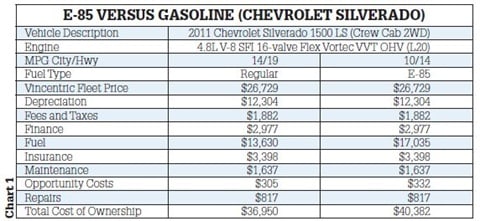
The Chevrolet Silverado’s fuel costs were significantly higher when running on E-85 versus running on gasoline (nearly $4,000 over three years). Although E-85 fueling costs are lower, reduced fuel economy led to higher fuel costs.
E-85 May Mean Higher Fuel Costs
E-85 has been an available alternative for those concerned about America’s dependence on foreign oil. It is produced domestically from corn and other crops. An additional advantage is the reduced amount of greenhouse gas emissions it produces compared to conventional fuels. Recent pricing for E-85 across the U.S. was $2.80 per gallon versus the cost of regular grade gasoline of $3.427 per gallon.
E-85, however, is not without its disadvantages. A key drawback to E-85 is that ethanol contains less energy per volume than gasoline, resulting in reduced fuel economy for flexible fuel vehicles compared to their gasoline counterparts. In addition, some are concerned that use of a food source as fuel is not appropriate.
In the comparison in Chart 1, the 2011 Chevrolet Silverado’s fuel costs were significantly higher when running on E-85 versus running on gasoline, resulting in an overall lifecycle cost that was about 10 percent higher for the E-85 vehicle.
The total cost of ownership (TCO) for a Toyota Prius hybrid is less than that of the Camry, but the Corolla’s lower acquisition cost caused it to have the lowest TCO of the three vehicles.
Hybrid TCO Hovers in the Middle
The top-selling hybrid vehicle in the U.S., the Toyota Prius, has been sold in this country since 2000. By most accounts, if its form and function meet the needs of the fleet, it’s an excellent vehicle. At 51 miles per gallon, it has impressive fuel economy. However, as fleet managers know, fuel is only one component of total cost of ownership (TCO). Whether or not the hybrid is a better financial choice depends largely on what it is compared to. Keeping this comparison in the Toyota family, Chart 2 looks at lifecycle costs for the Prius versus both the Corolla and Camry.
In spite of having a Vincentric fleet price more than $6,000 greater than the Corolla, the TCO for the Prius is only $1,700 greater. Although its superior fuel economy helped close the TCO gap, the Corolla still has 7-percent TCO advantage over the Prius. On the other hand, in comparing the Prius with the Camry, it is shown that in spite of the Prius having a higher acquisition price, its TCO is actually 7 percent less than the Camry.
Although Toyota, Lexus, Honda, and Ford hybrids no longer receive tax credit, hybrid customers can still receive tax credits for purchasing hybrids from other brands. Oftentimes, these credits can help make the hybrid a financial winner.
More Expensive Diesel Fuel Still Results in Lower Vehicle TCO
Clean diesels have been gaining popularity among some consumers thanks to offerings from Audi, BMW, Volkswagen, and Mercedes-Benz. Additionally, the U.S. government has been helping this market segment by providing generous tax credits to diesel buyers.
The new clean diesels have much to offer: They hold their value better than gas vehicles, have good track records for durability, and burn cleaner than previous generation diesels. When these benefits are combined with tax credits, we’d expect their popularity to soar, but at this point, that would be an overstatement. The major obstacles are incorrect perceptions of clean diesels as dirty and foul-smelling, and more importantly, the price of diesel fuel in the U.S. Recent prices peg diesel fuel at $3.776 per gallon versus $3.427 per gallon for regular grade gasoline. However, the key is to identify the difference in overall lifecycle cost of diesel compared to a similar non-diesel vehicle. (See Chart 3.)
In spite of a higher Vincentric fleet price, the Mercedes-Benz E350 diesel vehicle has a 10-percent lower TCO than the gasoline-powered E350. This is primarily due to the stronger residual values for the E350 diesel, resulting in lower depreciation, better fuel economy that offsets the higher-priced diesel fuel, and a $1,550 tax credit from the federal government.[PAGEBREAK]
CNG Has Higher TCO Despite Lower Fuel Costs & Tax Incentives
CNG is an attractive alternative fuel because it is abundant in the U.S. and generates fewer air pollutants and greenhouse gases than gasoline. Therefore, it has the benefit of reducing U.S. oil imports, and it is environmentally friendlier than gasoline.
The downside is that the vehicle’s CNG storage tank takes up a considerable amount of room, reducing the cargo and cabin space often important to fleet buyers. Additionally, with only about 900 CNG filling stations across the country, it’s not always convenient to fuel these vehicles.
What is the financial impact of the choice to move to CNG? The data in Chart 4 looks at the only mass-produced CNG passenger vehicle, the Honda Civic GX, and compares it to the gas-powered Honda Civic LX.
Although the CNG vehicle starts out with one strike against it due to a Vincentric fleet price about $7,000 higher than the Civic LX, its TCO is only $2,000 higher. Much of the difference is made up in its lower fuel expense, as CNG, at $1.93 per gasoline gallon equivalent (GGE), is a less expensive fuel than gasoline. Additionally, the Civic GX benefits from a large $4,000 tax credit. In spite of this, the gasoline-powered Civic LX still has a 7-percent lower TCO than the Civic GX.
While the acquisition cost of a Chevrolet Volt is nearly double that of the Chevrolet Malibu, its TCO is shown to be lower (without considering possible charging station costs).
Tax Credit Lowers Electric Vehicle TCO
The Chevrolet Volt and other electric- powered vehicles have generated more interest in alternative-fuel vehicles than this industry has seen in a long time. As has been well documented, the Volt extends its range with a gas-powered generator providing the advantages of a pure electric vehicle while eliminating the “range anxiety” drivers may feel with pure electric vehicles. A comparison of the Volt’s lifecycle cost with the Chevrolet Malibu found some surprising results (See Chart 5).
The Vincentric Fleet Price for the Volt is nearly double that of the Malibu; however, its TCO is actually lower than the Malibu. These savings are primarily due to a $7,500 tax credit offered by the U.S. government and tremendous savings in fuel costs. Another notable factor associated with the Volt is the potential desire to purchase a charging station. The charging station can dramatically speed up the charging process for electric vehicles, but it comes at an additional cost for the unit and installation, which would also need to be included in a vehicle’s total lifecycle cost analysis.
AFV Options Will Increase
There is no shortage of choices in today’s market for alternative-fuel vehicles, and in the coming years, the choices will become even greater. Most major manufacturers have electrified vehicles in their product pipeline and are testing other alternatives. By performing a lifecycle cost analysis on these current and future vehicles, fleet managers will understand the expected cost impact of these AFVs and can then determine if the environmental benefits, public relations benefits, and other factors warrant the price differential for an AFV.
The main consideration of any fleet manager is to obtain the right vehicle for right application. After all, a high mileage, low emissions vehicle that doesn’t get the job done is seldom — if ever — a good investment.
About the Author
David Wurster is the president of Vincentric LLC, an automotive data compilation and analysis firm. He can be reached at david.wurster@vincentric.com.
Originally posted on Automotive Fleet
More Vehicle Research
2027 Lexus NX Moves to Fully Electrified Lineup
For 2027, the NX moves to an entirely electrified lineup, with either hybrid or plug-in hybrid powertrains.
Read More →
2027 Mitsubishi Eclipse Sportback Named Green SUV of the Year
Green Car Journal recognized Mitsubishi’s new battery-electric crossover, which offers NACS compatibility and DC fast charging at up to 150 kW.
Read More →
Dave Carroll Named President of Ford Energy
Carroll succeeds Lisa Drake, who will remain with Ford through Dec. 31 to support the leadership transition.
Read More →
City of Long Beach Named No. 1 Green Fleet of 2026
NAFA's 2026 Green Fleet Awards recognized fleets for sustainability efforts spanning alternative fuels, technology, facilities, workplace culture and fleet operations.
Read More →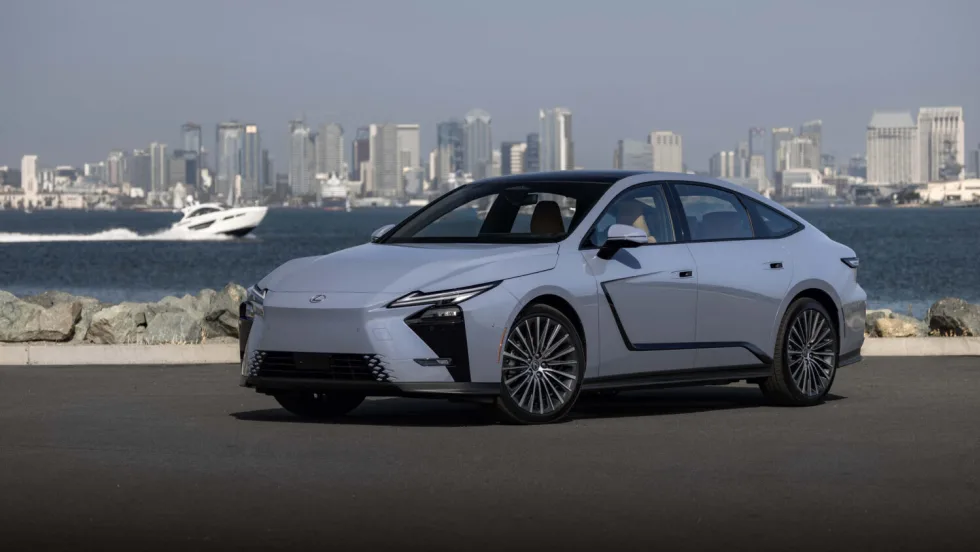
2027 Lexus ES Adds First Battery-Electric Models
The ES 350e and ES 500e join the hybrid ES lineup with up to 338 hp, an EPA-estimated 307 miles of range and standard NACS charging capability.
Read More →
EV Fleet Reality Check: What Operators Wish They Knew Before Electrifying Their Work Vans
Electric work truck upfits bring new compatibility questions. Learn how parts availability, OEM guidance, power demands, and route planning can affect fleet performance.
Read More →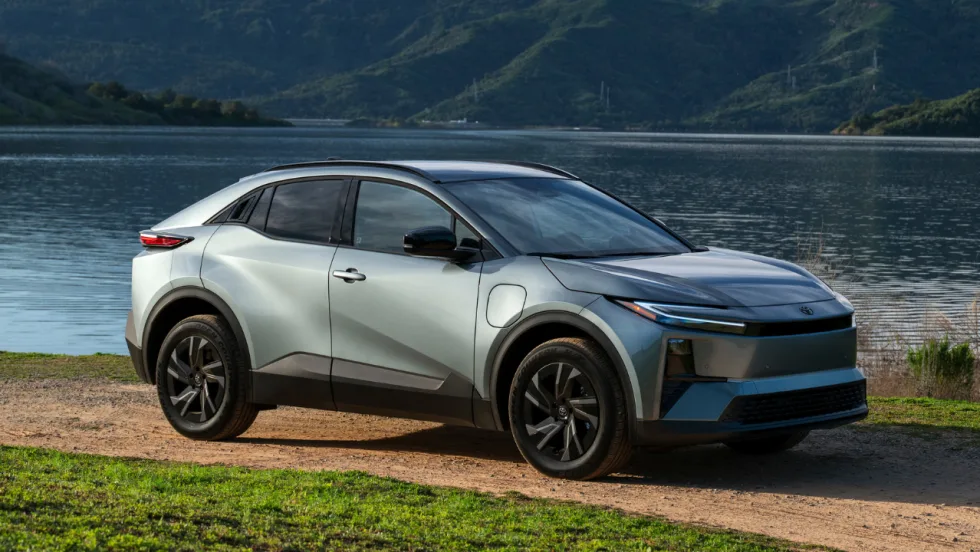
2027 Toyota C-HR Offers 287-Mile Range and Standard AWD
Toyota’s 2027 C-HR brings 287 miles of estimated range, standard all-wheel drive, and NACS fast-charging capability to the compact EV market. See what its mix of performance, cargo space, and everyday technology could offer business users.
Read More →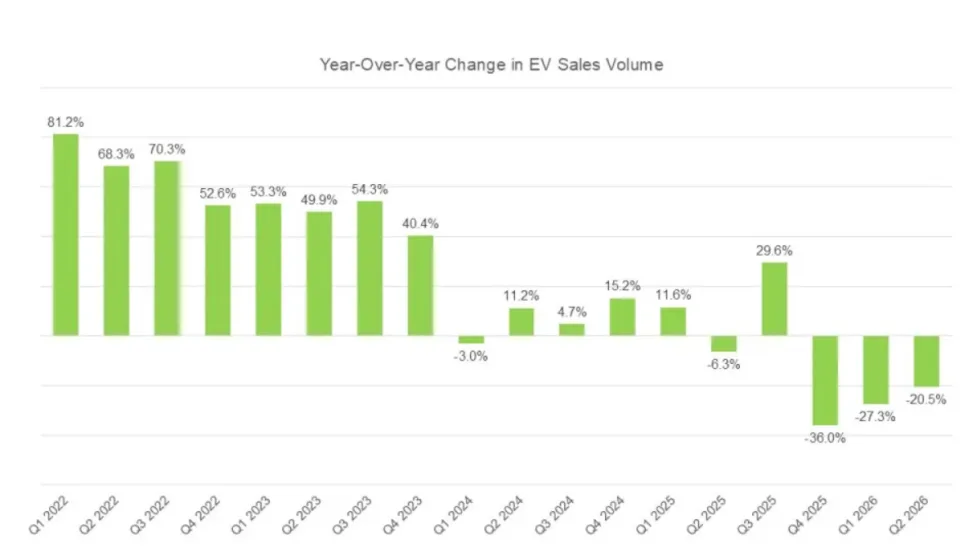
New Vehicle Models Stabilize Electrified Market In Q2
But more credit goes to hybrids than to all-electric vehicles, as more buyers look for fuel-efficient alternatives amid high gas prices.
Read More →
Slate Debuts Colorful, Unique EV Models
A recent media and client event, studded with electric vehicles dressed up on platforms, planted a new position for the manufacturer in the wider EV market. Fleets will find cost-saving advantages.
Read More →
Slate Electric SUV, Pickup Switchable Model Aims For Light-Duty Fleets
Everything about this EV is counterintuitive and understated, making it stand out from the crowd.
Read More →