Geotab’s analysis of charging data reveals that most commercial electric vehicles charge on AC power, have a long dwell time, and charge before the battery level drops to half.
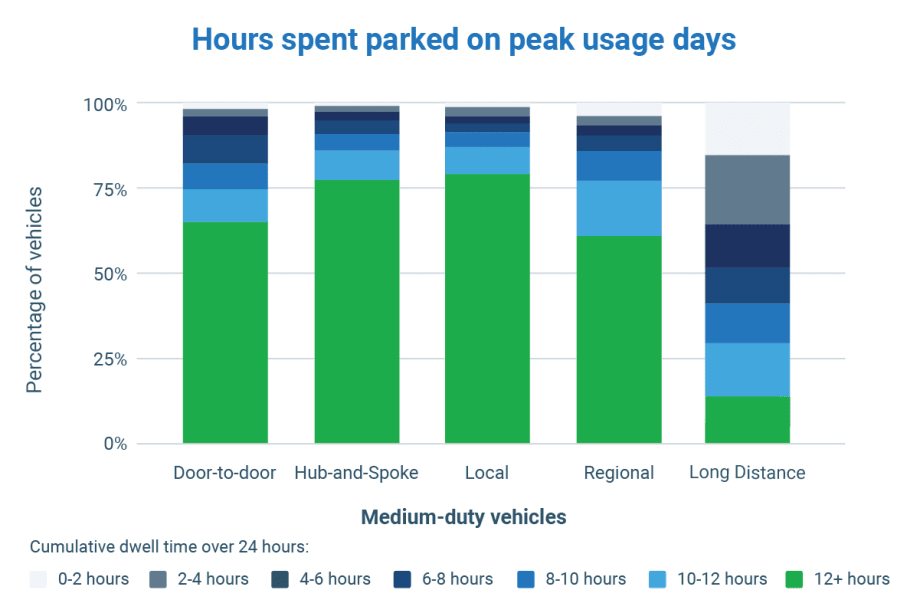
Of the medium-duty EVs analyzed in the Geotab study, most types had dwell times over 12 hours.
Graph: Geotab
3 min to read
Commercial electric vehicles are rapidly entering the market. Charging is a key consideration for managing EVs and getting the most out of them. Based on aggregated data from real-world connected vehicles, Geotab studied fleet charging trends in the U.S. and Canada to gather insights into how commercial EVs are being used.
Take a look at some key trends:
Ad Loading...
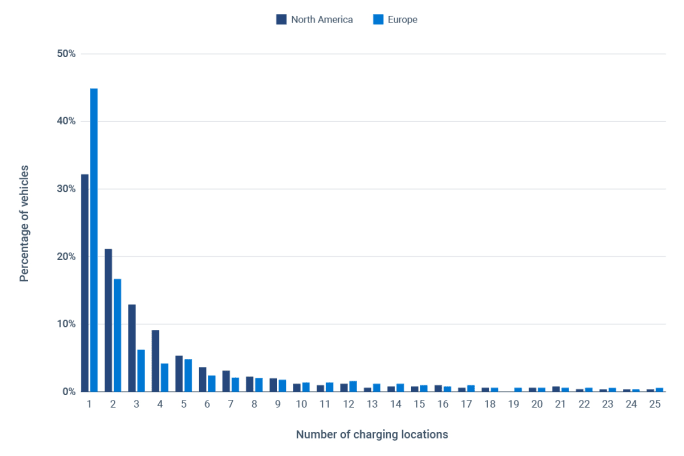
Most fleet vehicles charge at only one or two locations.
According to Geotab data, more than 50% of EVs in North American and European fleets only ever charge at one or two locations. Less than 10% of vehicles use four or more charging locations.
These findings most likely cover EVs that have predictable routes, return to the same domiciles each day, and have the ability to charge onsite at the fleet’s facility or the driver’s home — having one or two charging locations.
As fleets begin adopting EVs in applications with more complex charging requirements, this overall pattern may change.
More than 50% of EVs in North American and European fleets only ever charge at one or two locations. Less than 10% of vehicles use four or more charging locations.
Chart: Geotab
Charging at Home
Home EV charging and reimbursement are becoming hot topics as many employers offer take-home vehicles or company cars for business travel and personal use. Having a home charging policy for employees can save time, reduce unnecessary trips, and save money. Here are key questions to ask employees when setting up an employee home-charging program.
Do you have access to off-street parking (such as a garage or driveway)?
Do you own your home?
Do you live in a detached home or a multi-unit dwelling?
Is there sufficient electrical capacity?
Most trucks have a large window for charging.
Knowing how far a vehicle drives is not the only factor determining if it is suitable for electrification. Dwell time is also a major consideration. Given charging takes longer than refueling with gas or diesel, the optimal time to recharge is when the vehicle is stopped or parked during its normal duty cycle.
Data reveals that duty cycles may not need to change to accommodate charging. Looking at how long vehicles dwell on their highest-use days — the days of the year where driving time is highest and dwell time lowest — for many trucks, there would be ample time to charge if they were to transition to EVs. This assumes charging is deployed where the vehicles park.
Ad Loading...
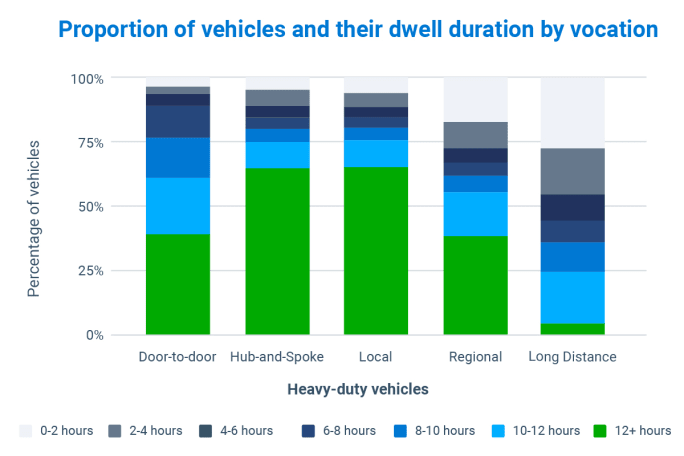
The majority of trucks spent nearly half of their time parked in a 24-hour period — at least 12 hours for medium-duty and 10 hours for heavy-duty, excluding long-distance trucks.
This chart provides insights into the length of time vehicles are parked across various vocations, for their highest-usage days. This helps to understand vehicle dwell times and therefore charging opportunities, even on the most demanding days.
Chart: Geotab
Charging Facts
Top three factors impacting charging times:
How much energy the battery holds, also known as total battery capacity (kWh)
How full the battery is, or current state-of-charge (SOC)
How quickly the battery is being filled, measured by charging power (kW)
Light-duty fleet EVs rely on AC charging.
AC charging accounted for 90% of charging for light-duty charging sessions in North America.
Overall, AC charging accounted for the majority of all charging in North America and the EU and across all types of trucks: door-to-door, hub-and-spoke, local, regional, and long-distance.
European vehicles utilized DC charging almost twice as much as North American vehicles, but it still only accounted for 20% of their total charge sessions.
The higher rates of DC charging are possibly due to greater public availability of DC chargers and a more mature market where fleets may be more willing to invest in this type of infrastructure at their depots.
Ad Loading...
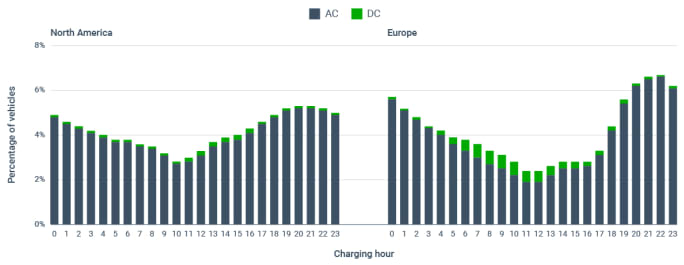
These graphs represent the proportion of total charging sessions by North American and European EVs that occur at some point during that hour, irrespective of the length of the sessions.
Graph: Geotab
According to an industry survey by Geotab, over two-thirds of fleet professionals (68%) say that lack of infrastructure and charging points was the biggest hurdle delaying or preventing their fleets from adopting EVs.
Charging patterns suggest an opportunity for greater utilization.
65% of North American fleet EVs start their charge session before the battery drops to half.
Most fleet vehicles studied were charging cautiously and never depleted their batteries. This is a missed opportunity to utilize an EV to its full potential since many EVs can go well over 100 miles at 50% SOC. EV utilization can be increased by driving more and charging less often or for shorter periods.
Data was sourced from Taking Charge: On the Road to the EV Future, Geotab report that summarizes fleet usage trends from 520,000 trucks in the U.S. and Canada to delve into whether electric trucks have what it takes to transform the industry.
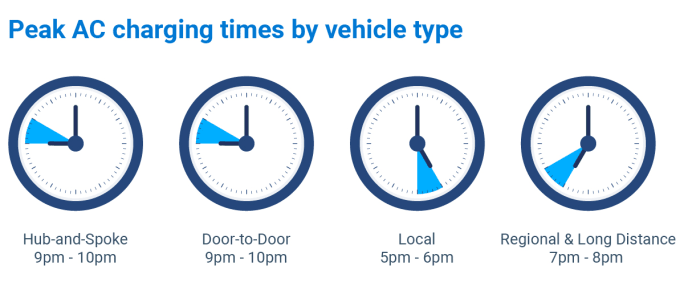
Peak charge times for all types fall between 5pm and 10pm.
The former Prologis Mobility and Shell executive will help expand EV Realty’s truck charging business and move its power-first infrastructure model into autonomous vehicle depots and other fleet sectors.
After logging more than 17,000 electric miles in the first year, New Mexico’s statewide pilot is moving into its second phase with larger vehicles, continued charging evaluations, and more.
Adam Cain, president and CEO of Sustainability Partners, explains how EV-as-a-service can help fleets scale deployments by addressing duty-cycle requirements and charging challenges.
Ford's $2 billion Louisville Assembly Plant overhaul introduces a three-part assembly process for the Fathom midsize electric truck, with production scheduled to begin in 2027.
From millions in operating savings to hundreds of millions of EV miles, Merchants Fleet’s latest report reveals what’s working and what’s changing in fleet electrification.
One of the nation's largest school bus electrification projects to date demonstrates how grants, charging infrastructure, and public-private partnerships can help fleets transition to EVs at scale.
Aptera Motors Corp. has issued purchase orders for the major structural components of its first 40 vehicles, and body and chassis components are expected to begin arriving in October.