Charged Fleet Logo

What Are Best and Worst States for Electric Vehicles?

A recent analysis ranks the average energy cost savings for EVs compared to internal combustion engine vehicles.

November 1, 2021
What Are Best and Worst States for Electric Vehicles?

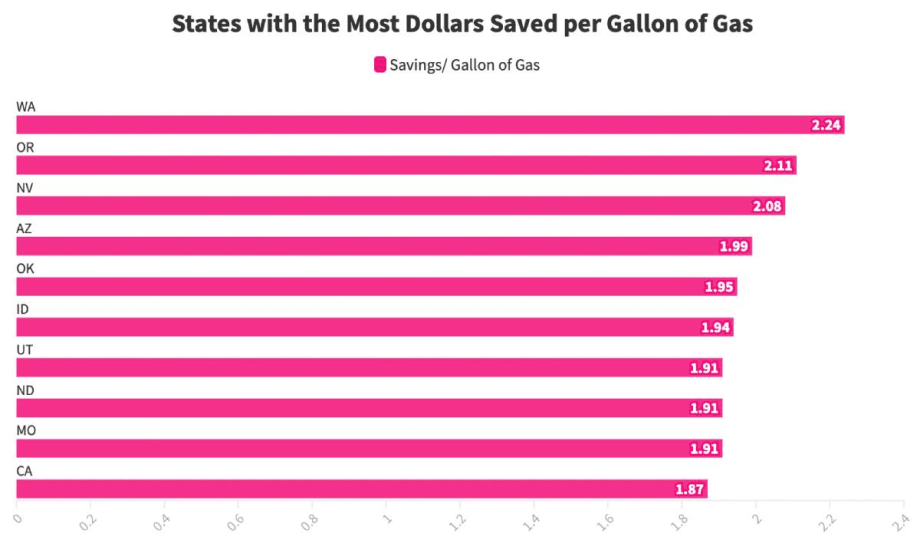
Drivers in Washington, Oregon, and Nevada save over $2 per gallon with an EV.

Graphic: Jerry

4 min to read


While many Americans dream of driving an electric vehicle and fleets are moving toward electrification, with many under mandates, buyers still may hesitate to purchase EVs because of costs, range anxiety, or charging port inaccessibility.

New research by Jerry, an automated compare-and-buy insurance shopping app, shows that purchasing and driving an EV can be a great financial and logistical decision but that highly depends on where you live. Drivers in East or West Coast states like Massachusetts, Vermont, and California have numerous financial incentives to purchase EVs, and more access to charging ports. Drivers in Louisiana, Kentucky, and Idaho are not so lucky.

Ad Loading...


Top 10 States to Own an EV: Massachusetts, Vermont, California, Hawaii, Rhode Island, Connecticut, New YOrk, Maine, Colorado and Maryland.

Worst 10 States to Own an EV:Louisiana, Kentucky, Idaho, Arkansas, North Dakota, Mississippi, Nebraska, West Virginia, Oklahoma, and Alabama.

The study ranked states based on three factors: EV charging port density, gas savings, and government incentives. East and West Coast States comprise nine of the 10 best states to own an EV; Southern and Midwest states cover nine of the 10 worst states to own an EV. 

Charging Station Availability

EV charging port distribution varies widely across states. Vermont and California top the list at 133 and 89 EV charging ports per 100,000 people. But there’s a significant drop from there. Maryland has the third-most EV charging ports at 59 ports per 100,000 people, but that is less than half the amount Vermont has. The bottom three states -- Alaska, Kentucky, and Louisiana -- have 8-9 charging ports per 100,000 people (0.009% charging station density).

Cost of Gas

EVs are good for your environment and your wallet. Drivers in Washington, Oregon, and Nevada save over $2 per gallon with an EV. That’s 47% savings for Washington, 43% savings for Oregon, and 40% savings for Nevada. Considering that the average American uses over 300 gallons of gasoline per year, drivers in Washington, Oregon, and Nevada could be saving over $600 a year if they make the switch to EVs. This is $4,800 over the average lifetime of car ownership. Even drivers in states like Hawaii and Rhode Island, which each save under a dollar per gallon of gas, can save a couple of hundred dollars a year from the switch.

Incentives

State governments encourage EV adoption with various tax and subsidization incentives. California, Massachusetts, and Maryland have more than 10 local government incentives to support EV purchase and/or leasing. This includes EV purchase rebates of up to $7,500, charging port rebates, EV purchase income tax credits, electric charging cost rebates, and more. This is over 10 times the incentives that states like West Virginia, North Dakota, Kansas, Missouri, Wyoming, and others have, ranging from 0 to 1.

Now, 46 states and Washington D.C. incentivize EV adoption. Consumer incentives include HOV lane exemptions, EV purchase rebates, vehicle inspections/emissions test exemption, parking incentives, utility rate reductions, and more. For example, utility providers often reduce EV charging prices during off-peak hours. This can save drivers hundreds of dollars per year. Tax credits and rebates often offer several thousand dollars in savings the year a driver purchases their EV. States also have business-facing incentives. For example, California, New Jersey, New York, Oregon, and nine other states require manufacturers to sell a certain amount of zero-emission vehicles per year.

EV Infrastructure Improving

EV infrastructure -- which refers to EV charging station accessibility and government incentives for EV adoption -- is getting better each year. The Biden Infrastructure Bill wants to designate $7 billion to bettering EV infrastructure, and many states are upping investment in zero-emission vehicles with or without the extra aid. Car companies including  Volkswagen, Ford, and Chevrolet are releasing better EVs with longer ranges and more features like smart parking.

Ad Loading...

When considering the financial benefits of gas savings, rebates, and tax incentives, owning an EV is less expensive than most think. You could save $4,800 in gas costs over the length of car ownership (eight years on average). If you live in the right state, like California or Maryland, you could also save $5,000-8,000 on vehicle purchase price. Increased EV infrastructure investment means more public charging ports will be available, and cities will offer more rebates and cost-lowering incentives to make EVs even more affordable. Buyers should check if their state or locality has financial incentives and check gas prices.



More Electric Vehicles

Kia Telluride hybrid SUV driving on a mountain road at sunset, highlighting award-winning electrified models recognized by U.S. News for performance, efficiency, and value.

Three Kia Models Win Hybrid, Electric Car Awards From U.S. News & World Report

The magazine highlighted the Telluride HEV, Niro HEV, and Sportage HEV for efficiency, performance, and overall value.

Read More →
Hyundai IONIQ 5 electric SUV parked near wind turbines, named Best Compact Electric SUV, highlighting fast charging, modern design, and efficiency.

Hyundai Sweeps EV and Hybrid Awards On U.S. News & World Report Best List

Hyundai earns three top spots in U.S. News’ 2026 hybrid and EV rankings, led by repeat wins for the Tucson Hybrid and IONIQ 5 and a category win for the new IONIQ 9.

Read More →
PG&E PowerHouse demo home in San Ramon with wall-mounted EV chargers, batteries, and electric systems, showcasing all-electric home technologies and energy management solutions.
Chargingby News/Media ReleaseApril 23, 2026

All Electric Test House Could Ease Path To EV Usage

An experimental model home shows how residential charging could enable electric fleet operations by allowing drivers to take EVs home.

Read More →
Ad Loading...
Subaru electric SUV driving along a coastal highway at sunset, representing the 2027 Getaway with three-row seating and all-electric performance.
Suppliersby News/Media ReleaseApril 22, 2026

Subaru Unveils New Electric SUV, a Three-Row 2027 Subaru Getaway

Subaru introduces the all-electric 2027 Getaway, a three-row SUV with 420 hp, over 300 miles of range, and fast-charging capability, expanding its EV lineup.

Read More →
Charts show March EV sales: 82,629 new units (up month over month, down year over year) and 42,924 used units (up sharply), with EV share at 5.9% new and 2.5% used.

High Gas Prices Spur EV Sales Rebound

EV sales showed strong month-over-month gains and surging used EV demand, while tighter inventory and declining prices narrowed the gap with gas-powered vehicles.

Read More →
Electric vehicle charging in a home garage with wall-mounted charging and energy systems, illustrating WEX EV At-Home fraud protection and fleet charging verification technology.
Chargingby News/Media ReleaseApril 21, 2026

WEX Launches Solution to Close EV At-Home Charging Visibility Gap

At NAFA I&E 2026, WEX debuted an EV solution that adds a layer of verification to help fleets track, validate, and trust every at-home charging dollar.

Read More →
Ad Loading...
Lucid electric vehicle equipped with rooftop sensors parked outside a modern building, representing expanded partnership with Uber for future robotaxi deployment.

Lucid Receives New Investments As It Expands Uber Robotaxi Venture

Lucid and Uber partner to provide at least 35,000 vehicles, backed by new investments totaling $750 million to support the deployment of autonomous fleets.

Read More →
Orange Slate electric pickup truck parked outdoors between industrial structures, representing the company’s upcoming customizable EV supported by new funding.
Suppliersby News/Media ReleaseApril 17, 2026

Slate Auto Raises $650 Million In Funds As It Prepares E-Truck Production

Slate Auto will use the money to advance production plans, with more than 160,000 reservations and deliveries targeted for late 2026.

Read More →
Aerial view of large EV truck charging hub in San Bernardino with multiple charging lanes and infrastructure for fleet vehicles.
Chargingby News/Media ReleaseApril 15, 2026

Major Truck Charging Hub Opens In Southern California

EV Realty opens a 76-port, 9 MW truck charging hub in San Bernardino, designed to support more than 200 medium- and heavy-duty vehicles per day with CCS and MCS capability.

Read More →
Ad Loading...
Dan Hilson and Martin Romjue photos on the title page.
Chargingby Martin RomjueApril 14, 2026

Software Speeds Up EV Fleet Charging

Learn about a new level of energy management that helps fleets control costs while maintaining service reliability. [VIDEO]

Read More →