


EV Sales, Supply, Prices Dip in June As Market Stays Solid
But the loss of government-backed incentives and the emergence of new tariff headwinds signal a more volatile phase for the electric vehicle industry.

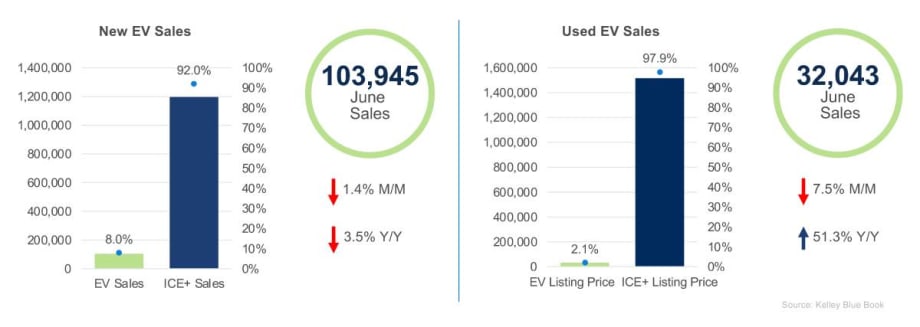
Year-over-year sales of used EVs jumped 51.3%, signaling strong long-term momentum.
Graphic: Cox Automotive
The EV market in June showed signs of steady momentum, even as underlying dynamics shifted, but the longer-term trends of EV purchases look favorable.
New EV sales softened slightly, but market share climbed. Used EV sales dipped monthly but remained sharply higher than a year ago. Inventory levels, pricing, and incentives all indicate a market adjusting to evolving consumer demand and the waning influence of policy-driven support.
Market Share and YOY Sales Increase
New EV Sales: In June, new EV sales totaled 103,945 units, marking a modest 1.4% decline from May. Despite the dip in volume, market share rose to 8%, up from 6.9% the previous month. On a year-over-year basis, sales declined 3.5%, a smaller decline than the overall market and an indication of the general market slowing. At the brand level, the top five performers were Tesla, Chevrolet, Hyundai, Ford, and Cadillac. Market leader Tesla saw a 2.9% month-over-month increase, while Chevrolet posted a robust 24.4% gain, helping General Motors maintain its position as the second-leading EV manufacturer. Kia also staged a notable comeback, with sales surging 48.2% to 2,094 units, signaling renewed momentum for the brand.
Used EV Sales: The used EV market declined 7.5% month over month in June to 32,043 units, holding a 2.1% share of the overall used-vehicle market. Still, year-over-year sales jumped 51.3%, signaling strong long-term momentum. Tesla remained dominant, though its share dipped to 45.2%, with the Model 3, Model Y and Model S ranking as the top three bestsellers. The Chevrolet Bolt EV edged out the Model X, placing fourth overall. Mercedes-Benz was one of the few major brands to post a monthly gain (5.4%), driven by a 38.6% rise in EQB sales. Audi and Porsche also saw growth, up 19.6% and 3.6%, respectively, highlighting strength in the luxury EV segment.
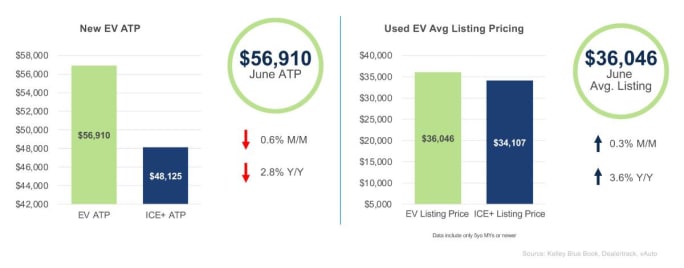
The price gap between used EVs and ICE+ vehicles remained narrow, below $2,000.
Graphic: Cox Automotive
New EV ATP: In June, the average transaction price (ATP) for new electric vehicles dipped slightly to $56,910, reflecting a 0.6% decrease from May and a 2.8% decline year over year. The price gap between EVs and ICE+ vehicles narrowed to $8,785, down from $9,260 the previous month. EV incentives rose for the third consecutive month, reaching a record 14.8% of ATP, or $8,451 – more than twice the incentive level offered on ICE+ vehicles.
This underscores the continued push to make EVs more accessible amid softening demand. Seven EV models had average transaction prices below $40,000, with the Nissan Leaf remaining the most affordable at $32,047. The Chevrolet Equinox, priced at $39,731, led in sales volume, making it the top-selling EV in this price range.
Used EV Listing Price: The used electric vehicle market saw a modest price increase in June, with the average listing price rising to $36,046, up 0.3% from the previous month and 3.6% year over year. The price gap between used EVs and ICE+ vehicles remained narrow, below $2,000. Importantly, 43% of used EVs sold were priced under $25,000, highlighting the growing affordability in this segment. The Tesla Model 3 and Model Y, the top-selling used EVs, both fell within this range, averaging $22,998 and $29,111, respectively.
Enough EVs To Go Around
New EV Days’ Supply: In June, new EV days’ supply rose 9.9% month over month to 125, though it remains 14.8% lower than last year. For the third consecutive month, EV inventory has outpaced ICE+ by more than 30 days — potentially benefiting consumers through greater availability and more competitive pricing, especially as the window for federal EV tax credits begins to close. Supply levels varied by brand: Audi, Volvo and Porsche posted the largest increases in EV days’ supply. Nissan remains the lowest for the second consecutive month.
Used EV Days’ Supply: The days’ supply of used electric vehicles increased by 1.7% in June, effectively rising by just one day to 41, still 9.9% below year-ago levels and indicative of continued tight inventory. For the third consecutive month, the gap between used EVs and ICE+ vehicles remained under five days. As with the new EV market, days’ supply for used EVs varies widely by make: Tesla remains among the lowest at 33 days, while GMC leads at 74 days.
What’s Next For EV Market
As the EV market enters the second half of 2025, momentum remains strong. Q2 sales rose 4.9% over Q1, and total EV sales for the year's first half hit a record 607,089, up 1.5% year over year, as reported in the Kelley Blue Book EV Sales Report.
With the federal EV tax credit under the Inflation Reduction Act set to expire at the end of September, the next few months will likely bring a wave of compelling EV offers, creating a critical window for consumers to act.
However, the landscape is shifting from one shaped by policy support to one increasingly defined by market realities.
Amid this evolving environment, the used EV segment is maturing, bringing greater model variety and more competitive pricing. These trends open new doors for buyers seeking long-term value and more accessible entry points.
But the outlook for Q4 is far less certain. The elimination of government-backed incentives and the emergence of new tariff headwinds signal a more volatile phase for the industry. The training wheels are coming off, and the transition to electrification will no longer be buoyed by incentives alone.
Automakers and retailers alike will need to navigate this next chapter with agility as the EV landscape becomes more complex and demands true market resilience.
More Electric Vehicles

EV Charging Use Is Outpacing Infrastructure Growth
ChargePoint’s 2026 Charging Forward Report points to rising charger use, higher-powered charging, commercial vehicle electrification, and energy-management technology. Here’s what fleets should know.
Read More →
EV Realty Names Henrik Holland President as Charging Platform Expands
The former Prologis Mobility and Shell executive will help expand EV Realty’s truck charging business and move its power-first infrastructure model into autonomous vehicle depots and other fleet sectors.
Read More →
GreenPower Expands New Mexico EV Pilot With Larger Buses, V2G Testing
After logging more than 17,000 electric miles in the first year, New Mexico’s statewide pilot is moving into its second phase with larger vehicles, continued charging evaluations, and more.
Read More →
Can EV-as-a-Service Help Fleets Scale Electrification?
Sustainability Partners CEO Adam Cain explains how matching EVs, charging infrastructure, and duty cycles can help fleets scale electrification.
Read More →
How EV-as-a-Service Is Moving Fleets Beyond Pilots
Adam Cain, president and CEO of Sustainability Partners, explains how EV-as-a-service can help fleets scale deployments by addressing duty-cycle requirements and charging challenges.
Read More →
PowerFlex, The Mobility House Join Forces to Advance Fleet Electrification
Two EV charging providers are joining forces to deliver a broader portfolio of energy management and fleet electrification solutions.
Read More →
Ford Retools Louisville Plant for Fathom Electric Truck Production
Ford's $2 billion Louisville Assembly Plant overhaul introduces a three-part assembly process for the Fathom midsize electric truck, with production scheduled to begin in 2027.
Read More →
Merchants Fleet Reports 290M EV Miles as Fleets Navigate Changing Electrification Market
From millions in operating savings to hundreds of millions of EV miles, Merchants Fleet’s latest report reveals what’s working and what’s changing in fleet electrification.
Read More →
California District Commits to Electrify 25% of School Bus Fleet by 2028
One of the nation's largest school bus electrification projects to date demonstrates how grants, charging infrastructure, and public-private partnerships can help fleets transition to EVs at scale.
Read More →
Aptera Orders Bodies and Chassis for Its First 40 Production Vehicles
Aptera Motors Corp. has issued purchase orders for the major structural components of its first 40 vehicles, and body and chassis components are expected to begin arriving in October.
Read More →