


More News: How to Maximize Benefits of PHEVs In Fleets
Navigating Transport Refrigeration in the Era of EVs
As regulations, rebates, and ESG goals affect the larger market to electrify fleets, they must be considered for transport refrigeration units (TRUs) as well.
by Matt Srnec, Thermo King
October 12, 2023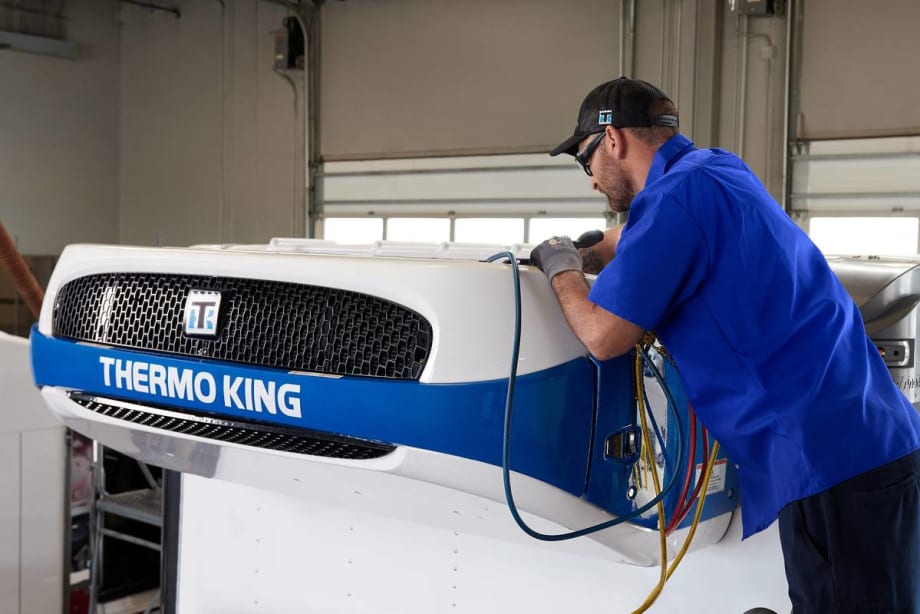
A Thermo King technician performs preventive maintenance on an all-electric transport refrigeration unit.
Photo: Thermo King
6 min to read
In a world increasingly concerned about climate change, the transportation sector finds itself at the forefront of decarbonization efforts. This shift toward sustainability is essential but comes with its unique set of challenges because addressing decarbonization requires changing how some everyday operations are executed.
Fleet managers are now navigating the complex landscape of transport refrigeration while striving to:
Ensure reliable, high-quality cold chain shipping and storage while maintaining safety protocols.
Comply with state and local regulations.
Take advantage of governmental rebates, grants and decarbonization incentives.
Achieve corporate environmental, social and governance (ESG) goals.
In this article, I’ll delve into these challenges and highlight solutions that can support fleets on their path to a greener future.
Decarbonization requires more than a simple change a company can implement instantly. It requires a shift in the organization’s mindset and likely in their operations and procedures. These transitions can be difficult to apply across an entire fleet — particularly while following regulatory requirements, coordinating infrastructure development, and meeting ESG goals.
Looming Regulations
California has implemented stringent net-zero emissions (ZE) mandates, necessitating a shift to ZE transport refrigeration units (TRUs) from self-powered truck TRUs by specific deadlines.
For example, according to the California Air Resources Board (CARB) statute 2477.5(b)(1), “Beginning Dec. 31, 2023, no owner or owner/operator shall operate or cause to be operated in California, any (straight) truck TRU in the owner’s truck TRU fleet, unless the fleet meets or exceeds the required ZE truck TRU fleet percentages specified.” At this time, the regulatory requirements for trailers are focused on engine emissions only.
The required number of ZE truck TRUs is based on the truck TRU fleet size reported to CARB on Dec. 31 each year. TRU OEMs shall not manufacture a truck TRU for sale or use in California beginning Dec. 31, 2023, unless it is a ZE truck TRU, according to the statute.
This presents a challenge for fleet operators and TRU OEMs who must innovate, adapt, and adhere to these regulations. Regulatory compliance demands careful planning and investment by all stakeholders involved.
Infrastructure and Grid Loads
The transition to greener equipment is happening incrementally as technology and infrastructure evolve. This is why it's impractical for a large segment of critical services, like commercial transport, to shift to entirely new energy sources instantaneously. Similarly, truck and TRU OEMs must plan carefully to adjust production.
In the transition to electrical energy as fuel, progress is constricted by supply chain and administrative timelines required for utilities and contractors to plan, permit, and source equipment for projects. The process to construct infrastructure for electrical distribution, along with manufacturing requirements for components such as transformers and chargers, is a barrier to fleet adoption of these new technologies.
The limits of infrastructure impact the viability of electric long-haul trucking including trailer TRUs in particular. Even if OEMs could begin producing solely electric vehicles tomorrow, the energy infrastructure required in central freight corridors must be at scale to handle the power levels and connections necessary to keep cargo moving and properly climate controlled.
There are two essential variables to provide adequate charging infrastructure:
There must be enough total power to keep trucks running and refrigerated trailers operating even when the trucks and their drivers are at rest.
Power must be available in the appropriate locations to serve a fleet’s operational logistics. This could be at the distribution centers of their customers, at the fleet’s hub or at truck stops along their routes.
Adding sizable amounts of EV charging stations for commercial vehicles, like refrigerated trucks and trailers, could strain local electrical transmission and distribution networks. Many power companies are eager to help scope and size energy requirements and can partner with experts in transport refrigeration and fleet energy planning.
As an example, it is estimated that for every 50 refrigerated trailers operating at the same time, circuits would be allocated at a total of 1 MW. Smart refrigeration controls, power management, grid intelligence, and use of standardized charging technologies for transport refrigeration can turn passive grid loads into a managed energy solution.
Meeting ESG Goals
With the rise of global climate concerns and pressure to operate sustainably, corporations are taking greener ESG stances. For fleet operators, this means increasing efficiency and searching for opportunities to save energy and reduce product waste.
This challenge to the status quo presents an innovation opportunity. Sustainability initiatives are gaining importance among consumers, stakeholders, and the public. For example, tracking use of all-electric shore power for transport refrigeration units while they are stationary, may be an opportunity in contributing to ESG carbon emissions reduction goals.
Approach to Decarbonization
To address these challenges, companies like Thermo King offer solutions catering to each fleet’s unique sustainability journey. There is a wide range of temperature-controlled transport solutions available to aid carbon emission reduction efforts. These include:
Reliable, high-efficiency diesel TRUs with shore power connections
All-electric TRUs for commercial EV trucks and vans
Qualified alternative fuel sources for TRUs (e.g., HVO, and more)
Adding facility infrastructure connections and using shore power for equipment is the fastest way to reduce hydrocarbon consumption in transport refrigeration fleet operations. Several reliable and flexible solutions are available with incentive programs in many regions that support operational advantages, ROI, and regulatory requirements.
Transport refrigeration solutions that are purposefully designed and built for electric vehicles help fleets comply with complex regulatory requirements present in certain locales, simplifying the switch to ZE commercial fleets. Companies should look for partners, like Thermo King, who manufacture and sell solutions eligible for government rebates and incentives, and also educates customers about ESG initiatives, compliance, and supporting scalable growth and adoption.
Additionally, refrigerated fleet monitoring systems and dashboards have become indispensable for making fleets more efficient. These digital tools provide real-time status updates and the data and reports required to prove effectiveness. These telematics solutions keep operators and administrators up to date on operational health, and they can provide diagnostics to help guarantee proper cooling by the most efficiently powered means possible.
Decarbonizing the Cold Chain
Decarbonizing transport refrigeration is a unique journey for each fleet operator. Regardless of the motivation for changes — be it regulatory compliance, rebate incentives, ESG goals or some combination of the three — there is a customized path every company can follow.
By transitioning to more sustainable fleets, organizations can reduce lifetime total cost of ownership through efficient operations, conform to regulatory standards, and reduce emissions, ultimately stewarding the earth for future generations.
It will take everyone to preserve the planet, and adopting electrical and other alternative energy sources for TRUs is one way fleet operators can do their part. As with all significant change, there will be growing pains. However, decarbonization will help the transport industry meet mounting social pressure and regulatory requirements in the coming decades while keeping fleet operational costs in check.
Topics:Zero EmissionsTransportation Refrigeration UnitsThermo KingElectric VehiclesOperationsSuppliers
Originally posted on Automotive Fleet
Subscribe to Our Newsletter
More Electric Vehicles

EV Charging Use Is Outpacing Infrastructure Growth
ChargePoint’s 2026 Charging Forward Report points to rising charger use, higher-powered charging, commercial vehicle electrification, and energy-management technology. Here’s what fleets should know.
Read More →
EV Realty Names Henrik Holland President as Charging Platform Expands
The former Prologis Mobility and Shell executive will help expand EV Realty’s truck charging business and move its power-first infrastructure model into autonomous vehicle depots and other fleet sectors.
Read More →
GreenPower Expands New Mexico EV Pilot With Larger Buses, V2G Testing
After logging more than 17,000 electric miles in the first year, New Mexico’s statewide pilot is moving into its second phase with larger vehicles, continued charging evaluations, and more.
Read More →
Can EV-as-a-Service Help Fleets Scale Electrification?
Sustainability Partners CEO Adam Cain explains how matching EVs, charging infrastructure, and duty cycles can help fleets scale electrification.
Read More →
How EV-as-a-Service Is Moving Fleets Beyond Pilots
Adam Cain, president and CEO of Sustainability Partners, explains how EV-as-a-service can help fleets scale deployments by addressing duty-cycle requirements and charging challenges.
Read More →
PowerFlex, The Mobility House Join Forces to Advance Fleet Electrification
Two EV charging providers are joining forces to deliver a broader portfolio of energy management and fleet electrification solutions.
Read More →
Ford Retools Louisville Plant for Fathom Electric Truck Production
Ford's $2 billion Louisville Assembly Plant overhaul introduces a three-part assembly process for the Fathom midsize electric truck, with production scheduled to begin in 2027.
Read More →
Merchants Fleet Reports 290M EV Miles as Fleets Navigate Changing Electrification Market
From millions in operating savings to hundreds of millions of EV miles, Merchants Fleet’s latest report reveals what’s working and what’s changing in fleet electrification.
Read More →
California District Commits to Electrify 25% of School Bus Fleet by 2028
One of the nation's largest school bus electrification projects to date demonstrates how grants, charging infrastructure, and public-private partnerships can help fleets transition to EVs at scale.
Read More →
Aptera Orders Bodies and Chassis for Its First 40 Production Vehicles
Aptera Motors Corp. has issued purchase orders for the major structural components of its first 40 vehicles, and body and chassis components are expected to begin arriving in October.
Read More →