Designing Truck Bodies for the Coming Wave of Commercial EVs
John B. Poindexter and Mark Hope of JB Poindexter & Co discuss how bodies and upfits are evolving to integrate with electric vehicle chassis and how the company’s new business unit will serve this burgeoning market.
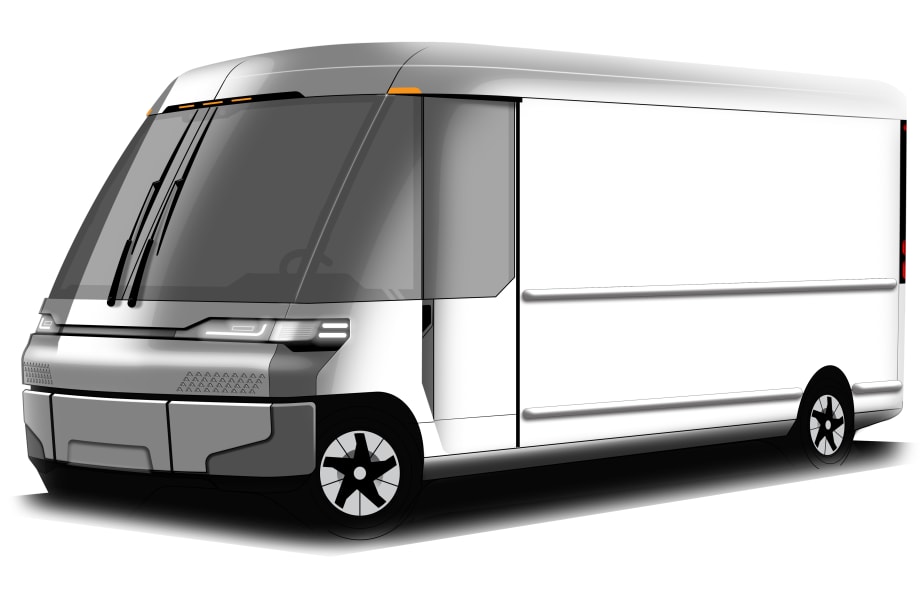
EAVX — which created this next generation delivery vehicle concept — will lead JB Poindexter & Co’s R&D and prototyping efforts with vehicle manufacturers and the company’s individual business units.
Image courtesy of JB Poindexter & Co.
5 min to read
You may not be familiar with JB Poindexter & Co, even if you’re in fleet or the work truck industry. It’s because John B. Poindexter, the company’s chairman and CEO, preferred it that way — until now.
Traditionally, Poindexter’s company has approached the market through its business units: Morgan Olson, Morgan Truck Body, Reading Truck, Truck Accessories Group, and Masterack. Those business units are well known to fleet operators through their products for light- and medium-duty commercial vehicles — walk-in vans, dry freight and refrigerated boxes, platforms and dump bodies, service bodies, truck caps and tonneau covers, as well as shelving, bins, racks, and storage systems. (The company’s other units involve machining services, foam products, and funeral coaches.)
Ad Loading...
“In the future, there's going to be a lot more cross selling, collaboration, and technology sharing among our business units, because it will benefit our customers,” Poindexter says. “As this new market is evolving, we are more interested in getting our business enterprise understood than in the past.”
The new market Poindexter references is with electric and alternative fuel chassis producers. The company’s newest unit — EAVX — is the catalyst into this future.
Fleets won’t be able to buy a body directly from EAVX. Rather, EAVX will lead the R&D and prototyping efforts with vehicle manufacturers and the company’s individual business units, which will produce the bodies and upfits for the new electric and alternative fuel chassis.
Though this market is only beginning to form, the time to act is now. “It’s only natural that the EV chassis manufacturers would attempt to fabricate the entire body,” Poindexter says. “We think that over time the economics will assert itself, and (those manufacturers) will conclude that their time is better spent on the EV end of the business, not the metal bending end of the business,” he says.
While those manufacturers are building generic bodies and shelving, partnering with seasoned upfitters and bodybuilders makes sense, Poindexter maintains. They can offer the manufacturing capabilities, tooling, and engineering expertise to produce a greater variation for the vocational bodies to come.
Ad Loading...
According to Poindexter, early integrations with chassis producers are proving out this theory on market direction.
Poindexter is also ready to leverage his business enterprise in another crucial area for EV startups — a service and support network. He claims the largest footprint of work truck upfitting facilities in North America, and the company has made four facilities acquisitions in the last 18 months.
Servicing EVs takes the company in another new direction. However, “We know the market space, we know the end users from a body perspective, and we can help the startups get there with the service and support to keep those vehicles on the road,” he says.
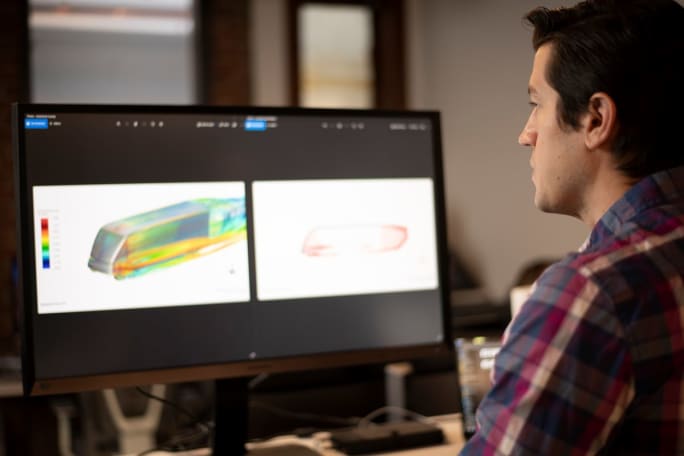
Photo courtesy of JB Poindexter & Co.
Designing Bodies for EVs
So, is designing bodies for electric trucks and vans really that different than for those with internal combustion engines (ICE)?
“We design body applications for efficiency and ergonomics, and that holds true for ICE vehicles and EVs,” says Mark Hope, chief operating officer and general manager at EAVX.
Ad Loading...
However, in the EV domain, weight savings and better aerodynamics will make an outsized difference to the range of the application and thus the cost of the batteries. “If you can hit the same range with less battery, that's in everybody's best interest,” Hope says.
Body manufacturers have traditionally employed composite technologies to decrease body weight, and that will continue. But for EV bodies, Hope says the greater savings — and engineering challenge — is to combine structural elements of the chassis and the body that removes duplication of parts.
“Fundamentally, it's about how we integrate (the body) to the frame in a way that keeps the batteries safe and serviceable without adding structure,” he says.
In general, the unique layout of electric chassis presents design advantages and challenges.
As the battery packs sit between the chassis’ frame rails, the hardpoints — the areas where the engine and suspension connect to the chassis to carry loads — will change. The body design must accommodate high-voltage battery harnesses and a way to safely access and remove the batteries.
Ad Loading...
Without a traditional combustion engine and drive axle, a walk-in van’s driver’s seat could move to the middle, allowing for equal egress on both sides. Bulkheads can be repositioned. The floor can be flattened and lowered to improve step-in heights.
This could, in turn, allow for a decrease in the wheelbase and a lower weight, which would allow for the same payload and volume but in a smaller class of vehicle.
As telematics play an increasing role in commercial fleets, bodies can be designed to better integrate telematics components and camera technology. With fewer components to control, inside the cab the dash layout can be modified.
For electric vehicles, HVAC — particularly cabin heat — is a range killer. Engineers are exploring body designs that minimize heat loss and compartmentalize HVAC where it’s needed. “On an ICE vehicle, you don't have to worry so much about thermal management and optimizing energy consumption, but on an EV it’s a big deal,” Hope says.
The transition away from internal combustion engines to EVs will be gradual, and ICE trucks will be around for many years. For body manufacturers, that presents another challenge — keeping manufacturing streamlined for different propulsion types.
Ad Loading...
“We can't create a body that works only for EVs and doesn't work for ICE,” Hope says. “We're continually working with our business units to make sure that we get the right solution that would fit across multiple chassis.”
And when autonomous transportation arrives?
Aerodynamics and weight will still be a design focus, especially in middle-mile applications that involve some freeway travel. As well, other parts of the journey will need to be automated. Cargo containment may take on a completely new industrial design, with standardized boxes being potentially loaded and offloaded in an automated system. Whatever form, those boxes should be made to live for over 20 years.
EAVX is working with a couple of autonomous companies now, though in the early stages.
Ultimately, the design process will replicate the collaboration with EV chassis manufacturers. “Let the autonomous (companies) do what they excel at, the technology, and let us come in and do what we excel at, which is the body development and engineering,” Hope says. “And then the joint effort gets us to the right product.”
The former Prologis Mobility and Shell executive will help expand EV Realty’s truck charging business and move its power-first infrastructure model into autonomous vehicle depots and other fleet sectors.
After logging more than 17,000 electric miles in the first year, New Mexico’s statewide pilot is moving into its second phase with larger vehicles, continued charging evaluations, and more.
Adam Cain, president and CEO of Sustainability Partners, explains how EV-as-a-service can help fleets scale deployments by addressing duty-cycle requirements and charging challenges.
Ford's $2 billion Louisville Assembly Plant overhaul introduces a three-part assembly process for the Fathom midsize electric truck, with production scheduled to begin in 2027.
From millions in operating savings to hundreds of millions of EV miles, Merchants Fleet’s latest report reveals what’s working and what’s changing in fleet electrification.
One of the nation's largest school bus electrification projects to date demonstrates how grants, charging infrastructure, and public-private partnerships can help fleets transition to EVs at scale.
Aptera Motors Corp. has issued purchase orders for the major structural components of its first 40 vehicles, and body and chassis components are expected to begin arriving in October.