


Wireless EV Charging Stations Cut the Cord
The latest developments in wireless electric vehicle charging eliminate fueling station clutter and reduce the risk of equipment damage.

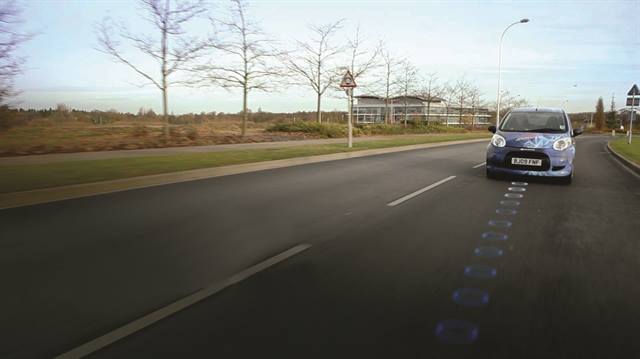
Companies such as Qualcomm and Evatran are working to develop dynamic charging in the U.S. to make charging effortless and to bring EVs to the mass market. Dynamic charging has been demonstrated in Korea, using two all-electric buses.
Does wireless charging hold the key to mass-market appeal for electric vehicles (EVs)?
It’s still too early to tell, but with the U.S. government, automakers, start-ups, and global wireless firms all making big bets on wireless EV charging research and development, the possibilities are intriguing and promising for solving one of the biggest issues facing electric vehicle technology — convenient and effective recharging. The convenience of wireless charging could make EVs more acceptable to drivers who are resistant to changing habits — drivers who don’t want to hassle with a cord and plug, especially in short-term parking situations or when parking outdoors in inclement weather. Wireless chargers also require less hardware and can be installed below ground, making them more conducive for public charging infrastructure by eliminating street clutter and reducing risk of vandalism and damage to electric connections often associated with plug-in systems.
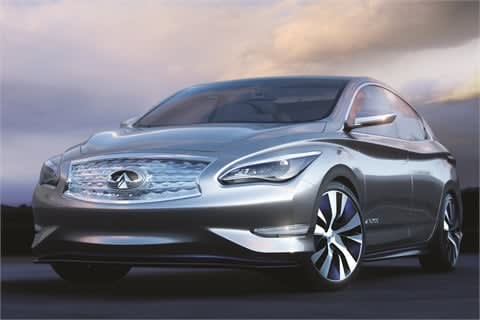
The 2014 Infiniti LE is Infiniti’s luxury EV with wireless charging capability. The vehicle automatically positions itself over the wireless charging pad, guaranteeing the most efficient charge.
Although wireless charging technology has been around for a few years for small consumer electronics, such as smartphones and electric toothbrushes, cutting the cord on the much larger and more complicated EV technology has been a far more ambitious goal. How can huge amounts of power, substantial enough to fully charge an EV battery within a reasonable time period, be transferred over an air gap of several inches, with minimal loss of energy efficiency?
Recent technological breakthroughs are making
wireless EV charging a reality today — and the technology is a potential game changer for the future of transportation.
Commercializing Wireless Charging Technology
The first commercially available wireless EV charger, released September 2013, is Evatran’s Plugless L2 (Level 2) EV Charging System, an aftermarket retrofit product for the Chevrolet Volt and Nissan LEAF. For roughly $3,000 (plus installation costs), the Plugless system includes a vehicle adapter (installed underneath the EV), wall-mounted control panel to provide vehicle positioning guidance for optimal charging, and a parking pad, consisting of a floor-mounted wireless charging transmitter.
To begin automatic charging, drivers position their vehicle over the parking pad, assisted by directional arrows on the wallmounted control panel if needed.
The Plugless L2 system uses inductive power technology, leveraging magnetic fields to transfer energy from a transmitting coil in the parking pad over an air gap to a receiver coil in the vehicle adapter, to offer charging times comparable to conventional Level 2 plug-in stations.
Nissan Motors is developing a similar system for its Infiniti LE concept EV, but instead of the wall-mounted control panel guiding the vehicle to the optimal position over the floor-mounted charger, the LE uses a vehicle transmitter called an “intelligent park assist” within the vehicle itself.
Qualcomm also entered the wireless EV charging market by performing an experimental wireless EV charging trial where the co
mpany is testing a number of EVs and the driver response to the Qualcomm Halo wireless electric vehicle charging (WEVC) system. The trial included using an inductive power transfer technology, which enables high-efficiency power transfer across a large air gap between the parking pad and the vehicle transmitter.
Finally, Momentum Dynamics Corporation, a company based in Malvern, Pa., is designing wireless power transmission technologies to provide charging support for larger electric and hybrid-electric commercial and fleet vehicles. Current field trials are in progress, with systems that can transmit 30 kW of power across a 12-inch air gap.[PAGEBREAK]
Charging While in Traffic
While the capability to transfer kilowatts of power over a wide air gap is impressive in itself, imagine if EVs could be charged while moving slowly or stopped for short periods of time, such as at traffic lights, taxi stands, and bus stops. That could be the direction wireless charging is heading.
“The convenience factor is a big part of the advantage of [wireless EV charging] but it’s also about making wireless charging more suitable for many charging situations and charging locations,” said Joe Barrett, senior director of marketing for Qualcomm. “Taxi drivers, for instance, will want to be able to charge for a few minutes between fares — and they don’t want to have to get out, plug in, then unplug when a passenger gets in. Car share is also another user case. Wireless does away with the plug — and the inconvenience.”
WAVE Inc., a Utah State University spin-out
company, worked in cooperation with the USTAR Advanced Transportation Institute to develop the Aggie Bus, which is the first bus designed and developed by a North American organization that is charged with wireless power transfer technology, with power levels up to 25 kW and greater than 90-percent efficiency, with a maximum misalignment (the maximum distance the charging base and vehicle transmitter can be separated) of up to six inches. The bus is used to transport students on campus, recharging each time it’s driven over a wireless charging pad embedded in the road at bus stops.
Charging in Motion — Anytime, Anywhere
What if EVs could be charged not only while parked, or moving slowly, but also while operating at full speed? This is known as “dynamic charging,” which is an area where the industry sees the greatest possibilities for wireless EV charging to shape the future of transportation. And, in South Korea, that technology exists and is being put to the test.

The Evatran Plugless Power uses inductive power transfer technology to wirelessly charge the all-electric Nissan LEAF or Chevrolet Volt.
The Korea Advanced Institute of Science and Technology (KAIST) has developed an all-electric bus that can be charged wirelessly while stationary or driving, thus removing the need to stop at a charging station. Power comes from electrical cables buried under the surface of the road, creating magnetic fields. The receiving device installed on the underbody of the bus converts these fields into electricity. The length of power strips installed under the road is generally 5 to 15 percent of the entire road, requiring only a few sections of the road to be rebuilt with the embedded cables.
Since the bus is charged while driving, it can employ a smaller battery (one third the size of batteries in electric sedans). And
, the charging system embedded in the road offers smart technology to distinguish electric buses from regular cars, automatically switching on the power strip when the buses pass over them and turning
off the power strip when non-EV vehicles pass over them, preventing electric and magnetic field (EMF) exposure and standby power consumption.
“While [dynamic charging] entails a certain amount of cost because it’s embedded in the roadway, it solves the problem of limited range because the vehicle is constantly recharging. And, it can allow you to downsize the battery, bringing down the cost of the vehicle and hopefully presenting better prospects for EVs,” said Lisa Jerram, senior research analyst, Navigant Research.
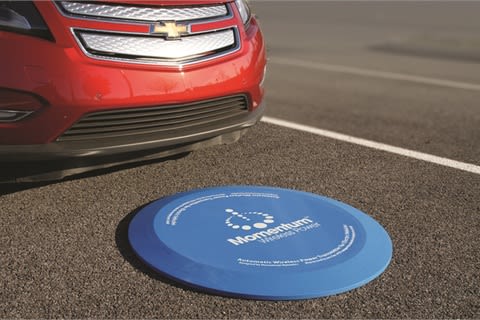
Momentum Dynamics has developed high power wireless chargers for multiple vehicles including passenger EVs and commercial EVs. Transmitters can be embedded within pavement or installed as a ground pad, as shown.
Andrew Daga, CEO of Momentum Dynamics Corporation offered this vision: “You’ll see wireless charging pads embedded in pavement in most public locations. They’ll be all-weather operable, priced on a different energy rate schedule, and revenue-sharing models will evolve to reward the owners of the transmitters. We’ll begin the move to incorporate dynamic charging in this period as well, and vehicles that are equipped with a wireless receiver will be able to charge while parked or while driving. I predict that more than 75 percent of commercial EVs will charge wirelessly in five years, and less for cars, but only because the automakers are prone to be slower adopters.”
Rebecca Hough, CEO of Evatran, creator of the Plugless L2, predicted: “Static wireless charging [which occurs while the vehicle is parked] is a gamechanging technology on its own, but it is also the first step toward dynamic charging. There’s a lot of buzz about this capability right now, but I would predict that the next five to 10 years will be focused on making this concept a reality. Pairing the ability to charge a vehicle wirelessly as it travels down the road with the development happening around autonomous driving could lead to a complete revolution in how we travel over the next 10 to 20 years.”[PAGEBREAK]
Growing a Customer Base
Despite all the possibilities of wireless EV charging, Navigant Research forecasts that wireless chargers will comprise less than 10 percent of the global EV charging market in 2022, with 301,000 wireless systems sold, compared to 4.3 million home and commercial EV chargers sold.
“There needs to be technology developed to increase compatibility with a wider range of vehicles, offering higher power capabilities, at a lower price point,” said Jerram of Navigant. “Right now, we’re seeing the greatest prospects for wireless chargers in the high-end market.”
Nonetheless, Daga of Momentum Dynamics pleads the case that wireless technology is inherently better than plug-in systems for developing common standards, to solve the compatibility issue, and make public charging infrastructure more affordable in the long run.
“Eliminating the plug and socket transfers the ‘compatibility’ burden from the physical interface to the electronic interface, which means that intelligent systems can be designed to interpret and adjust to meet the variable demands of multiple vehicle types,” Daga said. “It also means that the capability of wireless charging systems can be upgraded and improved over time by means of remote software upgrades. We are doing this today in our systems — not only monitoring all activity of the charging devices but also flash upgrading our firmware.”
And, as compatibility improves, so will scale, which is essential to justify investments in the public wireless charging infrastructure.
“Although [Evatran’s] Plugless L2 is built to withstand nature’s elements and can be mounted on either a garage wall or on a freestanding pedestal outdoors, public [wireless charging] infrastructure doesn’t make sense economically without a dedicated base of wirelessly equipped EVs,” said Hough of Evatran. “We’re beginning with residential and fleet recharging because these vehicles have dedicated charging needs on a daily basis. As we grow our customer base and wireless charging becomes the norm, public infrastructure will begin to transition to support this growing base of wirelessly equipped EVs.”
Originally posted on Automotive Fleet
More Vehicle Research
2027 Lexus NX Moves to Fully Electrified Lineup
For 2027, the NX moves to an entirely electrified lineup, with either hybrid or plug-in hybrid powertrains.
Read More →
2027 Mitsubishi Eclipse Sportback Named Green SUV of the Year
Green Car Journal recognized Mitsubishi’s new battery-electric crossover, which offers NACS compatibility and DC fast charging at up to 150 kW.
Read More →
Dave Carroll Named President of Ford Energy
Carroll succeeds Lisa Drake, who will remain with Ford through Dec. 31 to support the leadership transition.
Read More →
City of Long Beach Named No. 1 Green Fleet of 2026
NAFA's 2026 Green Fleet Awards recognized fleets for sustainability efforts spanning alternative fuels, technology, facilities, workplace culture and fleet operations.
Read More →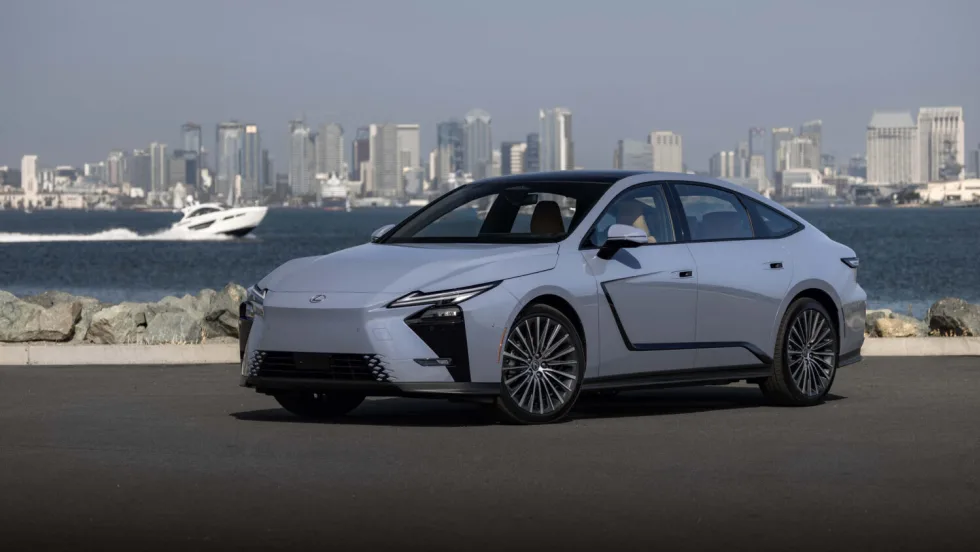
2027 Lexus ES Adds First Battery-Electric Models
The ES 350e and ES 500e join the hybrid ES lineup with up to 338 hp, an EPA-estimated 307 miles of range and standard NACS charging capability.
Read More →
EV Fleet Reality Check: What Operators Wish They Knew Before Electrifying Their Work Vans
Electric work truck upfits bring new compatibility questions. Learn how parts availability, OEM guidance, power demands, and route planning can affect fleet performance.
Read More →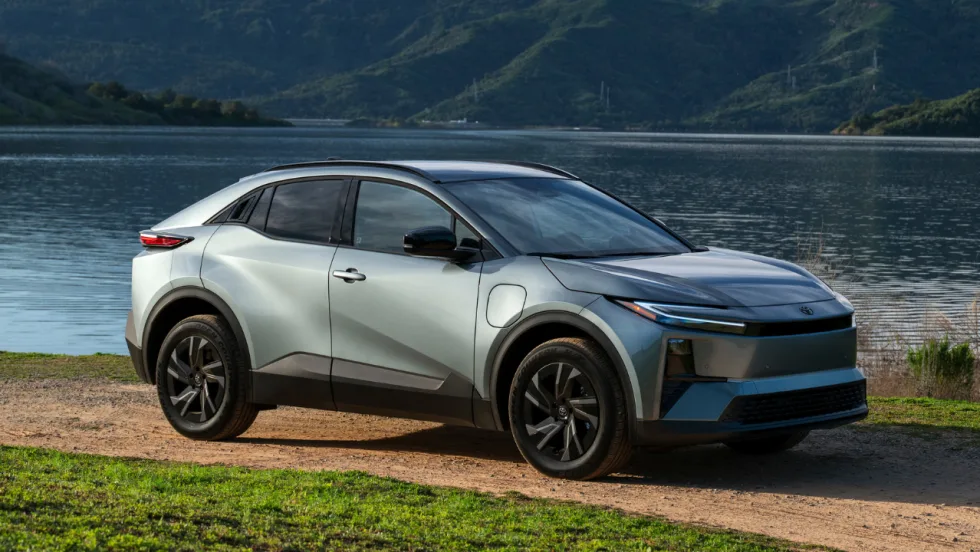
2027 Toyota C-HR Offers 287-Mile Range and Standard AWD
Toyota’s 2027 C-HR brings 287 miles of estimated range, standard all-wheel drive, and NACS fast-charging capability to the compact EV market. See what its mix of performance, cargo space, and everyday technology could offer business users.
Read More →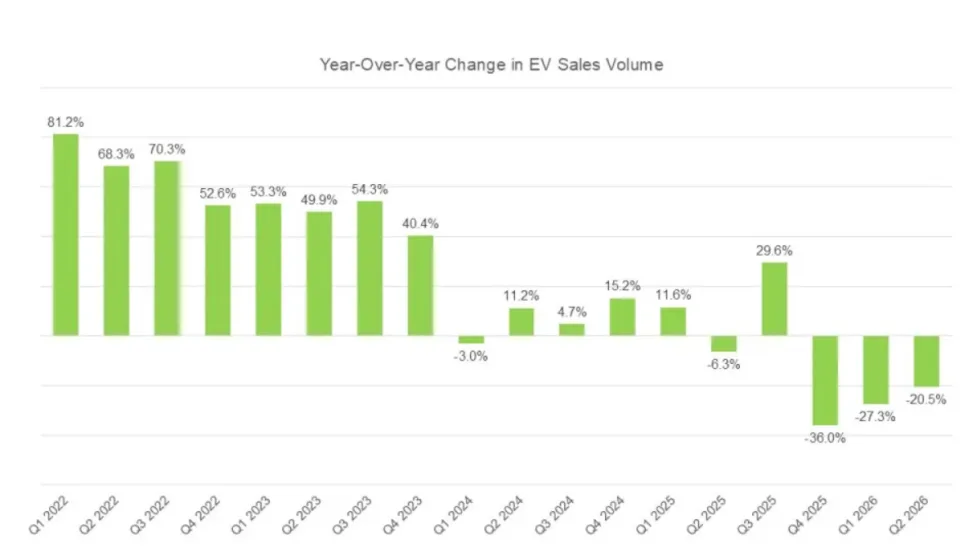
New Vehicle Models Stabilize Electrified Market In Q2
But more credit goes to hybrids than to all-electric vehicles, as more buyers look for fuel-efficient alternatives amid high gas prices.
Read More →
Slate Debuts Colorful, Unique EV Models
A recent media and client event, studded with electric vehicles dressed up on platforms, planted a new position for the manufacturer in the wider EV market. Fleets will find cost-saving advantages.
Read More →
Slate Electric SUV, Pickup Switchable Model Aims For Light-Duty Fleets
Everything about this EV is counterintuitive and understated, making it stand out from the crowd.
Read More →