



Related: Creating Data That Can Help Drive Electric Fleet Vehicles
Understanding Effects of Payload and Towing on Commercial EV Range
As fleet operators adjust duty cycles for commercial electric vehicles, they must consider weight, vehicle modifications, environment, and EV-specific factors. How will published and projected specs compare to the real world?
February 16, 2021

The Ford E-Transit has a maximum published range of 126 miles.
Photo courtesy of Ford Motor Co.
10 min to read
Electrification is finally reaching the commercial vehicle market, with launches of new electric truck and van models starting later this year and ramping up in 2022. These new choices are great for the market, fleet operators, and the environment.
But in contrast to the truck war upgrades with every new Silverado, F-150, or Ram 1500, electric propulsion performance is only beginning to be tested in the real world.
Commercial EVs will be relied on to replicate the jobs of the traditional trucks and vans they’ll replace. How will they perform carrying cargo or pulling a trailer?
Fuel economy on internal combustion engine (ICE) vehicles nosedives at peak payload or towing load, but we accept the trade-off because the overall range on those vehicles is more than enough. The first commercial EVs, however, will have expected ranges of only 20% to 35% of their ICE counterparts.
As fleet operators adjust duty cycles to EVs, they must consider a variety of factors that will affect actual EV ranges in the real world.
The Commercial EV Wave
A ripple of news on commercial EVs three years ago has turned into a wave of EV releases this year and next, from small cargo vans to larger Class 3 and 4 step vans on truck chassis.
Ford and General Motors are launching electric vans later this year. Mercedes currently sells an electric Sprinter in Europe. Independent automakers have permeated the market as well.
EV startup Canoo is making two electric delivery vans in two initial sizes for a limited launch in late 2022, with production ramping up in 2023. The MPDV1 has dimensions comparable to the Ford Transit Connect and Ram ProMaster City, but with more cargo capacity — 230 cu.-ft. — behind the bulkhead. The larger MPDV2 fits in the large van category (Mercedes Sprinter, Ford Transit) and offers comparatively substantial 450 cu.-ft. of cargo volume.
Three battery pack capacities will be offered: 40kWh (for an estimated 130 miles range on the MPDV1 and 90 miles on MPDV2), 60kWh (190 miles/140 miles), and 80kWh (230/190 miles).
The Class 1 urban delivery vehicle from Electric Last Mile Solutions (ELMS) is expected to have a range of 150 to 200 miles and a cargo capacity of 170 cu.-ft. Product launch is expected in the third quarter of 2021.
Cenntro Automotive Group, best known for its low-speed electric utility vehicles, unveiled plans in January to produce an electric Class 4 urban delivery vehicle with a top speed of 60 mph. The CityPorter is projected to offer a range of up to 220 miles and 636 cu.-ft. of cargo capacity.
Workhorse unveiled its C650 electric step van at the 2020 Work Truck Show. The C650 and C1000 will offer (you guessed it) 650 and 1,000 cu.-ft. of cargo capacity. The vehicles are powered by a modular battery pack system that will provide 35 kWh of power when equipped with two battery packs and 70 kWh in its standard four pack configuration, for range estimates of 100 and 150 miles.
Xos is testing its electric delivery trucks with UPS and cash management provider Loomis. The company’s modular battery pack system can be configured to accommodate a range of up to 250 miles.
Amazon has started testing its Rivian-made van for deliveries in January with wider deployment scheduled for this year, though details on battery, drivetrain, and range are scant.
The European electric Sprinter is equipped with a small 55-kWh battery, giving it a stated range of only about 90 miles. Mercedes is planning an all-new Sprinter that can accommodate both electric and ICE drivetrains that will have more room for batteries. It’s reportedly headed to the U.S. in 2023.
The BrightDrop EV600, the electric delivery van from GM’s new EV business unit, will have, yes, 600 cu.-ft. of cargo capacity and is projected to achieve a maximum range of 250 miles. BrightDrop isn’t yet divulging EV600’s battery specs, but it will use GM’s Ultium battery system that spans 50 kWh of available energy up to a massive 200 kWh, which theoretically offers 400 miles of range. BrightDrop will start delivering 500 of its new EV600 delivery vans to Fedex, its first customer, later this year.
The Ford E-Transit, headed to market in late 2021 for first customers, will come in three roof heights and two lengths. E-Transit’s single battery pack offers 67 kWh of usable energy for an expected range of 126 miles, though that range is for the low roof height model only.

Photo courtesy of BrightDrop.
EV Range Variables
These commercial EV manufacturers are publishing maximum payload capacities as well. For instance, the E-Transit offers up to 3,800 lbs. in the regular van and up to 4,290 lbs. for the cutaway version.
But with limited initial ranges of electric vans and trucks, it’s clear why manufacturers are targeting last-mile deliveries for first deployments. Urban and suburban environments welcome clean tailpipe emissions, delivery vehicles don’t require intricate — and heavy — upfits, their loads lighten as the day progresses, and they return to a depot to charge at night.
The typical payload of e-commerce deliveries may not be a range killer (they usually “space out” before they “weight out”) but many external variables will also affect range, just as they do for ICE vehicles. Those include payload (passengers, cargo, or tow trailers), wind resistance, road grade, driving style, speed, weather, and driving surface. EVs have added variables to contend with such as battery state of charge, battery and ambient temperature, and gradual battery degradation over time, which lowers maximum charge capacity.
Adam Berger — president of Doering Fleet Management and owner of 10 Teslas to date — says driving in winter hurts range 20% to 30% while excessive speed dings range by 10% to 15%.
Berger lays out a scenario of the potential drags on range: Imagine an electric van spec’d with a high roof and long wheelbase. Outside, add a pipe carrier and a galvanized steel ladder rack with two ladders and a small utility trailer to tow. Inside, add a set of racks, a bulkhead, tools, and equipment. Set off into the snow or hilly terrain. “Then turn the electric heat on,” he says.
This scenario describes applications beyond package delivery, but it’s not out of the ordinary. “That added weight won’t leave much of a range buffer,” Berger says.
EV manufacturers must balance the benefits and drawbacks of adding more battery capacity. “The difficulty is batteries are heavy, but not necessarily much heavier than engines and transmissions plus fuel,” Berger says. “Payload may be sacrificed in EV vans but not consequentially.”
An EV’s displayed range can be misleading, says Ed Sanchez, senior analyst at Strategy Analytics. “From a personal standpoint as an EV owner, I’ve just learned to charge for more than I think I’ll need for a given trip by about 25% to 30%.”
As an EV’s battery pack gets closer to depletion during a trip, available power and peak voltage delivered to the motor drops. For instance, a Tesla Model 3 has 450 peak hp at the drivetrain, but close to full drain that power drops to about 67 hp, according to Mark Hanchett, CEO and founder of Atlis Motor Vehicles, which is developing an electric heavy-duty pickup. “If this isn’t properly taken into account, then your driving experience can change drastically,” he says.
Sanchez explains that many electric automakers only utilize a portion of the vehicle’s maximum capacity when new, and gradually “unlock” charge capacity as the vehicle ages to deliver a consistent maximum range for the driver over the vehicle’s lifetime. “The most notable exception to this strategy is Tesla, which is upfront about battery degradation, and tells owners to expect it over time,” he says.
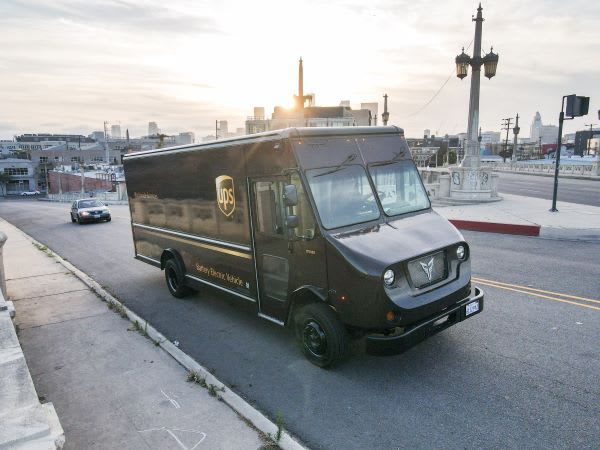
Photo courtesy of Xos.
Standards Needed
These real-world factors, however, aren’t necessarily baked into how automakers calculate maximum range.
Light-duty vehicles (both ICE and electric) that adhere to the U.S. Environmental Protection Agency (EPA) regulations on fuel economy are tested under controlled conditions in a laboratory and without excess payloads outside of the driver. These tests do not consider weights added to vehicles before any payload, such as ladder racks, rack-and-bin packages, and other vocation-specific upfits. There are no requirements to undergo additional testing or meet specific performance criteria under maximum load conditions.
Whether governed by EPA mpg regulations or not, all manufacturers test their vehicles for performance, fuel economy, and range to benchmark against competitors and formulate new product requirements.
Yet EV manufacturers never publish those numbers when fully loaded, Hanchett says. “At this point, the industry is concerned about peak numbers, not realistic performance.”
“I imagine at some point there will be a call for range calculation standardization for commercial EVs,” says Sanchez. “If not, there definitely should be. It’s a very confusing issue, and one that needs to be addressed and standardized.”
The range analysis for the BrightDrop EV600 was completed at half payload, GM confirmed. “We're testing for a lot of different scenarios,” said BrightDrop CEO Travis Katz. “I can't get into a lot of detail right now, but we're very confident in the 250-mile range.”
The Ford E-Transit was tested without payload to achieve the maximum published range of 126 miles. Ford confirmed that further tests of the E-Transit at various levels of payload — including max payload — put the range “well above the daily average of 74 miles per day” for likely customers running planned, pre-determined city routes in service and delivery applications.
While 126 miles is on the lower end of today’s commercial EV range spectrum, Ford has published specs and pricing for the E-Transit, which starts under $45,000 MSRP. This combination should be an indicator of a viable commercial EV in terms of functionality, range, price, and profitability. Other OEMs’ specs, pricing, and ranges are estimates at this point.
EVs and Towing
Though not a factor in delivery scenarios, towing reveals how extreme weights and aerodynamic impacts affect EV range.
Although we’re still in the early days of commercial EVs, as a broad rule of thumb any substantial towing or payload will effectively cut the vehicle’s rated range in half, Sanchez says. In some circumstances Berger says towing can cut EV range by as much as 80%.
Berger has firsthand towing experience with his Tesla Model X. Yes, a Model X can tow: It has a respectable 4,960 lbs. tow limit, is prewired for a trailer brake controller, levels the suspension automatically, and turns off the car’s rear proximity sensors during towing. (Audi e-tron is also tow-rated, with a published capacity of 4,000 lbs.)
Berger towed a sailboat with a total trailer setup of 3,200 lbs. starting with 150 miles on the range estimator. After a 15-mile trip he arrived with 31 miles to spare.
While the anxiety of watching range plummet was real, his companion following in a three-quarter ton diesel pickup was unable to pass the Model X. “It was a pleasure to drive and smooth as can be,” Berger says. “I enjoyed the doubletakes along the way from the few dozen cars I passed.”
In a more extreme scenario, TFL (The Fast Lane) Truck guys used a Model X to tow a 4,500-lb. trailer over the Ike Gauntlet, an eight-mile stretch of I-70 near Denver at a 7% grade. The tow required 58 miles of range to go those eight miles, or more than seven times the energy consumed without towing.
The TFL testers have completed hundreds of towing torture tests. And like Berger, the experience was a pleasure. They reported the quickest uphill towing they’ve ever experienced, along with excellent torque and stability.
While towing with a commercial EV shouldn’t provoke angst when cresting a 7% grade, finishing with enough range will, particularly with smaller battery capacities.
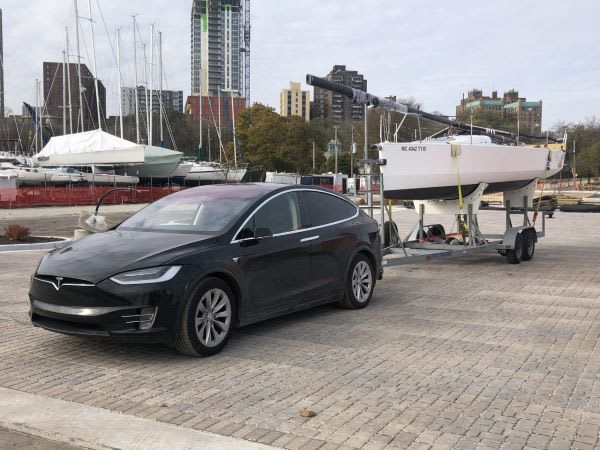
Photo courtesy of Adam Berger.
A Worthy Tradeoff
Fleet first adopters will have to reevaluate their duty cycles to match the limited ranges of the first commercial EVs. With vehicle modifications and a host of external influences, operators will have to make sure they have enough juice for the task — and even then, a safe buffer calculated on paper may diminish range further with real-world experience.
In certain applications — particularly last-mile package delivery — the tradeoff is worth it, as fleets will more quickly recoup EVs’ benefits of uptime, operating costs, and environmental sustainability. And a sacrifice in range does not come with a sacrifice in performance.
Berger puts the present-day tradeoffs into historical context: “Six plus years ago when we dove into EVs, it was unclear how fast things would transition. Today the immediacy is high, and the inevitability is absolutely clear. Those with their heads in the sand, from OEMs and dealers to government agencies and company owners, will lose. Now is the time to adopt, understand, and evolve — or die.”
Topics:Commercial Electric VehiclesElectric Last Mile SolutionsElectric VansCanooTesla Model XElectric VehiclesSuppliers
Originally posted on Automotive Fleet
Subscribe to Our Newsletter
More Electric Vehicles
EV Charging Use Is Outpacing Infrastructure Growth
ChargePoint’s 2026 Charging Forward Report points to rising charger use, higher-powered charging, commercial vehicle electrification, and energy-management technology. Here’s what fleets should know.
Read More →
EV Realty Names Henrik Holland President as Charging Platform Expands
The former Prologis Mobility and Shell executive will help expand EV Realty’s truck charging business and move its power-first infrastructure model into autonomous vehicle depots and other fleet sectors.
Read More →
GreenPower Expands New Mexico EV Pilot With Larger Buses, V2G Testing
After logging more than 17,000 electric miles in the first year, New Mexico’s statewide pilot is moving into its second phase with larger vehicles, continued charging evaluations, and more.
Read More →
Can EV-as-a-Service Help Fleets Scale Electrification?
Sustainability Partners CEO Adam Cain explains how matching EVs, charging infrastructure, and duty cycles can help fleets scale electrification.
Read More →
How EV-as-a-Service Is Moving Fleets Beyond Pilots
Adam Cain, president and CEO of Sustainability Partners, explains how EV-as-a-service can help fleets scale deployments by addressing duty-cycle requirements and charging challenges.
Read More →
PowerFlex, The Mobility House Join Forces to Advance Fleet Electrification
Two EV charging providers are joining forces to deliver a broader portfolio of energy management and fleet electrification solutions.
Read More →
Ford Retools Louisville Plant for Fathom Electric Truck Production
Ford's $2 billion Louisville Assembly Plant overhaul introduces a three-part assembly process for the Fathom midsize electric truck, with production scheduled to begin in 2027.
Read More →
Merchants Fleet Reports 290M EV Miles as Fleets Navigate Changing Electrification Market
From millions in operating savings to hundreds of millions of EV miles, Merchants Fleet’s latest report reveals what’s working and what’s changing in fleet electrification.
Read More →
California District Commits to Electrify 25% of School Bus Fleet by 2028
One of the nation's largest school bus electrification projects to date demonstrates how grants, charging infrastructure, and public-private partnerships can help fleets transition to EVs at scale.
Read More →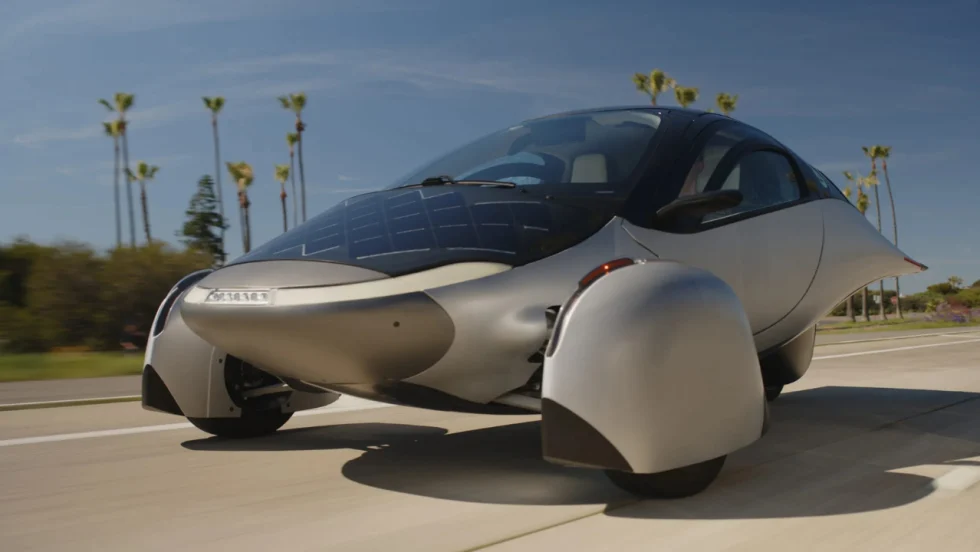
Aptera Orders Bodies and Chassis for Its First 40 Production Vehicles
Aptera Motors Corp. has issued purchase orders for the major structural components of its first 40 vehicles, and body and chassis components are expected to begin arriving in October.
Read More →