


Safelite Autoglass Pilots the Chevrolet Volt
The company leased 18 Chevrolet Volts as part of a pilot program to see if the vehicle would help reduce fuel spend and greenhouse gas emissions in the sales and repair segments of its fleet. The results have been positive so far.

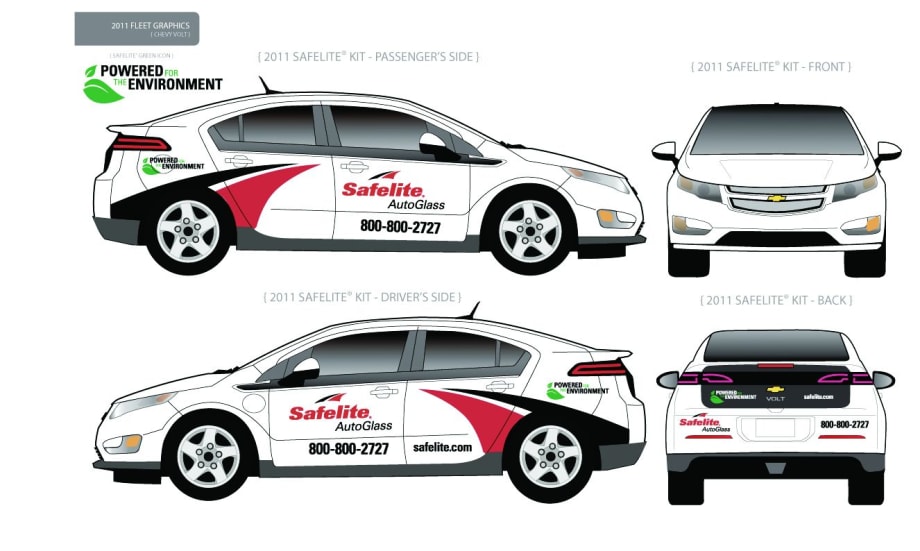
Shown above are different angles of the Chevrolet Volt with the Safelite AutoGlass branding. Safelite AutoGlass tested the Volt in a pilot program in an effort to help reduce fuel consumption.
Shown above are different angles of the Chevrolet Volt with the Safelite AutoGlass branding. Safelite AutoGlass tested the Volt in a pilot program in an effort to help reduce fuel consumption.
As fuel price volatility continues to be a cost-containment challenge fleet managers must grapple with, vehicle selection becomes more important than ever. Safelite AutoGlass, an automotive glass repair and replacement company with global operations, has undertaken a number of measures to reduce fuel spend while meeting corporate sustainability goals. These measures include testing the Chevrolet Volt in a pilot program to determine potential applications for the vehicle in one of the company’s fleet segments.
Erin Gilchrist, fleet manager for Safelite AutoGlass, shared how these changes are helping contain fleet costs from a corporate sustainability standpoint.
Cutting Back on Fuel
In 2011, the Safelite AutoGlass fleet drove more than 152 million miles and consumed more than 10.4 million gallons of fuel, according to Gilchrist.
“With that in mind, some quick math can tell what that looks like from a cost and greenhouse gas (GHG) emissions standpoint,” Gilchrist said. “So, it makes sense for us to be thinking about what we can do to reduce [fuel] consumption, and there are a lot of different ways we’re doing that."
Gilchrist said the company looked at a few different vehicle types before deciding to run a pilot program with the Chevrolet Volt.
“We thought about hybrids, but some of the analysis we’ve done shows they come out at a higher cost per mile than the gasoline engines with higher mpg ratings,” Gilchrist said. “That’s not to say we won’t go down that road as well with the fleet, but we started with electric and plug-in hybrid electric vehicles.”
Safelite AutoGlass’ choices came down to two vehicles for the pilot: the extended-range electric Chevrolet Volt and the fully electric Nissan Leaf.
“Our game plan was to test Chevrolet Volts and Nissan Leafs in our fleet environment to see if there is a potential to roll them out on a wide scale,” Gilchrist said. “After further consideration, we chose to pilot the Volt due to its extended-range electric vehicle capabilities.” When the battery energy is depleted, the Volt seamlessly transitions to extended-range mode. Power is inverted from a 1.4L 63-kW (84-hp) gasoline-powered onboard engine to the electric drive unit to provide up to 344 additional miles of range.
Leasing the Volts
To launch the pilot program, Gilchrist and her associates at Safelite AutoGlass contacted GE Capital Fleet Services, which has been working with electric and plug-in hybrid vehicles.
“We worked with our fleet management companies (FMCs) to see if there was one particular company that was focusing on electric vehicles (EVs),” Gilchrist said. “We work with all the FMCs from a strategic consulting standpoint, from vehicle leases to certain programs we use to manage our fleet.”
Safelite AutoGlass leased 18 Volts through GE Capital Fleet Services (via a terminal rental adjustment clause, or TRAC, lease). GE is also helping collect vehicle use data in order to better project total cost of ownership (TCO) for these vehicles. So far, Gilchrist said there are a few applications in Safelite AutoGlass’ fleet segments the Volt can meet.
“We’re using the EVs in our sales and repair fleets,” Gilchrist said. “A salesperson averages 2,300 miles per month, while a repair technician averages just below that. We chose these two profiles of our fleet based on the average miles driven, the nature of their job, and the vehicle category suitable for these applications. Our dedicated repair technicians carry a repair kit and vacuum and are not required to haul glass or heavy tools, making it possible for us to pilot the Volt in this profile.”
Gilchrist said the leasing terms are currently flexible, due to this program being a pilot. She said that without knowing how long to keep the vehicle before remarketing it, among other calculations, testing was crucial to determining how to maximize utility and minimize TCO.
“We put these vehicles on a longer lease term to gather data,” Gilchrist said. “It was difficult to determine when in the depreciation schedule we would want to remarket the vehicles. We weren’t sure what kind of mpg we would be getting, or what the maintenance costs would be, which are fundamental to TCO calculation.”
Looking Good So Far
According to Gilchrist, the Volts went on the road between mid-May and July 2011. So far, she said the program’s results are fairly positive, with average mpg in the upper 50s.
“We hope to see the mpg number increase as we get accustomed to operating this vehicle in the fleet,” she added.
Safelite AutoGlass operates more than 6,000 vehicles and was ranked No. 53 on AF’s Top 300 Commercial Fleets in 2011.
Originally posted on Automotive Fleet
More Suppliers

Slate Debuts Colorful, Unique EV Models
A recent media and client event, studded with electric vehicles dressed up on platforms, planted a new position for the manufacturer in the wider EV market. Fleets will find cost-saving advantages.
Read More →
Slate Electric SUV, Pickup Switchable Model Aims For Light-Duty Fleets
Everything about this EV is counterintuitive and understated, making it stand out from the crowd.
Read More →
Polestar Barred from U.S. Market Under Connected Vehicle Rule
The automaker loses its authorization to sell new vehicles in the U.S., starting with the 2027 model year. Polestar owners will retain access to the brand's service network.
Read More →
Uber, Nuro and Lucid Plan Houston Robotaxi Service in 2027
The tripartite venture brings out the combined advantages of electric vehicles, mobility, and autonomy into ground transportation.
Read More →
Electrify America Opens EV Fast Charging Station in Southern California
The large-format depot features 20 hyper-fast chargers capable of delivering 350 kilowatts and is backed by a powerful battery energy storage system.
Read More →
Inspiration Mobility Acquires Key Electrada Assets
Inspiration Mobility Group has acquired select assets of Electrada, adding the fleet electrification provider's team, technology, and charging infrastructure development capabilities to its energy management business.
Read More →
Lucid Adds Hands-Free Highway Driving, Software Updates To Gravity SUV
Hands-free drive assist makes highway driving more comfortable while keeping drivers attentive to the road.
Read More →
Harbinger Creates Hybrid-Electric Unmanned Vehicle Platform for Defense Use
The platform is based on the company's medium-duty plug-in hybrid chassis, which is also used in commercial vehicles.
Read More →
Mitsubishi To Debut All-Electric Eclipse Subcompact For North American Market
The 2027 Mitsubishi Eclipse Sportback is a small SUV that will go on sale by this fall.
Read More →
Stellantis To Build Smaller, Affordable EVs For European Market
Stellantis aims to expand access to urban EV mobility in Europe and address the decline in the smaller-vehicle segment.
Read More →