DTE Energy has invested in simulators, training videos, and more to ensure its drivers are prepared for any situation.
Lexi Tucker・Former Senior Editor
May 3, 2021
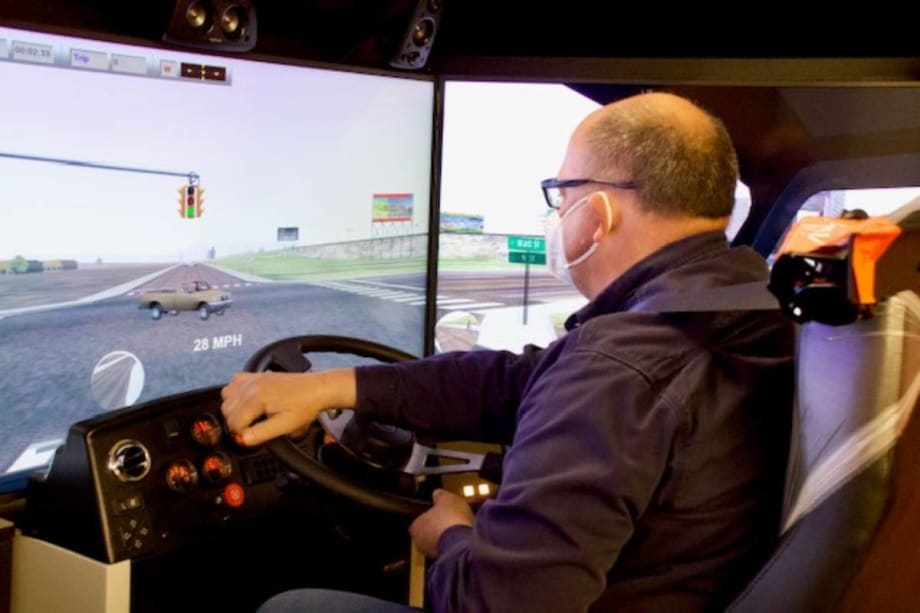
Simulators are an excellent tool to improve driver performance and more quickly pre-pare drivers for challenging situations in a typical work environment.
Photo: DTE Energy
4 min to read
“Safety first” has become somewhat of a trite catch phrase for many operations. When it comes to putting those words into practice, how far will they actually go? DTE Energy recently purchased simulators to take its training program one leap further, enabling it to provide drivers with hands-on experience without the added threat of actually putting them in harm’s way.
Investing in Professional Development
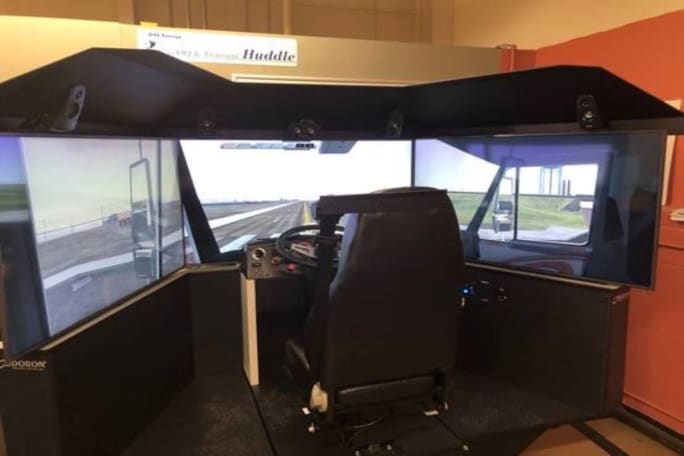
After benchmarking other industries, DTE’s cross-functional vehicle safety team decided on two types of simulators: the Doron Industries 550 Plus and John Deere multi-use simulator model 310SL. The first is for its CDL drivers, and the second is for construction crews. Fleet and DTE’s Learning and Technical Development team worked together to find the right products, then proceeded with procuring the devices.
Ad Loading...
Amy Joyce, director of fleet, says the decision to purchase the simulators is one example of how the company is partnering with its Learning and Technical Development team to integrate vehicle safety into its new hire and ongoing curriculum for employees. The simulators allow the company to train new employees and provide refresher training for existing employees in a safe way.
“This way, we can create virtual examples of potentially hazardous situations and train on response and avoidance without putting our employees in any real danger. This enables us to build muscle memory without jeopardizing personal safety,” she explained.
“We also know training that is memorable and directly applicable to one’s work is something that supports continued application. Many of our drivers are experts in their field working on gas and electric distribution systems. They are hands-on, skill-based employees who excel in practical approaches,” Joyce said.
Preparing for Challenges
Anthony Battle, technical training manager, said he believes simulators are an excellent tool to improve driver performance and more quickly prepare them for challenging situations in a typical work environment.
“We use simulators in a multi-modal, blended approach to learning so we can safely reduce the learning curve while at the same time providing situationally-based content that would take significant effort and time in the field,” he explained.
Ad Loading...
The company has developed the Bucket Truck Confidence Course to help new and less experienced drivers. It is a confined area road course with a series of 11 obstacles to maneuver. Each represents situations a driver might encounter in a typical day. Scoring is recorded on a proficiency checklist with comments, with points being deducted for items such as lane encroachment, moving cones, safety etc. There are no pass/fail criteria. The intent is to identify positive areas and those requiring improvement, and the underlying goal is to provide coaching and build confidence and skills with drivers.
Simulators have been successfully deployed in other industries (e.g., airlines, heavy equipment) for many years, and have proven to be a key tool in the learning process. When deployed strategically as an element of a fully blended learning program, they can prove exceptional value.
Other technology, like VR and AR, have also moved into the market as a viable option, each with a price-point and technology evolution to be considered. Learners must be engaged and part of the learning environment, using various methods (blended learning) to maintain interest, develop skills, and enhance learning.
“Unlike previous generations, people entering the workforce today are adept with many forms of digital tools and gaming, and simulations are a natural extension of these experiences. Our employees are not only professional trades people, but professional drivers as well. Our goal is to support all methods to provide them with knowledge, skills, and experience to be successful and safe in the work environment and beyond,” he said.
Simulators allow the company to train new employees and provide refresher training for existing employees in a safe way.
Photo: DTE Energy
Keeping Training Relevant
The company has created short videos using its own employees that have been effective communication tools, especially during the pandemic. These videos reach all employees, whether they are digital or field workers. In addition to videos highlighting safety features of vehicles, the company also films employees’ personal stories about how a motor vehicle incident or distracted driving has impacted them.
Ad Loading...
“We also use employees to demonstrate how to properly conduct a 360-degree walkaround of vehicles, disinfect touch points before and after use, etc. Basically, we try to use multi-media approaches to reach the right employees in a way that will resonate with them and keep repeating the messaging on these critical safety topics,” Joyce explained.
DTE’s Corporate Safety team, in conjunction with its Corporate Communications team, lays out an annual communication plan for vehicle safety. For example, it dedicates April and May safety stand-ups with every employee focused on vehicle safety. This is accompanied by movie-themed posters, tips, and lessons learned via other media channels. It also measures and reports vehicle safety metrics like crashes per million miles and motor vehicle accidents on a weekly basis to the CEO and tiered safety teams.
A Focus on Safety Initiatives
The company’s Vehicle Safety Committee is a cross-functional team that creates a strategy of initiatives based on the data it analyzes around motor vehicle incidents. It works to solve root causes of accidents to drive the number of those incidents down, keep employees and the public safe, and reduce risks.
For 2021, DTE is focused on the following:
Enhanced incident investigation protocols – getting to the root cause with data and leveraging union and management involvement.
Enhanced driver training – including the use of simulators and obstacle/confidence courses.
Driver feedback enhancement – establishing talking points or a framework for leaders designed to improve driver coaching and conduct effective conversations. The company will also be recommending driver recognition programs for those who have great performance.
Execution of an electronic DVIR for ease of tracking – establishes a more efficient way for in-house mechanics to receive notice of vehicle defects, resultant corrections, and sign off.
Technology pilots – utilization of camera technology and driver feedback. The camera technology can help drivers “see” better, especially in multi-vehicle configurations. Driver feedback applications provide alerts relative to the environment around the vehicle and allow the driver to make an immediate correction.
Driver record and licensing expansion –to non-CDL drivers to reduce risks and liabilities.
As fleets electrify, charging capacity does not always arrive on the same timeline as the vehicles. Operating data from one Xos Hub shows how mobile, grid-independent charging can support vehicles when permanent infrastructure or utility upgrades aren't available.
The installation can charge up to 20 rental vehicles simultaneously and uses overhead equipment to preserve ground-level space at the airport's Quick Turnaround Facility.
Octopus Charge allows EV drivers to locate and access public charging stations through a single app, building on the company's Electroverse platform in Europe.
Schneider Charge uses integrated SmartAmp technology to adjust charging output based on household electrical demand and is available with NACS or J1772 connectors.
GridLink CEO Josh Silets explains what causes EV chargers to fail, why fleet operators often struggle to identify the source, and what questions they should ask charging vendors.
The integration gives GM EV drivers access to additional DC fast chargers and Level 2 stations through a single app while expanding the automaker's public charging ecosystem.
How do you successfully operate an all-electric rental car fleet? Whether you manage a rental fleet or another commercial fleet, this conversation offers practical lessons on deploying, operating, and scaling electric vehicles.
A seamless charge depends on a string of independent companies getting it right together, every time. How can electric fleets navigate the challenges to create a successful charging plan?