



More Reading: 9 Trends from 2022 Work Truck Week
Designing Trucks of the Future
Truck experts from Navistar, Volta Trucks, EAVX, and Work Truck Solutions discuss how aerodynamics, ergonomics, safety, and new technologies will be integrated into future truck cabs, chassis, and bodies.
January 31, 2023
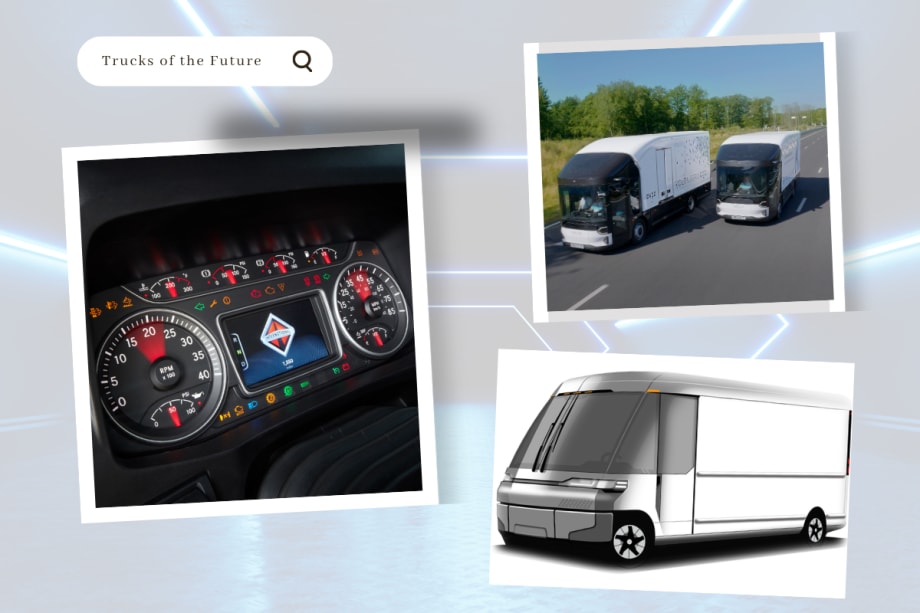
The difference in electrical needs for electric trucks is one of the many consideration for new vehicle bodies.
Photos: Volta Trucks, Navistar, EAVX/Canva
6 min to read
When designing a truck of the future, how will components like aerodynamics, ergonomics, safety, and technology applications be integrated into future truck cabs, chassis, and bodies?
As manufacturers try to keep up with the evolving market, there is pressure to move quickly to bring new powertrain products to market.
At the 2022 Fleet Forward Conference, a panel of experts shared insights on how their companies are facilitating the path to all-electric vehicles – and eventually autonomous vehicles.
“The challenge right now is integrating these new powertrains,” said Laura Ricart, chief of vehicle performance integration at Navistar. “Diesel and gasoline have been around for so long that we already have tons of ratings on rear axles and body length. We can basically make the decision on the vehicle at the point of sale to the customer. EVs are very different. We have to understand what the customers are doing with the vehicles.”
Use Cases
At Navistar, the company offers a range of different types of chassis, including an electric powertrain. The fully electric International eMV is a work truck that can be built as a box truck, a boom truck, or however the customer needs its truck designed, according to Ricart. Navistar also offers its electric bus (E bus).
“A lot of our work is really understanding what the vehicles are doing day to day at the different customers that we supplied,” said Ricart. We have to understand how factors like weather and driver usage are impacting the vehicle. We can’t provide just a single mile range number. We have to give ranges of when it’s cold. Or if you haven’t preconditioned your battery, you could lose this much range.”

A Fleet Forward Conference panel of Kathryn Schifferle, Work Truck Solutions; Julie Johnson, Volta Trucks; Mark Hope, EAVX; and Laura Ricart, Navistar, discussed the many considerations for future truck builds.
Photo: Ross Stewart, RMS3Digital
For the E bus, it’s a fixed body. Different customers will add accessories such as stop signs or other items needed for municipality. However, the eMV is more complicated because of the high diversity of use cases among its customers. Customers have included Hollywood Studios that want to use the electric vehicle on location as an air conditioner for the crew. In this case, it basically just idles for 10 hours without the noise factor, according to Ricart.
“All of our eMV customers have been unique,” she said. “The key is working with them and trying to get as much data as we can as quickly as we can, so we can basically present to them the range of the battery set that we have. Or we can tell them that they need to upgrade to the higher range battery.”
Launched in 2019, Volta Trucks has designed a 16-ton electric straight truck using Meritor’s electric motor and the Proterra-powered battery. Currently, the Swedish company is mainly based in the U.K., where the truck was designed and testing is being done. The company plans to go into series production next year.
“It takes putting a truck into an operation to really start to gain the insights,” said Julie Johnson, who works in market development and growth strategy for Volta Trucks. “We really don’t have history today. By putting a truck into your operation, we can do a lot of mapping and take geography and weather conditions into consideration.”
Software, Aerodynamics & Safety Integrations
Because EVs are different, companies like EAVX are looking at how to make the truck body more suitable for electrification.
“With the software, the bodies have to become more intelligent,” said Mark Hope, chief operating officer and general manager of EAVX. “We have to think about how we interface with the chassis from an electrical standpoint and a communication standpoint. Then you’re starting to drive in more safety control systems.”
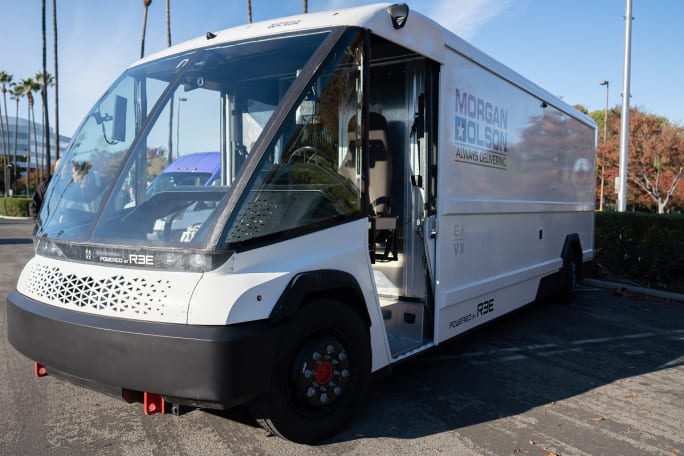
The Proxima Class 5 step van, powered by REE and with an EAVX/Morgan Olson body, will be designed for both electric and internal-combustion powertrains.
Photo: Ross Stewart, RMS3Digital
EAVX, a division within JB Poindexter & Co., partners with electric and alternative power chassis producers to design and manufacture commercial vehicles. Founded about two years ago, EAVX collaborates with companies like Navistar to design truck bodies and accessories that match the company’s technology.
As the truck bodies become more intelligent and have autonomous features, that means more data will be flowing through the body, according to Hope.
“We get to do things with a [electrical] body that we couldn’t necessarily do with a traditional truck body,” said Hope. “All of the design is driven around improving safety, efficiency, and communication.”
At Navistar, each electric vehicle is sold with its own telematics device. With its software tools, Navistar tries to simulate how much battery power the vehicle should be consuming.
“When trying to figure out how much power the vehicle should be consuming, we were coming in a bit too high,” said Ricart. “Because we were using this average velocity, the drag was higher the slower the vehicle was going. Once we figured this out, we put in a recorder, got more data, and then were able to confirm what we believe the vehicle should be consuming.”
For its all-electric cab, Volta Trucks has created a design that’s focused on safety. The central and low driving position provides a 220-degree range of visibility. And sliding doors and a low step provide smooth entry in and out of the cab, according to Johnson.
Future Projects, Challenges
Because of the Advanced Clean Trucks (ACT) regulation, many big fleets are looking to start electrifying their vehicles. The regulation ensures that more zero-emission electric trucks are sold each year. According to Ricart, Navistar has around 100 companies that are the first takers running its electric vehicles, mostly in California and Canada (where there are more incentives to go electric).
EAVX is working on its new walk-in step van body called Proxima, which will be designed for both electric and internal-combustion powertrains. Additionally, Hope said that the company will be paying attention to different use cases, especially utility municipal markets.
“We’re going to have to look at ways of electrifying the worksite,” said Hope. “It’s more than just the EV chassis; it’s going to probably expand into full EV body and chassis and exportable power. I think that’s going to be where the next challenge will be for us.”
Another potential challenge is how to plug in something from the body into the truck, such as a reefer unit. How will that impact the battery in the electric chassis? Hope said that this will be a challenge since the battery systems on the chassis are usually designed for the driving duty cycle of the use case. How will companies like EAVX, Navistar, or Volta Trucks package new battery systems? And where can they put it on the truck body?
For Johnson, the future of electrifying vehicles is about prepping the aftermarket support and collaborating with multiple markets.
“After the purchase of the vehicle, we’ve got a great customer and everybody is committed, but that’s just the front end,” said Johnson. “Then it’s the interoperability of the vehicles and the chargers. It’s making sure that we have the right players and people together when you go into a deployment dynamic because you’re dealing with multiple engineering teams from different companies. And when things go wrong, you need to try to figure it out and pinpoint what really triggered it.”
Originally posted on Automotive Fleet
Subscribe to Our Newsletter
More Electric Vehicles

EV Charging Use Is Outpacing Infrastructure Growth
ChargePoint’s 2026 Charging Forward Report points to rising charger use, higher-powered charging, commercial vehicle electrification, and energy-management technology. Here’s what fleets should know.
Read More →
EV Realty Names Henrik Holland President as Charging Platform Expands
The former Prologis Mobility and Shell executive will help expand EV Realty’s truck charging business and move its power-first infrastructure model into autonomous vehicle depots and other fleet sectors.
Read More →
GreenPower Expands New Mexico EV Pilot With Larger Buses, V2G Testing
After logging more than 17,000 electric miles in the first year, New Mexico’s statewide pilot is moving into its second phase with larger vehicles, continued charging evaluations, and more.
Read More →
Can EV-as-a-Service Help Fleets Scale Electrification?
Sustainability Partners CEO Adam Cain explains how matching EVs, charging infrastructure, and duty cycles can help fleets scale electrification.
Read More →
How EV-as-a-Service Is Moving Fleets Beyond Pilots
Adam Cain, president and CEO of Sustainability Partners, explains how EV-as-a-service can help fleets scale deployments by addressing duty-cycle requirements and charging challenges.
Read More →
PowerFlex, The Mobility House Join Forces to Advance Fleet Electrification
Two EV charging providers are joining forces to deliver a broader portfolio of energy management and fleet electrification solutions.
Read More →
Ford Retools Louisville Plant for Fathom Electric Truck Production
Ford's $2 billion Louisville Assembly Plant overhaul introduces a three-part assembly process for the Fathom midsize electric truck, with production scheduled to begin in 2027.
Read More →
Merchants Fleet Reports 290M EV Miles as Fleets Navigate Changing Electrification Market
From millions in operating savings to hundreds of millions of EV miles, Merchants Fleet’s latest report reveals what’s working and what’s changing in fleet electrification.
Read More →
California District Commits to Electrify 25% of School Bus Fleet by 2028
One of the nation's largest school bus electrification projects to date demonstrates how grants, charging infrastructure, and public-private partnerships can help fleets transition to EVs at scale.
Read More →
Aptera Orders Bodies and Chassis for Its First 40 Production Vehicles
Aptera Motors Corp. has issued purchase orders for the major structural components of its first 40 vehicles, and body and chassis components are expected to begin arriving in October.
Read More →