Creating Data That Can Help Drive Electric Fleet Vehicles
Business intelligence analysis provider Utilimarc is setting up the process to field detailed information on running electric vehicles in large fleets.
Utilimarc uses the information to provide customers with industry benchmarks and live analysis empowering fleets to understand total cost of ownership for electric vehicles as well as baseline comparisons with fuel powered vehicles.
Photo: Utilimarc
As electric vehicles gain in range and numbers of models, they will hit a critical mass in fleets that can generate reliable data on how they perform and how much they cost to operate.
One company positioning itself to collect such data is Utilimarc, a firm and platform that analyzes fleet data. Utilimarc uses the information to provide customers with industry benchmarks and live analysis empowering fleets to understand total cost of ownership for electric vehicles as well as baseline comparisons with fuel powered vehicles.
Ad Loading...
Utilimarc includes a tech staff that sits on top of existing data streams, such as telematics, enterprise resource planning systems, fuel cards, drive cameras, and fleet management systems. Although the company provides a telematics product and is a reseller for Geotab, it focuses more on managing the business intelligence of intersecting data points for a fleet operation.
“All of these data systems do fantastic jobs, but most of the time the data is very siloed or difficult to integrate or cross-tab,” said Christopher Shaffer, founder and CEO. “It’s a challenge to layer this data to a single analytical environment.”
Clearing Way For EV Data
To that end, Utilimarc on Dec. 9, 2020 announced a new integrated business intelligence platform that creates a cohesive place for its fleet benchmarking, analytics and lifecycle applications so it can provide complete data services for enterprise fleets. It bridges the gap between siloed data streams and the insights needed for smarter fleet management.
Shaffer sums up the process as clearing and cleaning all the data to make it reliable and accurate. “We are data-stream agnostic. We give you that flexibility to bring all the data into the environment.”
Utilimarc’s approach carries deep potential for electrified fleets, since recent and future electric vehicles will have API connections that allow for systems to transmit and collect data. Utility companies and municipal and government fleets, which are Utilimarc’s primary clients, will increasingly need to handle data feeds provided via API connections embedded by the vehicle manufacturers, Shaffer said.
Ad Loading...
With electric vehicles, most telematics and data providers focus on the front end metrics, such as capital costs, fuel savings, range and charging capabilities, he said.
“What we’re trying to do is take it all from that point and move it forward and see how it affects the entire fleet organization as a whole.”
Utilimarc CEO Chris Shaffer sums up the process as clearing and cleaning all the data to make it reliable and accurate. “We are data-stream agnostic. We give you that flexibility to bring all the data into the environment.”
Photo: Utilimarc
Fielding Data Points
Such an approach can yield insights not yet fully realized, given the relative newness of viable electric fleet vehicles and short time in fleets so far. Connections among a broader array of data can pinpoint total cost of ownership and predict replacement cycles, Shaffer said. The key is to align EV data and future available analytics.
“If you have 1,000 trucks, when does the math tell us to replace them?” Shaffer said. “No one knows the maintenance costs for the next 10 years. How many technician labor hours will be needed? We could tell you for every year a vehicle ages how many labor hours are needed. No one knows yet for EVs the complexities of availability, downtime, technical labor hours, replacement and life cycles. These are real big challenges that no one has the answers to.”
New Data Info
So far, the primary data on electric vehicles come from passenger vehicles that have been on the market less than 10 years.
Ad Loading...
“We deal with fleets for utilities and municipalities,” Shaffer said. “What they really need are work trucks, pick-up trucks and vans that will transform the industry. Many utilities have committed to putting light duty electric fleets in place by 2030. Once the electric pick-up truck is available, such as the Ford F-150, it will be a game changer.”
ICE and electric vehicles bring different usage patterns so far, he said. EVs are not being driven as much as ICE vehicles or in the same way, given concerns about range or lack of accumulated information on their performance. “You need to find a way to get those vehicles to be used, or you won’t gain any benefit.”
Despite ranges rising, users still are not entirely educated and comfortable with such a big change from ICE to electric mode, and either avoid EVs or don’t drive them as often, Shaffer said, based on observing client fleets that average about 2,500 vehicles.
“Data provides the assurance you can use EVs the same way,” he said. “No one has seen a full electric pick-up truck go to work every day. We think we know, but the reality is no one knows how vehicles will perform in a true work environment.”
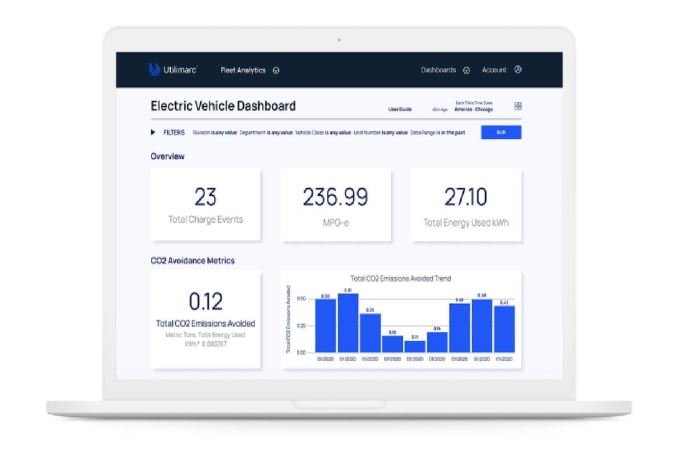
Utilimarc on Dec. 9, 2020 announced a new integrated business intelligence platform that creates a cohesive place for its fleet benchmarking, analytics and lifecycle applications so it can provide complete data services for enterprise fleets.
Photo: Utilimarc
Detailed EV Metrics
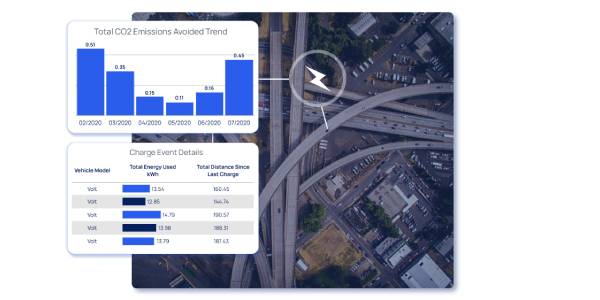
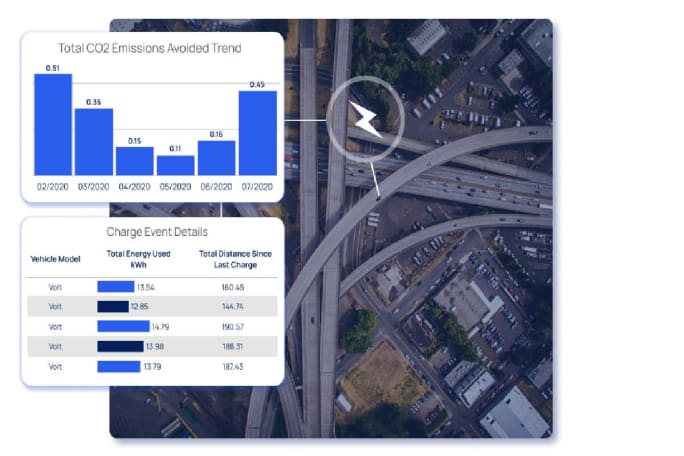
By providing performance analytics on electrified fleets, Utilimarc can report ROI insights on different makes and models, so managers can compare them in terms of costs, lifecycles, durability, maintenance needs, power consumption, emission reductions, range, and depreciation. “We can benchmark your fleet EV performance against peers.”
Ad Loading...
And by evaluating electric consumption, Utilimarc can also accurately track kilowatt hours and charging demand, which would be of interest to the utilities in assessing overall grid demand.
A Big Data Tent
Utilimarc focuses on two main fleet niches, utility and utility construction, and municipal government fleets. Shaffer prefers these sectors as opposed to corporate passenger fleets because they generate deeper data on a wider variety of EVs, including larger working vehicles, and are more challenging and rewarding to evaluate. Such fleets operate everything from lawn mowers, to pumper trucks, to refuse side loaders.
As early adopters, these sectors remain committed to long-term electrification.
“Electrification of those fleets will be fascinating for use cases. Those vehicles suit our platform very well.”
Utilimarc monitors about 200,000 vehicles across 120 fleets. Of those vehicles one percent are fully electric while 10% are hybrid. Its largest fleet segment, utilities, includes 111,763 active vehicles, with about 3.6% either electric or electric-hybrid. Municipal fleets under its watch run 42,070 active vehicles with about 6.8% of the vehicles either electric or electric-hybrid.
Ad Loading...
The 20-year-old company retains historical data in its platform on large, diverse, domiciled utility fleets, such as those of Southern California Edison, Pacific Gas & Electric, San Diego Gas & Electric, Consumers Energy, Quanta, American Electric Power, Intren, and LG&E KU. The Minneapolis-based company, founded in 2000, has 30 workers and plans to grow along with the demand for EV data.
“We have amazing perspective on how vehicles have performed based on specific tasks,” Shaffer said. “As EVs work their way in, we will have like-for-like and use-case- for-use-case comparisons. We will have all the metrics for what it will mean for future forecasting and planning.”
FAST FACTS: Utilimarc
Founded: 2000
Products: business intelligence solutions, fleet benchmarking, fleet analytics and lifecycle analysis, telematics
Headquarters: Minneapolis, Minn.
CEO: Chris Shaffer
Employees: 30
Key clients: Southern California Edison, Pacific Gas & Electric, and San Diego Gas & Electric, City of Austin Texas, City of Columbus, Ohio
Samsung SDI is taking full control of its Indiana battery plant with GM, marking a major shift from the EV-focused joint venture Charged Fleet first covered in 2023.
Updated DMV rules open the door for heavy-duty AV testing and deployment while strengthening safety standards, emergency response coordination, and manufacturer accountability.
At NAFA I&E 2026, WEX debuted an EV solution that adds a layer of verification to help fleets track, validate, and trust every at-home charging dollar.
EV Realty opens a 76-port, 9 MW truck charging hub in San Bernardino, designed to support more than 200 medium- and heavy-duty vehicles per day with CCS and MCS capability.