


Oregon Adopts Clean-Trucks Rules; Other States May Follow
Oregon's new rules will speed the transition to electric and lower-emissions trucks, buses, and vans, and likely will inspire other states to also adopt the emissions regulations.

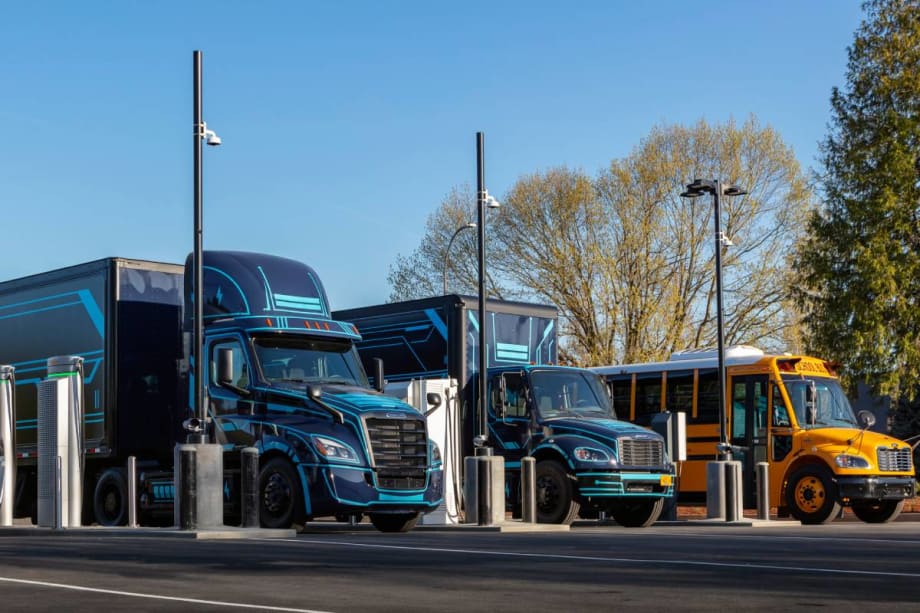
“Electric Island” at Daimler Trucks in Portland, Oregon.
Photo: Daimler Trucks North America
New rules in Oregon will accelerate the electrification of school buses, package delivery vans, waste haulers, and commercial tractors. The Oregon Environmental Commission on Nov. 17 adopted the Advanced Clean Truck Rule and the Heavy-Duty Omnibus (Low-NOx) Rule as presented by staff at the Department of Environmental Quality.
Both of the rules are the same as California's and apply to sales of new medium- and heavy-duty (MHD) vehicles, such as trucks, buses, and vans. The ACT rule requires truck manufacturers to offer increasing percentages of new sales to be zero-emission MHD vehicles in Oregon, while the Low-NOx rule will require new fossil fuel-powered MHD engines to significantly reduce dangerous air pollution. Both rules begin in model year 2025.
In addition, updates to the low-emission vehicle (LEV program) rules will ensure they are identical to California’s current light-duty vehicle emission standards.
"It has been almost 14 years since the Oregon Legislature directed state regulators to reduce diesel particulate pollution so it would bring cancer risk below the EPA acceptable risk level in the state,” said Mary Peveto, executive director of Neighbors for Clean Air. “DEQ acknowledged in 2019 it had made little progress, with reductions less than 2% of the pollution needed to meet that health standard. Adopting the strongest standards for new trucks in our state is a significant step in the right direction for finally eradicating this environmental and public health injustice."
More About the New Emissions Rules
Under the ACT Rule, Oregon will require medium- and heavy-duty vehicle manufacturers to sell zero-emission vehicles (ZEVs) as a certain percentage of sales, beginning with the 2025 vehicle model year. Manufacturers must increase their zero-emission truck sales depending upon the class size of the truck. Under the HD Omnibus rules, Oregon would lower nitrogen oxides (NOx) and fine particulate matter (PM2.5) emission standards for new truck engines (both diesel and non-diesel engines), in addition to other requirements for these engines.
The ACT rule culminates at a ZEV sales mandate between 40-75% of all new sales depending on truck class.
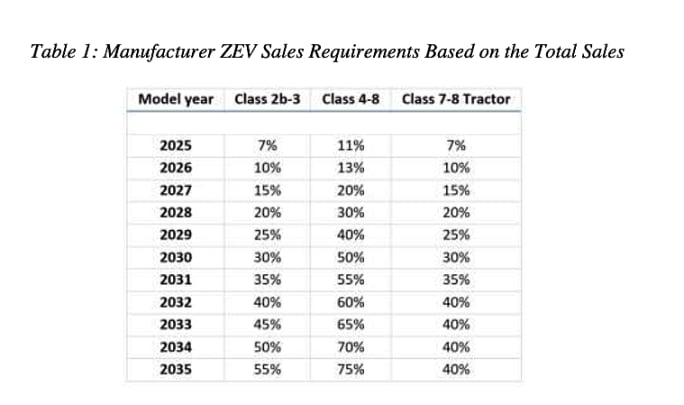
Photo: Oregon DEQ
The rule also includes a one-time reporting requirement for certain businesses that operate one or more facilities in Oregon that own, operate or dispatch five or more medium- and heavy-duty trucks, and it requires certain businesses with 2021 gross annual revenues of more than $50 million, to report information on fleet vehicle usage and location data no later than June 30, 2022.
Because not all vehicle applications or sectors will be able to make the transition to zero-emission technology in the near term, meaning there will still be demand for conventionally fueled vehicles, California developed the Heavy Duty Engine and Vehicle Omnibus Regulation to reduce tailpipe emissions associated with the continued sale of new non-ZEV medium- and heavy-duty trucks. Oregon is now adopting this rule as well.
The Omnibus rules apply to on-highway heavy-duty engines sold in Oregon beginning with engine model year 2024, and to on-highway medium- and heavy-duty trucks sold in Oregon beginning with model year 2025. The rules require lower NOx and PM2.5 standards for new truck engines (both diesel and non-diesel engines). NOx limits will be 75% below the current federal standards in 2024 and 90% below the federal standards in 2027. NOx reductions will also reduce secondary nitrate PM2.5 formation. The PM2.5 standard will be reduced by 50%, said the agency, "primarily to prevent backsliding with potentially less-efficient particulate controls to accommodate the lower NOx standard."
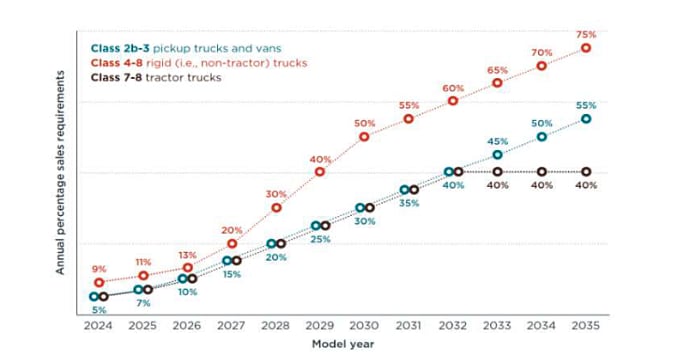
The ACT rule culminates at a ZEV sales mandate between 40-75% of all new sales depending on truck class.
Photo: Oregon DEQ
Beyond Oregon
The federal Clean Air Act grants the U.S. EPA jurisdiction for establishing emission standards for new motor vehicles, including heavy-duty trucks. It prohibits states from establishing standards — except for California. However, states may adopt vehicle emission standards that are more stringent than the federal standards if they are identical to California's. Oregon has previously adopted California’s emissions standards for passenger cars and trucks and, this rulemaking adds standards for medium- and heavy-duty vehicles.
While Oregon is the first state to adopt these rules following their creation and adoption in California, five other states — Washington, Maine, Massachusetts, New Jersey, and New York — are considering adopting at least the ACT this year, as well. These seven states contain more than 20% of the national fleet of medium- and heavy-duty trucks, according to Federal Highway Administration data.
Last year, Oregon joined 14 other states and the District of Columbia in setting a goal of 100% electric truck and bus sales by 2050. Adopting the ACT and HDO rules will accelerate this transition.
Oregon will see a projected $21.2 billion in net societal benefits and avoid 84,000 respiratory illnesses by 2050 with the adoption of these two rules, according to an independent study by MJ Bradley & Associates. Societal benefits include avoided premature deaths, missed work days, and other medical expenses due to lower diesel pollution, as well as financial savings from the low cost of electric fuel, and high-quality jobs from investments in Oregon charging infrastructure.
The study found Oregonians will see many health, climate, and economic benefits of the ACT and HDO rules by 2050, including:
Delivering net societal benefits of $21.2 billion, including public health benefits and savings for fleet owners and utility customers.
Avoiding nearly 84,000 respiratory illnesses, 160 premature deaths, and 120 hospital admissions and emergency room visits.
Reducing greenhouse gas pollution from trucks and buses by 50 million metric tons, particulate matter by over 1,290 metric tons, and smog-forming nitrogen by nearly 223,300 tons cumulatively by 2050.
Saving household utility customers $70 annually and commercial customers $410 per year on electricity bills.
Saving fleet owners more than $1 billion annually, in part through savings on fuel and maintenance.
Attracting nearly $87 million annually in investments in public electric vehicle charging infrastructure.
The report also found the ACT and HDO rules would contribute to reducing truck and bus emissions by 93% for nitrogen oxides (NOx), by 83% for particulate matter (PM), and by 55% for greenhouse gas emissions (GHGs), compared with today’s emission levels.
Originally posted on Work Truck Online
More Electric Vehicles

EV Charging Use Is Outpacing Infrastructure Growth
ChargePoint’s 2026 Charging Forward Report points to rising charger use, higher-powered charging, commercial vehicle electrification, and energy-management technology. Here’s what fleets should know.
Read More →
EV Realty Names Henrik Holland President as Charging Platform Expands
The former Prologis Mobility and Shell executive will help expand EV Realty’s truck charging business and move its power-first infrastructure model into autonomous vehicle depots and other fleet sectors.
Read More →
GreenPower Expands New Mexico EV Pilot With Larger Buses, V2G Testing
After logging more than 17,000 electric miles in the first year, New Mexico’s statewide pilot is moving into its second phase with larger vehicles, continued charging evaluations, and more.
Read More →
Can EV-as-a-Service Help Fleets Scale Electrification?
Sustainability Partners CEO Adam Cain explains how matching EVs, charging infrastructure, and duty cycles can help fleets scale electrification.
Read More →
How EV-as-a-Service Is Moving Fleets Beyond Pilots
Adam Cain, president and CEO of Sustainability Partners, explains how EV-as-a-service can help fleets scale deployments by addressing duty-cycle requirements and charging challenges.
Read More →
PowerFlex, The Mobility House Join Forces to Advance Fleet Electrification
Two EV charging providers are joining forces to deliver a broader portfolio of energy management and fleet electrification solutions.
Read More →
Ford Retools Louisville Plant for Fathom Electric Truck Production
Ford's $2 billion Louisville Assembly Plant overhaul introduces a three-part assembly process for the Fathom midsize electric truck, with production scheduled to begin in 2027.
Read More →
Merchants Fleet Reports 290M EV Miles as Fleets Navigate Changing Electrification Market
From millions in operating savings to hundreds of millions of EV miles, Merchants Fleet’s latest report reveals what’s working and what’s changing in fleet electrification.
Read More →
California District Commits to Electrify 25% of School Bus Fleet by 2028
One of the nation's largest school bus electrification projects to date demonstrates how grants, charging infrastructure, and public-private partnerships can help fleets transition to EVs at scale.
Read More →
Aptera Orders Bodies and Chassis for Its First 40 Production Vehicles
Aptera Motors Corp. has issued purchase orders for the major structural components of its first 40 vehicles, and body and chassis components are expected to begin arriving in October.
Read More →