On-Demand Driverless Vehicle Service Starts Road Testing
BotRide is Hyundai’s self-driving on-demand pilot service where riders can hail an autonomous Hyundai KONA Electric SUV from a smartphone.
by Staff
October 30, 2019
3 min to read
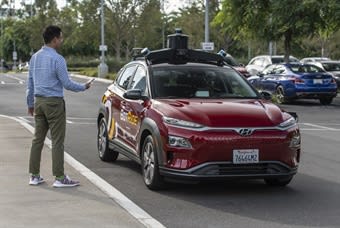
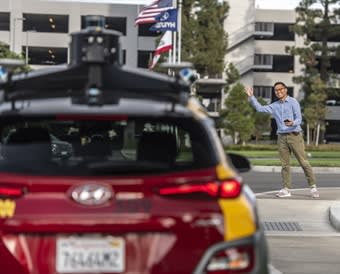
The BotRide pilot represents an important step in the deployment and eventual commercialization of a growing new mobility business. (photos: Hyundai)
IRVINE, Calif. – Hyundai, in collaboration with Pony.ai and the global public mobility developer Via, on Oct. 25 unveiled BotRide, a shared, on-demand, autonomous vehicle service operating on public roads.
Starting Nov. 4, a fleet of self-driving Hyundai KONA Electric SUVs will provide a free ride-sharing service to the local community of Irvine. BotRide will run from through January 31, 2020 as part of the pilot phase of the program.
Ad Loading...
“The pilot introduces BotRide to several hundred Irvine residents, including college students," said Christopher Chang, head of business development, strategy and technology division, Hyundai Motor Company. "The goal is to study consumer behavior in an autonomous ride-sharing environment. We will learn about ecosystems, where the vehicles travel and optimize the customer experience. BotRide, is another example of Hyundai’s ongoing efforts to actively build expertise in mobility technology as well as the company’s commitment to providing a more user-friendly mobility services to customers.”
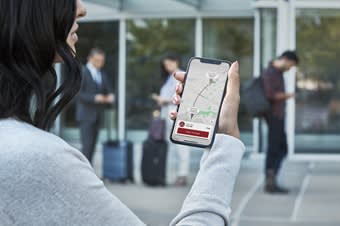
Using the BotRide app, riders can hail an autonomous Hyundai KONA Electric SUV directly from their smartphone.
Hyundai partnered with Pony.ai to use its self-driving system and with Via to create the BotRide ride hailing technology and application. Using the BotRide app, riders can hail an autonomous Hyundai KONA Electric SUV directly from their smartphone. Via’s advanced algorithms enable multiple riders to share the same vehicle, outfitted with Pony.ai autonomous vehicle technology. The app directs passengers to nearby stops for pick-up and drop-off, allowing for quick and efficient shared trips without lengthy detours, or inconvenient fixed routes and schedules.
Integrated Hyundai and Pony.ai technologies enable the BotRide vehicles to navigate complex road scenarios safely. These vehicles are equipped with Pony.ai’s latest sensor hardware and proprietary software to identify the precise position of surrounding vehicles, handle pedestrian traffic in urban areas, accurately monitor its surroundings, predict the behavior of other road users, and precisely plan actions accordingly.
BotRide’s technology prioritizes passenger-to-system interactions such as automated onboard passenger verification, giving riders the chance to familiarize themselves with technologies expected to become commonplace in an autonomous mobility future.
In addition to self-driving capabilities, BotRide is validating its user experience to prepare for a fully driverless future.
BotRide launches with multiple popular destinations where a passenger may hail a ride using the BotRide app. The service area covers several residential, commercial, and institutional points of interest. BotRide’s technology prioritizes passenger-to-system interactions such as automated onboard passenger verification, giving riders the chance to familiarize themselves with technologies expected to become commonplace in an autonomous mobility future. Each vehicle will have human co-pilots in charge of monitoring the self-driving system for additional safety. The program is only available to pre-registered riders.
Ad Loading...
FACT FACTS
BotRide Program Highlights
SAE Level 4 autonomous vehicle technology
Multi-party collaboration to bring to market this type of service
All electric autonomous vehicle fleet
Fully flexible routes
Includes ride sharing service
Optimized trip planning allows multiple users to share rides with minimal inconvenience
Fully automated rider identification using QR codes
BotRide Service Overview
Unlimited free rides in autonomous vehicles to several points of interest in Irvine
“Through BotRide, Hyundai is leveraging cutting-edge autonomous vehicle and mobility technologies to introduce a new, safe, and convenient form of transportation to the public,” said Daniel Han, manager, Advanced Product Strategy, Hyundai Motor America. “The BotRide pilot represents an important step in the deployment and eventual commercialization of a growing new mobility business. In addition to the technology partners powering BotRide, the broader city and community ecosystem have also played an important role in making BotRide possible. The BotRide pilot can serve as an example of how cities and companies can come together to truly enable smart cities and smart transportation systems of the future.”
ABOUT THE PARTICIPANTS:
Hyundai Motor Company: Established in 1967, Hyundai Motor Company is committed to becoming a lifetime partner in automobiles and beyond with its range of world-class vehicles and mobility services available in more than 200 countries. Hyundai sold more than 4.5 million vehicles globally in 2018 and is currently employing more than 110,000 employees worldwide. Hyundai Motor continues to enhance its product line-up with vehicles that are helping to build solutions for a more sustainable future, such as NEXO, the world’s first dedicated hydrogen-powered SUV.
Pony.ai: Pony.ai aims to deliver autonomous mobility everywhere by building the safest and most reliable self-driving technology. Pony.ai’s full-stack solution enables BotRide to accurately perceive its surroundings, predict what others will do, and maneuver itself safely and effectively. Pony.ai is currently testing its self-driving system in multiple geographies across the US and China. The company was founded in late 2016 and its investors include Sequoia Capital China, IDG Capital, Legend Capital, among others.
Via: Via is re-engineering public transit, from a regulated system of rigid routes and schedules to a fully dynamic, on-demand network. Via’s mobile app connects multiple passengers who are headed the same way, allowing riders to seamlessly share a premium vehicle. First launched in New York City in September 2013, the Via platform operates in the United States and in Europe through its joint venture with Mercedes-Benz Vans, ViaVan. Via’s technology is also deployed worldwide through dozens of partner projects with public transportation agencies, private transit operators, taxi fleets, private companies, and universities, seamlessly integrating with public transit infrastructure to power cutting-edge on-demand mobility. For more information, visit www.platform.ridewithvia.com.
The former Prologis Mobility and Shell executive will help expand EV Realty’s truck charging business and move its power-first infrastructure model into autonomous vehicle depots and other fleet sectors.
After logging more than 17,000 electric miles in the first year, New Mexico’s statewide pilot is moving into its second phase with larger vehicles, continued charging evaluations, and more.
Adam Cain, president and CEO of Sustainability Partners, explains how EV-as-a-service can help fleets scale deployments by addressing duty-cycle requirements and charging challenges.
Ford's $2 billion Louisville Assembly Plant overhaul introduces a three-part assembly process for the Fathom midsize electric truck, with production scheduled to begin in 2027.
From millions in operating savings to hundreds of millions of EV miles, Merchants Fleet’s latest report reveals what’s working and what’s changing in fleet electrification.
One of the nation's largest school bus electrification projects to date demonstrates how grants, charging infrastructure, and public-private partnerships can help fleets transition to EVs at scale.
Aptera Motors Corp. has issued purchase orders for the major structural components of its first 40 vehicles, and body and chassis components are expected to begin arriving in October.