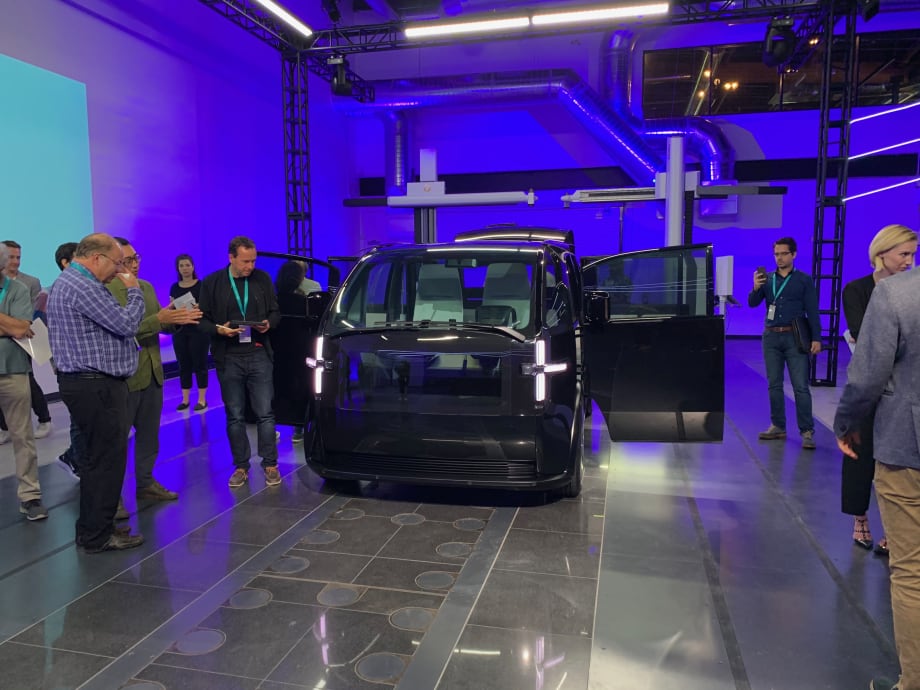
Using a proprietary skateboard architecture, the electric Canoo is designed for a ridesharing future, the company states.
by Staff
September 26, 2019
Canoo has developed a "skateboard" architecture, the cabin sits atop the batteries and electric drivetrain.
Photo by Kendra Rodriguez.
2 min to read
Los Angeles based car maker Canoo began designing and engineering its first model 19 months ago and Sept. 24 it unveiled its subscription-only electric vehicle, simply named Canoo. The subscription service is slated to bring affordable EV’s to market by 2021.
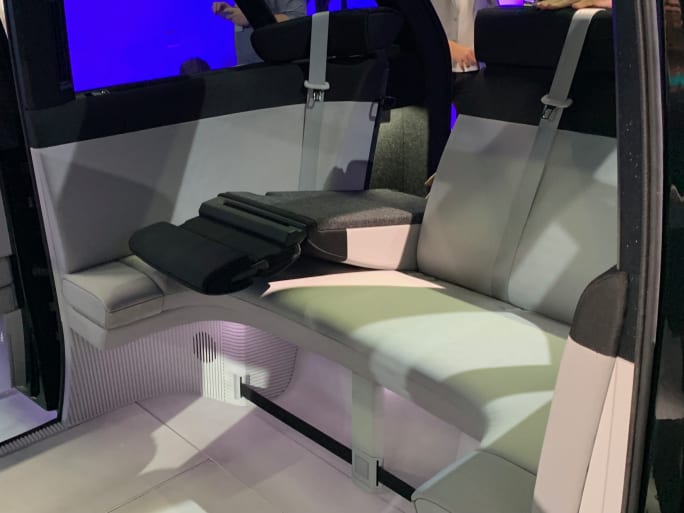
The vehicle hones a minimalist design, in what the company calls “an urban loft on wheels.” The vehicle maximizes interior space by eliminating compartmentalization and carrying a more furniture-like appearance, while still holding enough space for up to seven passengers.
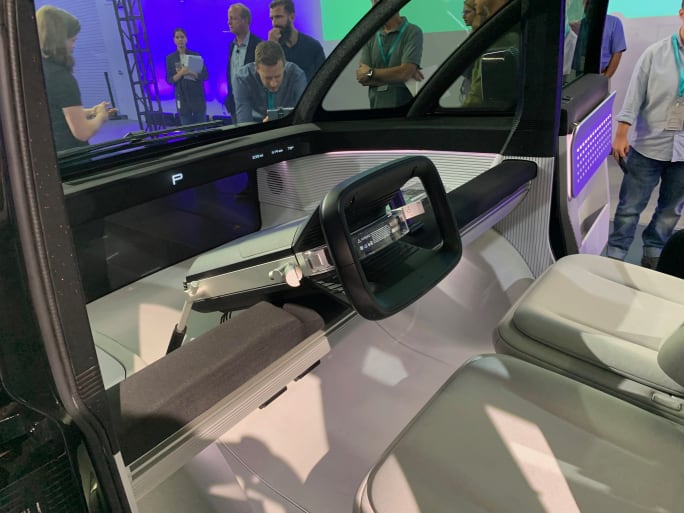
The minimalist design carries through to the user interface. Riders will bring their device such as a phone or tablet to use for music, navigation, and other non-driving features.
Ad Loading...
Photo by Kendra Rodriguez.
Skateboard Platform
Canoo has developed a proprietary “skateboard” architecture, directly housing the batteries and electric drivetrain. All future vehicles will share the same underpinning and different cabins or “top hats” can be married on top to create unique vehicles. Leveraging the same fixed and flat skateboard allows for reduced research and development costs, efficient production and better use of interior space.
The vehicle and skateboard are designed for an overall five-star safety rating. The skateboard houses the most critical components of the vehicle. The skateboard is also set up in a way that it could support a dual, front or rear motor configuration.
Autonomy for Ridesharing Future
Canoo also announced that it aims to build driver-assist features in its vehicles with plans to create autonomous vehicles to be used for ridesharing. The vehicle uses seven cameras, five radars, and 12 ultrasonic sensors. Currently, the sensors place the vehicle at Level 2 autonomy with plans to improve as technology evolves.
Canoo will also feature the first true steer-by-wire vehicle on the market without a hardware connection between the steering wheel and wheels. This means the Canoo steers by electric signals only. The company hopes the steering wheel will pave the way for autonomous driving. Adding that the elimination of mechanical connection will allow freedom to arrange the interior space of the vehicle.
Photo by Kendra Rodriguez.
The electric vehicle will have an approximate range of 250 miles and will reach an 80% charge in less than 30 minutes. The battery pack is fastened to the skateboard structure.
Canoo will now kick-off a beta testing period in which all functionalities and components are tested together in a fleet of custom-built Canoo validation vehicles. During this time, Canoo’s development engineers will evaluate the interplay of all parts and systems.
Ad Loading...
Canoo will present its vehicle to the public as part of a tour in two Southern California locations:
The Abbot Kinney Festival in Venice, California, on September 29
The Car Classic at the ArtCenter College of Design in Pasadena, California on October 20
The former Prologis Mobility and Shell executive will help expand EV Realty’s truck charging business and move its power-first infrastructure model into autonomous vehicle depots and other fleet sectors.
After logging more than 17,000 electric miles in the first year, New Mexico’s statewide pilot is moving into its second phase with larger vehicles, continued charging evaluations, and more.
Adam Cain, president and CEO of Sustainability Partners, explains how EV-as-a-service can help fleets scale deployments by addressing duty-cycle requirements and charging challenges.
Ford's $2 billion Louisville Assembly Plant overhaul introduces a three-part assembly process for the Fathom midsize electric truck, with production scheduled to begin in 2027.
From millions in operating savings to hundreds of millions of EV miles, Merchants Fleet’s latest report reveals what’s working and what’s changing in fleet electrification.
One of the nation's largest school bus electrification projects to date demonstrates how grants, charging infrastructure, and public-private partnerships can help fleets transition to EVs at scale.
Aptera Motors Corp. has issued purchase orders for the major structural components of its first 40 vehicles, and body and chassis components are expected to begin arriving in October.