


ACRA President Gains Federal Advisory Seat on EVs
Sharky Laguana of the American Car Rental Association will help shape EV-related policies with car rental and private ground transportation priorities in mind.

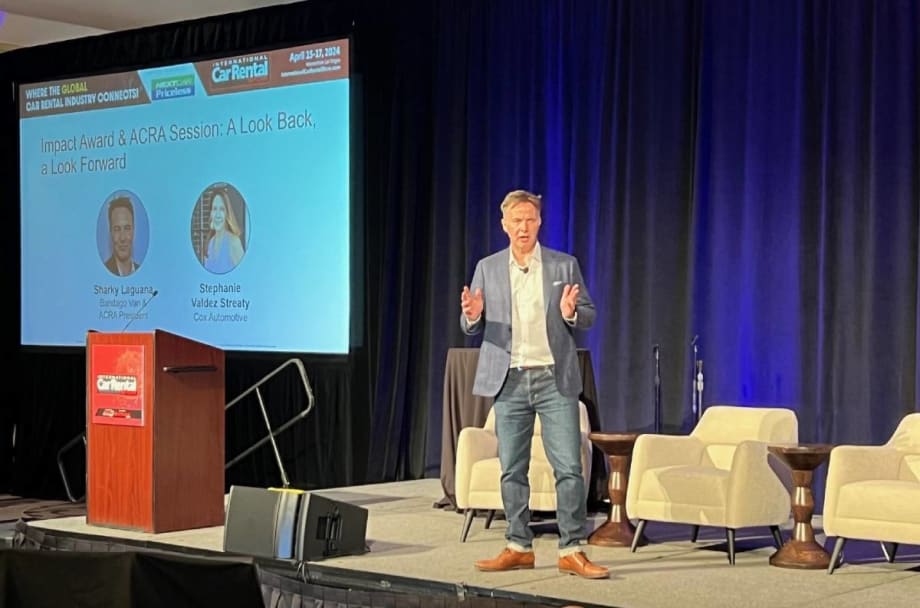
ACRA President Sharky Laguana outlines an industry EV agenda on March 16, 2024 during the International Car Rental Show in Las Vegas. He said technology and battery advances in coming years will yield EVs with longer ranges, faster charging times, and lower costs than internal combustion engine vehicles, and that fleets should prepare.
Photo: Martin Romjue / Bobit
The rental car industry has gained some inside access in steering the evolving transition to electric vehicles.
The president of the American Car Rental Association, Sharky Laguana, took a seat earlier this year on the Joint Office on Energy and Transportation’s Electric Vehicle Working Group. The advisory committee has 24 working members, all pointed by Transportation Secretary Peter Buttigieg and Energy Secretary Jennifer Granholm.
As the leader of ACRA and CEO of Bandago of San Francisco, California, Laguana joins an advisory committee of 24 working members, who all serve for two-year renewable terms that can cross changes in Presidential administrations. It meets quarterly, with two times per year on Zoom and two in Washington, D.C.
Each seat is designated to represent a stakeholder in the EV transition, including one seat for OEMs, one for battery manufacturers, and one for for-hire transportation, occupied by Laguna. For-hire includes passenger transportation, rental car companies, buses, transportation management companies (TMCs), rideshare services, limousines, and taxis.
“It’s amazing for a member of the car rental industry to secure a seat,” Laguana said in an interview with ARN. “With for-hire passenger transportation, nobody is buying more EVs than we are. For the industry this represents a tremendous opportunity that our interests are considered when setting policy. What’s at stake is the extent to which we will have a car rental industry.”
The EV Working Group was established by the 2022 Bipartisan Infrastructure Law, enacted as the Infrastructure Investment and Jobs Act of 2021 (Public Law 117-58). It is responsible for advising the Departments of Energy and Transportation on the implementation of the federal electric vehicle research, funding, and grant programs from the legislation.
“Many people wanted to secure this seat,” Laguana said. “It makes recommendations to the joint office of Energy and Transportation on how we facilitate this transition and make it a successful one. When you think about how important transportation is to the economy, and how many billions we are spending on electric vehicle infrastructure, production, and purchasing of EVs, it’s hard to come up with a bigger moment for transportation within the past 50 years.”
Laguana cited the group’s well-rounded expertise that spans sectors contributing to EV development, such as labor matters, environmental issues, local government, and public utilities. The group will issue reports that help determine how to allocate funds from the Biden Administration’s infrastructure program and set future government policy.
“This is a once-in-a-lifetime transition for the country,” Laguana said. “The group is doing the work that will determine how the country will move forward on this effort strategically.”
Most of the work on these federal groups happens outside of formal meetings, Laguana said. The EV group has subcommittees, such as one for EV charging infrastructure that Laguana serves on.
“Right now, we are thinking about chargers and where they are going,” he said. “We are seeing where consumers are likely to go, such as destinations, airports, major hotels, national parks, and the kind of places consumers want to visit. We also think these chargers can serve under-served communities and get broad access to EVs.”
The subcommittee will research what type of chargers can qualify for National Electric Vehicle Infrastructure (NEVI) funds, and the requirements and specs for EV charger hookups.
“It’s more likely that we will see the Tesla hookup standard being widely adopted,” Laguna said. “It’s not helpful to have a many different standards.”
As part of his role, Laguana will report regular updates to ACRA. He emphasized that he is not representing any one company, but the industry overall among other for-hire transportation sectors.
“Any ACRA member will get a lot of consideration,” he said. “I’m willing to listen to anybody on how to move forward. I want to make sure we do as good a job as possible."
Originally posted on Auto Rental News
More Electric Vehicles

EV Charging Use Is Outpacing Infrastructure Growth
ChargePoint’s 2026 Charging Forward Report points to rising charger use, higher-powered charging, commercial vehicle electrification, and energy-management technology. Here’s what fleets should know.
Read More →
EV Realty Names Henrik Holland President as Charging Platform Expands
The former Prologis Mobility and Shell executive will help expand EV Realty’s truck charging business and move its power-first infrastructure model into autonomous vehicle depots and other fleet sectors.
Read More →
GreenPower Expands New Mexico EV Pilot With Larger Buses, V2G Testing
After logging more than 17,000 electric miles in the first year, New Mexico’s statewide pilot is moving into its second phase with larger vehicles, continued charging evaluations, and more.
Read More →
Can EV-as-a-Service Help Fleets Scale Electrification?
Sustainability Partners CEO Adam Cain explains how matching EVs, charging infrastructure, and duty cycles can help fleets scale electrification.
Read More →
How EV-as-a-Service Is Moving Fleets Beyond Pilots
Adam Cain, president and CEO of Sustainability Partners, explains how EV-as-a-service can help fleets scale deployments by addressing duty-cycle requirements and charging challenges.
Read More →
PowerFlex, The Mobility House Join Forces to Advance Fleet Electrification
Two EV charging providers are joining forces to deliver a broader portfolio of energy management and fleet electrification solutions.
Read More →
Ford Retools Louisville Plant for Fathom Electric Truck Production
Ford's $2 billion Louisville Assembly Plant overhaul introduces a three-part assembly process for the Fathom midsize electric truck, with production scheduled to begin in 2027.
Read More →
Merchants Fleet Reports 290M EV Miles as Fleets Navigate Changing Electrification Market
From millions in operating savings to hundreds of millions of EV miles, Merchants Fleet’s latest report reveals what’s working and what’s changing in fleet electrification.
Read More →
California District Commits to Electrify 25% of School Bus Fleet by 2028
One of the nation's largest school bus electrification projects to date demonstrates how grants, charging infrastructure, and public-private partnerships can help fleets transition to EVs at scale.
Read More →
Aptera Orders Bodies and Chassis for Its First 40 Production Vehicles
Aptera Motors Corp. has issued purchase orders for the major structural components of its first 40 vehicles, and body and chassis components are expected to begin arriving in October.
Read More →