


RELATED: Renault Trucks to Expand Electric Truck Offerings for European Fleets
2020 Commercial Vehicles & Electrification in Europe
With the increased amount of packages and groceries being delivered to European homes, the need for clean commercial vehicles is increasing. Also, the fact that a lot of cities must improve inner city emissions to comply with emission regulations is adding to the pressure.
by Julian de Groot, Head of Product & Marketing for Dataforce
March 26, 2021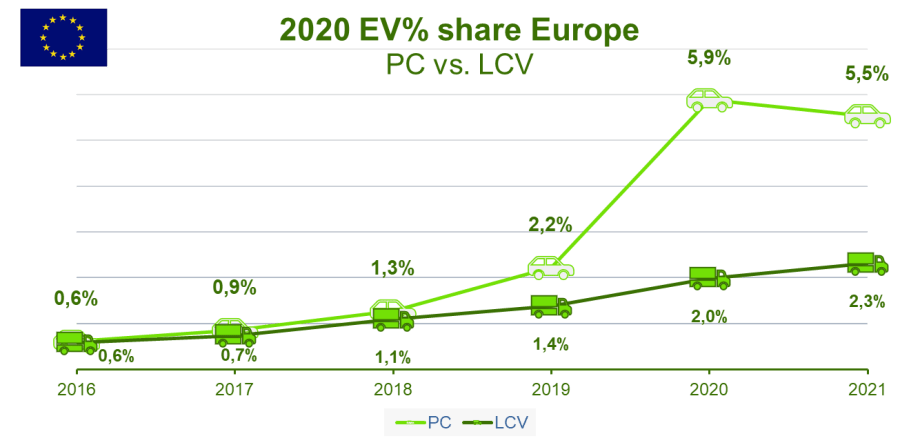
Source: Dataforce
2 min to read
In Europe the ratio of commercial vehicles sold with electrical propulsion is trailing behind passenger cars with a 2,0% share vs their 5.9% share over 2020.

Source: Dataforce
The focus of the manufacturers has been on developing electrified passenger cars. Also, from a subsidy point of view, emphasis has also been on passenger cars.
However, with the predominant road occupation transport during the daytime in cities comprises of commercial vehicles you could argue that more focus should or could be put in commercial vehicles. The net impact of an electrical commercial vehicle could well be more than that of a passenger car, which is standing still most of the day.
Some other factors that are potentially influencing the lower penetration of electrical commercial vehicles
Battery cost vs. weight. To move a full truck, you need a lot of energy, which requires a lot of batteries. And a lot of batteries are still expensive, resulting in a relatively higher cost of ownership vs. the regular diesel vehicles.
Range vs. usage. Commercial vehicles might be used all day. The range of an electric vehicle might not make it through the whole day, which would result in idling time because of charging. Or an increased number of vehicles so the drivers can swap vehicles.
Number of vehicles on offer. While in the beginning of the year there were more than 50 (and growing) different passenger cars models on offer, this is not the case for commercial vehicles, which has around 20 different models on offer.

Source: Dataforce
Which models are leading the pack? Both and Renault and Nissan were early out of the gate, just as with passenger cars. This has resulted in the top position for the Renault Kangoo EV with 26% share in 2020, followed by the Nissan e-NV200 with 17%. The Mercedes Vito is 3rd with 6% of the market. Worth mentioning is that in 2019 number 3 was StreetScooter, part of Deutsche Post/DHL, but they decided to discontinue production last year.

Source: Dataforce
The predominant segment for the electrical Vans is the small van segment. As these Vans are more fit for last mile delivery, specifically in older city-centres this trend will most probably not change in the near future.
Although with a trend behind passenger cars, the commercial vehicles are also starting their transitional journey from ICE to EV. All major OEM’s have and will increase their proposition in the markets over the coming years, with the mandatory requirements to keep up with environmental targets. It also opens the door for new players, such as Maxus, which is a brand of the Chinese SAIC group. In the beginning of this 2021 they already achieved a market share of 5.4% among electrical commercial vehicles!
Originally posted on Automotive Fleet
More Electric Vehicles
EV Charging Use Is Outpacing Infrastructure Growth
ChargePoint’s 2026 Charging Forward Report points to rising charger use, higher-powered charging, commercial vehicle electrification, and energy-management technology. Here’s what fleets should know.
Read More →
EV Realty Names Henrik Holland President as Charging Platform Expands
The former Prologis Mobility and Shell executive will help expand EV Realty’s truck charging business and move its power-first infrastructure model into autonomous vehicle depots and other fleet sectors.
Read More →
GreenPower Expands New Mexico EV Pilot With Larger Buses, V2G Testing
After logging more than 17,000 electric miles in the first year, New Mexico’s statewide pilot is moving into its second phase with larger vehicles, continued charging evaluations, and more.
Read More →
Can EV-as-a-Service Help Fleets Scale Electrification?
Sustainability Partners CEO Adam Cain explains how matching EVs, charging infrastructure, and duty cycles can help fleets scale electrification.
Read More →
How EV-as-a-Service Is Moving Fleets Beyond Pilots
Adam Cain, president and CEO of Sustainability Partners, explains how EV-as-a-service can help fleets scale deployments by addressing duty-cycle requirements and charging challenges.
Read More →
PowerFlex, The Mobility House Join Forces to Advance Fleet Electrification
Two EV charging providers are joining forces to deliver a broader portfolio of energy management and fleet electrification solutions.
Read More →
Ford Retools Louisville Plant for Fathom Electric Truck Production
Ford's $2 billion Louisville Assembly Plant overhaul introduces a three-part assembly process for the Fathom midsize electric truck, with production scheduled to begin in 2027.
Read More →
Merchants Fleet Reports 290M EV Miles as Fleets Navigate Changing Electrification Market
From millions in operating savings to hundreds of millions of EV miles, Merchants Fleet’s latest report reveals what’s working and what’s changing in fleet electrification.
Read More →
California District Commits to Electrify 25% of School Bus Fleet by 2028
One of the nation's largest school bus electrification projects to date demonstrates how grants, charging infrastructure, and public-private partnerships can help fleets transition to EVs at scale.
Read More →
Aptera Orders Bodies and Chassis for Its First 40 Production Vehicles
Aptera Motors Corp. has issued purchase orders for the major structural components of its first 40 vehicles, and body and chassis components are expected to begin arriving in October.
Read More →