

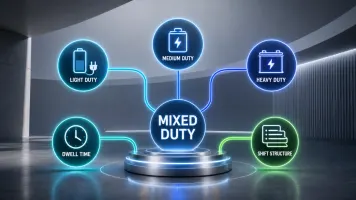
How To Set Up Charging For A Mixed-Duty Commercial Fleet
Fleet operators who manage a mix of light-, medium-, and heavy-duty vehicles can’t treat charging as an add-on to fueling. Here’s how to develop a specific strategy.

Follow these three concepts to get the most value when cycling out your electric fleet vehicles.
Fleet operators who replan their cycles and extend them to five, six, or even seven years for EVs find that the total cost of ownership looks much different when they're not exiting at the depreciation cliff.
Charged Fleet
Fleet managers approaching EV remarketing with their existing internal combustion engine (ICE) playbook are making expensive mistakes.
The depreciation curve follows its own pattern, the value drivers have shifted, and the wholesale market requires specialized expertise.
After years of running EV remarketing operations at scale, I've watched fleet operators repeatedly leave money on the table. Not because EVs are bad assets, but because they're being managed as if they were combustion vehicles with a different fuel source.
Fleet operators who replan their cycles and extend them to five, six, or even seven years for EVs find that the total cost of ownership looks much different when they're not exiting at the depreciation cliff.
Charged Fleet
Three strategic shifts separate the fleet operators capturing maximum resale value from those absorbing unnecessary losses:
Get these three things right, and EVs become among the most cost-effective assets in your fleet.
Get them wrong, and the depreciation headlines write themselves.
Industry data consistently shows that EVs depreciate faster than ICE vehicles over the first three years. Studies show that three-year-old EVs lose about 50% of their value, compared with around 39% for conventional vehicles.
When Hertz dumped 30,000 Teslas in 2024, vehicles originally purchased for over $40,000 were selling for under $20,000. The depreciation headlines alarmed many fleet managers.
Here's what those numbers miss: Steep early depreciation reflects technology maturation and market dynamics, not the vehicle's fundamental condition.
New EV models are improving rapidly: Better range, lower prices, more features. This compresses the value of older models. This is a characteristic of a maturing technology market, not evidence that your three-year-old EV is worn out.
The mechanical reality tells a different story entirely. EV powertrains contain about 20 moving parts compared to 2,000 or more in a combustion engine. There are no oil changes, no timing belts, no transmission rebuilds.
Consumer Reports data shows EVs cost about 50% less to maintain over their lifetime than ICE vehicles. Fleet operators in New York City have reported spending under $400 annually to maintain EVs compared to over $1,300 for combustion vehicles.
Electric motors are routinely rated for over a million miles of operation. The average ICE engine needs significant work around 150,000 miles. A three-year-old EV that's lost half its market value may be only 10-15% into its useful mechanical life.
Selling at that moment means absorbing the steepest part of the depreciation curve while capturing almost none of the low-maintenance years that follow.
Fleet operators who replan their cycles and extend them to five, six, or even seven years for EVs find that the total cost of ownership looks much different when they're not exiting at the depreciation cliff. The math favors keeping EVs in service longer, not shorter.

Plug CEO Jimmy Douglas (pictured) advises electric fleet operators that the TOC math favors keeping EVs in service longer, not shorter, to maximize resale value.
Plug
The high-voltage battery pack will be the single most important factor in appraising a used EV.
Today, that data doesn't heavily influence value in wholesale transactions. Most EVs entering the market are still under factory warranty, and most fall into the same condition band, with around 90% state of health, give or take a few percentage points. Buyers don't vary much on battery data because there's little differentiation to see.
This will change. As vehicles age beyond warranty coverage and accumulate higher mileage, battery health will begin to vary significantly.
Research from Recurrent and Geotab indicates batteries degrade by about 1-2% per year under normal conditions. But "normal" varies enormously based on charging behavior and operating environment.
The market will eventually assign real dollar values to these differences. Fleet operators who are preparing now will be positioned to capture that value.
Preparation means two things:
Traditional wholesale channels were built to value vehicles based on mileage, age, and condition. These metrics still matter for EVs, but they're no longer sufficient on their own.
The factors that determine the value of a used EV include battery capacity, remaining warranty coverage, software-enabled features, ADAS hardware versions, and access to the charging network, including whether the vehicle has a CCS or NACS charge port.
That last point deserves attention. The U.S. charging infrastructure has grown dramatically. DC fast-charging ports increased from about 51,000 to nearly 68,000 over the past year, with Tesla's Supercharger network accounting for more than half of all stalls. A vehicle with native NACS port access to that network is far more practical than one that requires adapters at multiple locations. Sophisticated buyers understand this. As I’ve said on many conference stages, when buying an EV, half the product is not even the car; it’s the charging network it has access to.
We are moving deeper into the world of the software-defined vehicle, which will add life-changing capabilities and the complexities that come with them.
Take Tesla's full self-driving capability: it costs $8,000 to purchase outright, but it adds value in the secondary market only when the software’s persistence through ownership transfer can be guaranteed.
If your remarketing channel doesn't understand how to represent and value these software features, you're leaving money on the table.
Here's what fleet operators routinely miss: a vehicle's capabilities differ at wholesale than when it was first deployed. Over-the-air updates change functionality, sometimes even maximum range.
The EV you're remarketing may not match the VIN decoder's results. Wholesale channels that can decode, verify, and accurately represent these configurations consistently outperform those that can't. The difference on individual vehicles can run into thousands of dollars.
Industry analysts project 10 million EVs will enter the secondary market over the next five years through trade-ins and lease returns.
Used EV sales grew 63% in 2024 and are forecast to grow another 57% in 2025. Off-lease supply is expected to surge more than 200% in 2026 alone. The market is maturing rapidly, and the operators who understand how to manage these assets will have big advantages over those still applying ICE-era assumptions.
There's also a broader context worth considering. When you deploy an EV, you're not just buying a vehicle. You're buying into an ecosystem. Three years ago, there were far fewer public fast chargers.
Today, we're approaching 70,000 stalls nationally. The EV you're preparing to remarket may be more useful to its next owner than it was to you, simply because the infrastructure has caught up. That's a value story worth telling at disposition, provided your remarketing channel knows how to tell it.
The depreciation curve for EVs tells one story. The useful life curve tells another. Fleet operators who read both curves, extend usage cycles, manage battery health with foresight, and remarket through channels built for software-defined vehicles will capture value that others leave behind.
Loading data...

Fleet operators who manage a mix of light-, medium-, and heavy-duty vehicles can’t treat charging as an add-on to fueling. Here’s how to develop a specific strategy.


Charging
A seamless charge depends on a string of independent companies getting it right together, every time. How can electric fleets navigate the challenges to create a successful charging plan?
Charging
Getting boots on the ground quickly is not enough. Fleets must now master charging management, one of the newest capabilities, the most critical of all the new skills the transition to EVs demands.
Charging
As more fleets transition to EVs, those that embed telematics deeply into their workflows will expand deployments with fewer surprises and more predictable economics.
Charging
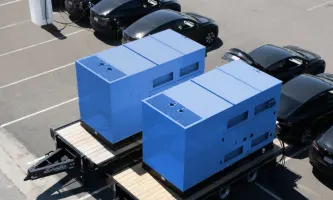
Off-grid charging assets have proven to be much more than stopgaps. Fleets can use those tools to hedge against grid delays, capacity bottlenecks, and other uncertainties.
Charging
Here's why the EV transition stopped being centered on ideology and started focusing on operational benchmarks.
Electric Vehicles
Follow these three concepts to get the most value when cycling out your electric fleet vehicles.
Operations
Successful electrification means reimagining fleet operations by building a system in which every vehicle is optimized for its role.