


Read More: How to Reduce Drivers' Idling Behavior
Preventive Maintenance Costs Increase 3-5% in 2021
A variety of factors converged to exert upward pressure on preventive maintenance costs, such as longer vehicle service lives due to limited product availability, the ongoing transition to synthetic oils, and higher labor rates to attract scarce technicians.
by Staff
November 1, 2021
The cost of raw materials is up across the board. If it goes in the vehicle, it's almost certainly more expensive than in years past.
Getty Images
8 min to read
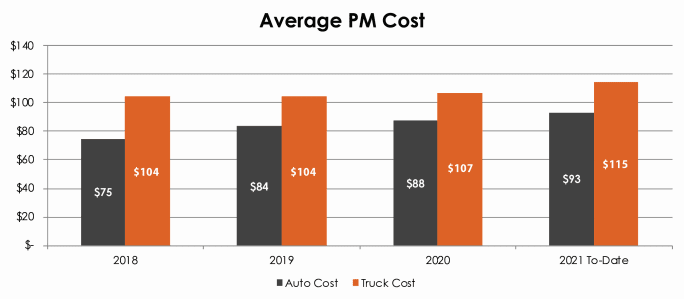
Preventive maintenance (PM) costs have increased in calendar-year 2021 primarily due to constrained new-vehicle inventory caused by a microchip shortage leading to extended service lives for those units unable to be replaced, the widespread OEM adoption of more expensive synthetic motor oils, and rising labor rates in a tight labor market.
All of these combined factors have caused PM costs to trend upward in 2021. While there are regional differences in prices, when averaged out on a national basis, PM costs in 2021 have increased.
“Consistent with recent years, PM average cost increases across most vehicle classes will likely continue in the 3-5% range annually, we’ve continued to see the PM trend of average cost increases across most vehicle classes annually in the 3-5% range, which is what we also expect for 2022,” said Chad Christensen, senior strategic consultant for Element Fleet Management.
The economic recovery has also contributed to higher PM cost, along with extreme weather conditions, such as last February’s winter storm in Texas.
“Motor oil prices spiked in 2021 as a result of an imbalance in supply and demand driven by extreme weather events and the economic recovery. Prices should ease as the imbalance is corrected,” said Mark Atchley, senior supply chain manager for Enterprise Fleet Management.
Another factor exerting upward pressure on PM costs is widespread increases in commodity prices that have impacted a variety of maintenance-related costs.
“The cost of raw materials – crude oil, rubber, etc. – is up virtually across the board. The ongoing labor shortage is also influencing costs since many manufacturers cannot sustain production levels to keep pace with demand. Add to that the number of repair facilities still struggling with their own parts and/or labor shortages, the general lack of new vehicle inventory, and vehicles remaining in service longer than originally anticipated and you can quickly see the perfect storm this creates,” said Chris Foster, manager, fleet management services for ARI.
However, the biggest factor for increased PM expenses is the widespread transition of fleet vehicles to the use of synthetic oils required by OEMs. For the past decade, more OEMs are recommending the use of more expensive synthetic motor oils, which is increasing the cost of each PM service. But the higher quality motor oil also allows the interval between these services to lengthen, which is offsetting some of the additional transaction costs.
“Factors impacting the cost of PM to fleets in 2021 include the continued use of synthetic oils, increasing percentage of overall vehicles require some blend of,” said Tim Brockschmidt, maintenance client partner for Element Fleet Management. “This is costlier per transaction, but longer lasting synthetics extends the oil change cycle.”
Compounding all of these issues are widespread supply chain constraints, which are causing fleet vehicles to be kept in service beyond their optimal recommended service lives due to the difficulty in sourcing replacement vehicles.
“The automotive industry as a whole is grappling with cost increases and a wide range of supply constraints and that certainly extends to the fleet sector as well. These disruptions are driving operating costs higher and in many cases, leading to extended downtime for fleets,” said Foster of ARI.
Lifecycle extensions of fleet vehicles due to the difficulty in sourcing replacement units is a relatively new phenomenon that is increase in PM costs at many fleets for these older, higher-mileage fleet units.
“PM costs increased due to extended vehicle replacement times as new vehicle production decreased limiting availability of replacement vehicles. This has led to more emphasis on maintaining vehicles for a longer period of time and a longer vehicle life,” said John Wuich, CAFM, vice president, consulting services for Donlen.
Another factor is longer stays at a repair facilities due to part shortages and an increase in expenses for short-term rental replacements.
“Vehicle supply constraints have also affected the rental segment, further inflating operating budgets. During the pandemic, many rental car providers liquidating a number of vehicles and relocated units to areas with sustained demand. Now, with a much smaller pool of rental units available and rental volume up significantly due to the general lack of new-vehicle inventory, fleet operators find themselves having to allocate more of their operating budget to rental costs,” said Foster of ARI.
Longer service lives for vehicles is adding additional preventive maintenance expenses for wear items that are operated beyond their recommended mileage thresholds.
“Preventive maintenance costs across all vehicle segments have increased in 2021 compared to last year. 2020 was characterized by vehicle lifecycle extensions due to fleet budget constraints. This year, fleets have continued to adjust interval schedules to account for vehicle lifecycle extensions in response to vehicle shortages and ordering delays. We expect to see higher mileage vehicles on the road in 2022, as new-vehicle inventory supply continues to struggle to meet demand,” said Joe Shinn, manager, fleet maintenance for Merchants Fleet.
One consequence to the extended service intervals is that it has increased the importance of regular oil level checks by drivers. It is also important to remind drivers, especially those operating vehicles in the commercial and vocational markets, that tires need to be rotated more often than every oil change when longer lasting synthetic motor oils are used, which could have 10,000-mile drain intervals.
“It is also important to acknowledge that as vehicles remain on the road longer, you’ll likely experience a higher percentage of downtime as your fleet ages. This is something you’ll need to account for and ensure you have the proper number of spare units available to effectively mitigate the impact of this increased downtime, especially for units that are especially critical to business operations,” said Foster of ARI.
One unintended consequence is that the pandemic contributed to higher PM costs due to a decrease in year-over-year PM compliance because fleet vehicles were driven fewer miles. “Coming out of the pandemic and as travel, overall, picked up this spring, we continued to see PM compliance that was down year-over-year,” said Wuich of Donlen. “We attribute this to fleet vehicles in industries sitting idle. Upon return, there were upticks in spend categories associated with vehicle inactivity; specifically dead batteries, low fluids, bad and leaking fluids, low or flat tires, fuel ‘gum,’ and even deteriorating oil.”
Reduced vehicle utilization was a key factor impacting PM costs in 2020 following the idling of non-essential fleets by economic lockdowns designed to slow the spread of the COVID-19 virus. “Many fleets had reduced usage in 2020, which equated to less frequent or skipped service intervals. Some fleets have seen the increase and ‘catch-up’ in services as they increase usage,” said Dale Jewell, senior director – fleet service operations for Emkay.
This accelerated with the first rollout of the mass vaccinations in January and February 2021. “The cost of PMs increased throughout 2021 as demand picked up following vaccine roll outs and the opening of state economies in the U.S. and provincial economies in Canada,” said Brockschmidt of Element Fleet Management.
Emkay
PM COST FORECAST FOR 2021-2022
The forecast is that PM costs will continue to trend upward in CY 2022.
“PM costs are expected to rise due to the cost of oil, labor cost, manufacturing, g and transportation costs. Close management of the continued extension of service intervals will be a critical component to offsetting these increases. Using the proper oil and fluids as well as capitalizing on OEM complimentary service programs are also important,” said Jewell of Emkay.
The ongoing trend of increased costs per service will continue as more and more vehicles requiring conventional oil are taken out of service and replaced with models that require synthetics.
“Recent estimates indicate that fleet operators should expect to see a five to 10% increase in operating costs for this year and next – and potentially beyond. With these disruptions likely to linger for the foreseeable future, we continue to provide proactive recommendations to our clients to help them adjust accordingly and minimize the impact on their business,” said Foster of ARI.
“PM costs should continue to increase in 2022 as manufacturers continue to manage through supply-chain disruptions associated with pandemic-related volatility. Ongoing labor shortages will continue to impact multiple areas of the repair industry despite lower unemployment rates compared to last year,” said Shinn of Merchants Fleet.
Another trend on the horizon is the potential impact of higher labor rates and whether these increased overhead costs will be passed on to fleet customers.
“The technician shortage will likely continue to drive up shop labor rates as shops must offer higher wages to attract quality talent,” said Erin Mills, national service department manager for Enterprise Fleet Management.
PRESSURE ON LABOR RATES
The ongoing labor shortages will into calendar-year 2022 and will impact multiple areas of the repair industry.
“The continued higher cost of labor, especially in urban markets, is impacting the cost of PM,” said Brockschmidt of Element Fleet Management. “The pandemic exacerbated a shortage of technicians. There are growing reports of delays especially at dealers,” said Brockschmidt. “In addition, more attention is being paid to PM compliance to ensure PM services are being done “on time” due to extended drain intervals. Longer times between oil changes can lead to lack of timely tire rotations and critical vehicle inspections, such as brakes for example,” said Brockschmidt. The cost of lubricants is another maintenance expense that is expected to increase. Lubricant prices tend to follow the crude oil market.
“Preventive maintenance costs across all vehicle segments have increased this year in comparison to last year. In 2020, the most significant factor affecting fleet PM costs was the widespread reduction of vehicle utilization resulting from the pandemic. This year, both total repair spend and average per-repair-costs increased. This can be attributed to several factors, including labor shortages, extended vehicle lifecycles, increased utilization of mobile repair services, and pandemic-related servicing costs,” said Shinn of Merchants Fleet.
One trend that continues to gaining momentum among commercial fleets, especially during the pandemic, is the use of mobile maintenance vendors. There has been a substantial uptick in fleet requests for mobile maintenance solutions as fleet managers look to minimize downtime and the administrative burden of taking their vehicle to a repair shop and having the driver wait.
“Since COVID, most clients are interested in mobile service or a pick-up and delivery service versus going into an actual brick and mortar store. This added level of service sometimes is provided at an incremental cost, and is sometimes provided without a premium. Medium-duty and heavy-duty work often has a mobile service per call/visit charge plus the actual work needed. Clients interested in this type of added value service have not pushed back on any added expense,” said Jenny Baker-Ford, manager, fleet maintenance for Mike Albert Fleet Solutions.
Topics:Fleet MaintenanceMaintenance CostsMaintenancefleet managementpreventive maintenanceElectric VehiclesHybridsOperationsBatteries/Tech
Originally posted on Automotive Fleet
Subscribe to Our Newsletter
More Electric Vehicles

EV Charging Use Is Outpacing Infrastructure Growth
ChargePoint’s 2026 Charging Forward Report points to rising charger use, higher-powered charging, commercial vehicle electrification, and energy-management technology. Here’s what fleets should know.
Read More →
EV Realty Names Henrik Holland President as Charging Platform Expands
The former Prologis Mobility and Shell executive will help expand EV Realty’s truck charging business and move its power-first infrastructure model into autonomous vehicle depots and other fleet sectors.
Read More →
GreenPower Expands New Mexico EV Pilot With Larger Buses, V2G Testing
After logging more than 17,000 electric miles in the first year, New Mexico’s statewide pilot is moving into its second phase with larger vehicles, continued charging evaluations, and more.
Read More →
Can EV-as-a-Service Help Fleets Scale Electrification?
Sustainability Partners CEO Adam Cain explains how matching EVs, charging infrastructure, and duty cycles can help fleets scale electrification.
Read More →
How EV-as-a-Service Is Moving Fleets Beyond Pilots
Adam Cain, president and CEO of Sustainability Partners, explains how EV-as-a-service can help fleets scale deployments by addressing duty-cycle requirements and charging challenges.
Read More →
PowerFlex, The Mobility House Join Forces to Advance Fleet Electrification
Two EV charging providers are joining forces to deliver a broader portfolio of energy management and fleet electrification solutions.
Read More →
Ford Retools Louisville Plant for Fathom Electric Truck Production
Ford's $2 billion Louisville Assembly Plant overhaul introduces a three-part assembly process for the Fathom midsize electric truck, with production scheduled to begin in 2027.
Read More →
Merchants Fleet Reports 290M EV Miles as Fleets Navigate Changing Electrification Market
From millions in operating savings to hundreds of millions of EV miles, Merchants Fleet’s latest report reveals what’s working and what’s changing in fleet electrification.
Read More →
California District Commits to Electrify 25% of School Bus Fleet by 2028
One of the nation's largest school bus electrification projects to date demonstrates how grants, charging infrastructure, and public-private partnerships can help fleets transition to EVs at scale.
Read More →
Aptera Orders Bodies and Chassis for Its First 40 Production Vehicles
Aptera Motors Corp. has issued purchase orders for the major structural components of its first 40 vehicles, and body and chassis components are expected to begin arriving in October.
Read More →