



Read On: 21 Fleet Leaders Nominated for the 2025 Edward J. Bobit Fleet Manager of the Year Award
Understanding Utilization and Charging Trends for Fleet EVs
The rise of EV use amongst fleets has started to display usage patterns.
August 10, 2025
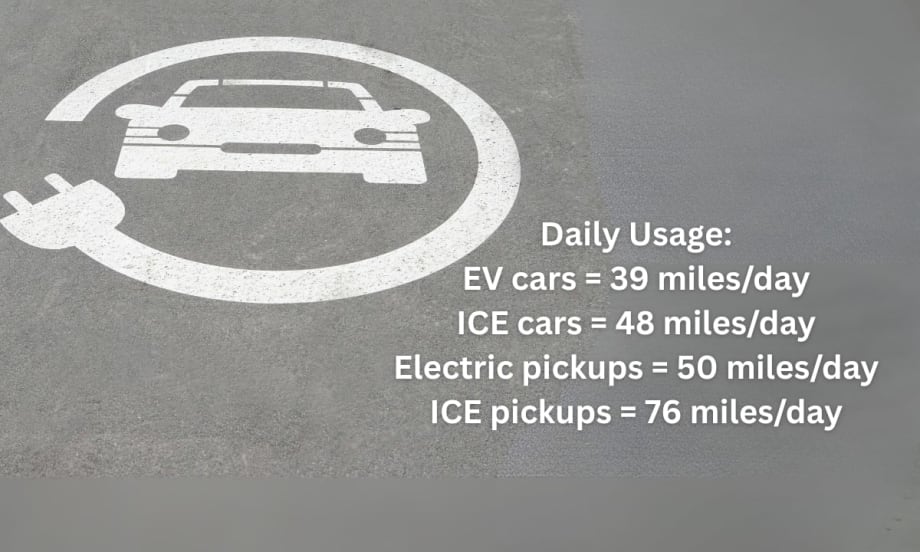
Electrification challenges are distinct amongst fleets, but small EV cars are keeping pace with ICE cars in daily mileage— at 39 miles and 48 miles— proving that the challenges can be overcome.
Source: Bobit
4 min to read
As fleets integrate electric vehicles (EVs), clear utilization patterns are emerging — and they vary between vehicle types.
Utilization Trends: How Are Fleets Using EVs Today?
As fleets integrate electric vehicles (EVs), clear utilization patterns are emerging — and they vary between vehicle types.
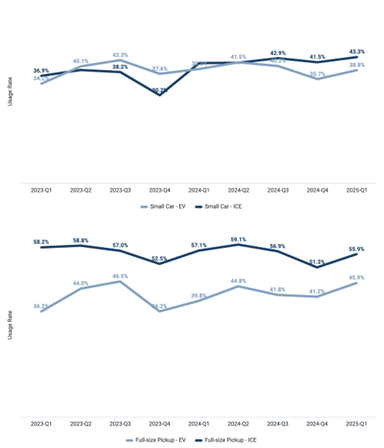
EV small cars are functioning as true like-for-like replacements for their internal combustion engine (ICE) counterparts. They’re being used in much the same way as the ICE small cars they’re replacing, often serving as general-purpose fleet assets.
Source: Bobit
Pickups, however, follow a different trend. EV pickups, which hit the market in force during the past 1-2 years, are not yet functioning as direct replacements for ICE pickups in high-utilization roles. Instead, they are more commonly deployed as supervisor vehicles or supplemental assets, rather than primary work trucks.
Our trend data shows that the average daily usage rate of an EV small car is just 0.6% lower than the average daily usage rate of an ICE small car for Q1 2023 through Q1 2025. Meanwhile, EV pickups, a newer entry to the Fleet space, report 13.5% less average usage than the ICE counterpart1. However, the EV pickups have shown a steady increase in their usage -- from 36.3% in Q1 2023 to 45.9% in Q1 2025. This suggests growing confidence in EV capabilities for some light-duty applications, while heavier-use assets are still finding their role in electric fleets.
Key Data Points:
Purchase Trends: Within the EV Consortium, x% of assets purchased have been EVs. Within the EV Consortium, prior to 2020 just 5% of assets purchased have been EVs and 9% were hybrids (HEV/PHEV) whereas since 2020 13% of assets purchased are EVs and 22% hybrids (HEV/PHEV)3. This growing percentage of fully or partially electric vehicles demonstrates confidence in EV technology and a desire to comply with corporate sustainability goals and state mandates.
Usage Trend Over Time: Quarterly data reveals steady increases in small electric cars miles, while EV pickup utilization grows more gradually as fleets experiment with their ideal use cases.
Charging Habits and Battery % Remaining: What Happens When EVs Return to Base?
Range anxiety is a well-documented concern in fleet electrification. Our 2024 Driver Sentiment Survey supports this conclusion with about 50% of respondents listing lack of range or range anxiety as primary concerns with driving an EV. 22% of respondents expressed a lack of confidence that the EV would get them to and from their destination.
The reality often looks very different. Charging behavior and battery management shed light on how EVs are actually performing in fleet operations. Data from the EV Consortium shows that in 2024 EV pickups return to their chargers at the end of their shift with 67% battery remaining4. For off-session periods where the vehicle drove at least 30 miles, it’s estimated that Full-size pickups could travel an additional 206 miles based on the kWh remaining5 — far more than what’s needed to meet their daily driving requirements or the daily driving requirements for an ICE pickup.
Key Insights:
Daily Miles Driven: EV small cars are keeping pace with ICE small cars in daily mileage, at 39 miles and 48 miles respectively, proving they’re well-suited to traditional fleet roles. EV pickups, on the other hand, average about 26 miles fewer miles per day than their ICE counterparts at 50 miles per day and 76 miles per day, respectively6.
Range Anxiety Disconnect: Driver sentiment survey results consistently highlight range anxiety as a concern, despite data showing that most EVs return to their chargers with ample battery remaining.
Observed Range vs. Manufacturer Capability: Real-World Proof
The strongest tool for overcoming range anxiety? Real-world data. By comparing actual fleet performance with manufacturer-stated range, within the Consortium, we observe that EVs typically operate well within expected ranges. This proof helps fleet managers build trust in EV capabilities, support expansion into higher-mileage duty cycles, and address the range concerns of drivers.
For example, the extended range for Ford Lightning promised ~300 miles and the median range observed is 294 miles. The extended range for Chevrolet Silverados promised ~400 miles and the median range observed is 438.7
Real-world performance data helps fleet managers set realistic expectations about what job assignments and geographies are reasonable and counter outdated assumptions about EV range limitations.
About the Electric Vehicle Consortium
The Electric Vehicle Consortium brings together fleet professionals, data analysts, and sustainability administrators to collaborate on solving the unique challenges of fleet electrification. Our members benefit from real-world data insights, collaborative research, and a strong peer network. Interested in joining or sponsoring? Contact us at evconsortium.org to learn more.
Data Sources
EVC Dataset, 2023-2025
Utilimarc Fleet Benchmarking Data (2023-2025)
EVC Driver Sentiment Survey, June 2024
Manufacturer Range Estimates (2024 Models)
Topics:Vehicle UtilizationDataEV ChargingFleet electrificationElectric VehiclesOperationsVehicle Research
Originally posted on Automotive Fleet
More Electric Vehicles

EV Charging Use Is Outpacing Infrastructure Growth
ChargePoint’s 2026 Charging Forward Report points to rising charger use, higher-powered charging, commercial vehicle electrification, and energy-management technology. Here’s what fleets should know.
Read More →
EV Realty Names Henrik Holland President as Charging Platform Expands
The former Prologis Mobility and Shell executive will help expand EV Realty’s truck charging business and move its power-first infrastructure model into autonomous vehicle depots and other fleet sectors.
Read More →
GreenPower Expands New Mexico EV Pilot With Larger Buses, V2G Testing
After logging more than 17,000 electric miles in the first year, New Mexico’s statewide pilot is moving into its second phase with larger vehicles, continued charging evaluations, and more.
Read More →
Can EV-as-a-Service Help Fleets Scale Electrification?
Sustainability Partners CEO Adam Cain explains how matching EVs, charging infrastructure, and duty cycles can help fleets scale electrification.
Read More →
How EV-as-a-Service Is Moving Fleets Beyond Pilots
Adam Cain, president and CEO of Sustainability Partners, explains how EV-as-a-service can help fleets scale deployments by addressing duty-cycle requirements and charging challenges.
Read More →
PowerFlex, The Mobility House Join Forces to Advance Fleet Electrification
Two EV charging providers are joining forces to deliver a broader portfolio of energy management and fleet electrification solutions.
Read More →
Ford Retools Louisville Plant for Fathom Electric Truck Production
Ford's $2 billion Louisville Assembly Plant overhaul introduces a three-part assembly process for the Fathom midsize electric truck, with production scheduled to begin in 2027.
Read More →
Merchants Fleet Reports 290M EV Miles as Fleets Navigate Changing Electrification Market
From millions in operating savings to hundreds of millions of EV miles, Merchants Fleet’s latest report reveals what’s working and what’s changing in fleet electrification.
Read More →
California District Commits to Electrify 25% of School Bus Fleet by 2028
One of the nation's largest school bus electrification projects to date demonstrates how grants, charging infrastructure, and public-private partnerships can help fleets transition to EVs at scale.
Read More →
Aptera Orders Bodies and Chassis for Its First 40 Production Vehicles
Aptera Motors Corp. has issued purchase orders for the major structural components of its first 40 vehicles, and body and chassis components are expected to begin arriving in October.
Read More →