



In the Switch to EVs, Many Are Leaving Big Money on the Table
Public Charging Landscape Deteriorating, J.D. Power Study Finds
The J.D. Power 2024 U.S. Electric Vehicle Experience Ownership Study identifies pain points in EV ownership, plus evaluates the top influences to customer satisfaction. See which vehicles ranked at the top in overall owner satisfaction.
March 1, 2024
Public charger availability not only remains the least satisfying aspect of owning a BEV, but also that the experience has become notably worse, particularly among non-Tesla owners.
Photo: J.D. Power/Canva/Automotive Fleet
5 min to read
Despite the difference in how battery electric vehicles and internal combustion engine vehicles are powered, what vehicle owners look for in the two remains the same.
Quality and cost of ownership have emerged as the top factors influencing satisfaction among EV owners, according to the J.D. Power 2024 U.S. Electric Vehicle Experience Ownership Study.
Another key finding in the study reveals that public charger availability not only remains the least satisfying aspect of owning a BEV, but also that the experience has become notably worse.
Now in its fourth year, the U.S. Electric Vehicle Experience Ownership Study focuses on the crucial first year of ownership.
Key Findings From the U.S. Electric Vehicle Experience Ownership Study
Below are some of the key findings J.D. Power highlighted from the study.
Publicchargingisn’tjustbad; it’sgettingworse: The study finds that the public charging experience continues to be a major source of EV owner frustration. Further, non-Tesla owners indicate that the situation is deteriorating. While more OEMs continue to create adapters so their vehicles can use Tesla's massive Supercharger network, the process takes time.
Among mass market BEV owners, satisfaction with public charger availability is 32 points lower than a year ago. “The industry should view this lack of improvement as a critical issue that requires decisive action,” Gruber said.Mass market BEVs deliver higher quality than premium BEVs: Owners of mass market brand BEVs experience fewer problems with their vehicle than do owners of premium BEVs. Eleven of the 14 ranked mass market models outperform the premium brand market average in total problems.
“Quality and reliability are the most important drivers of a positive EV ownership experience,” said Brent Gruber, executive director of the EV practice at J.D. Power. “As EVs extend to the broader market, minimizing problems will be key to meeting consumer expectations.”First-time BEV owners are less satisfied than BEV veterans: Buyers new to BEV ownership are less satisfied than those who have previously owned a BEV. This year, the satisfaction gap between the two groups is 28 points, whereas a year ago, the gap was 14 points.
Overall satisfaction among first-time BEV owners has declined 16 points from 2023. Battery range and public charging availability are the two factors in which the gap between previous BEV owners and new owners is greatest.Most BEV owners say they’ll consider a BEV again, but first-time BEV owners may be more fickle: First-time BEV owners say they are open to considering non-BEVs in the future. However, almost half (48%) say they will consider a plug-in hybrid vehicle and 39% say they are willing to consider hybrid or ICE vehicles.
Meanwhile, 38% of previous BEV owners say they are willing to consider a PHEV and only 19% would consider a hybrid or ICE vehicle for their next purchase.PHEVs might not present a good alternative to BEVs: Some experts have suggested plug-in hybrid vehicles could solve many of the issues plaguing BEVs, such as range limitations and lack of public charging availability.
However, this year’s study finds PHEV owners are, on the whole, much less satisfied with their vehicle than owners of BEVs are. Overall satisfaction with PHEVs is 629, while mass market BEVs and premium BEVs score much higher at 718 and 750, respectively.
“Plug-in hybrids may not be the simple solution to solving early issues with full battery electric vehicles,” Gruber said. “Expected lower running costs is a top purchase reason for EVs but satisfaction with the cost of ownership is much lower for plug-in hybrids. Plug-in hybrids retain the costs of maintaining a traditional powertrain yet without the benefit of the extended electric driving range found in full battery electric vehicles.”
Quality remains one of the biggest factors in EV ownership satisfaction, having also ranked on top in 2023. However, cost of ownership comes in as the other top factor, whereas styling took that spot in 2023.
Which Vehicles Ranked Highest
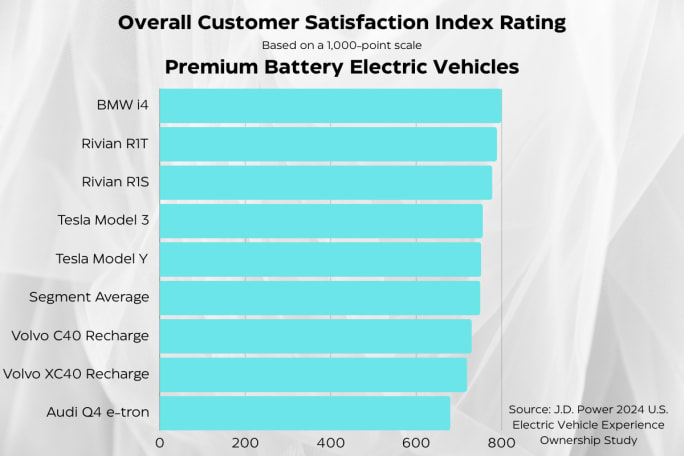
The BMW i4 ranks highest overall and highest in the premium BEV segment in J.D. Power's 2024 U.S. Electric Vehicle Experience Ownership Study.
Photo: J.D. Power/Canva
In the study, BEV owners rated their overall satisfaction with their specific vehicle makes and models.
The overall EVX ownership index score measures EV owner satisfaction in both premium and mass market segments. The 2024 study includes 10 factors:
Accuracy of stated battery range
Availability of public charging stations
Battery range
Cost of ownership
Driving enjoyment
Ease of charging at home
Interior and exterior styling
Safety and technology features
Service experience
Vehicle quality and reliability
The vehicles topping the list in the two segments rank highest in their respective segment on the strength of their performance in the vehicle quality and reliability factor.
The BMW i4 ranks highest overall and highest in the premium BEV segment with a score of 800. The Rivian R1T pickup truck ranks second at 789, and its Rivian R1S SUV counterpart ranks third at 778.
The MINI Cooper Electric ranks highest in the mass market BEV segment for a second consecutive year, with a score of 770. The Ford Mustang Mach-E ranks second just behind it at 764 and the Hyundai IONIQ 6 ranks third at 759.
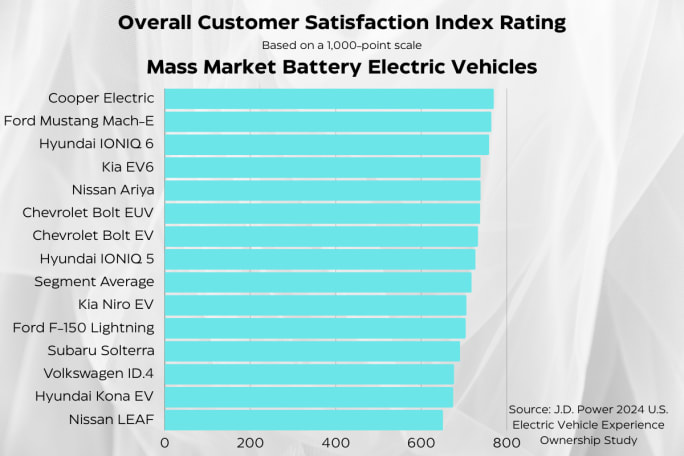
The MINI Cooper Electric ranks highest in the mass market BEV segment for a second consecutive year in J.D. Power's 2024 U.S. Electric Vehicle Experience Ownership Study.
Photo: J.D. Power/Canva
The BMW i4 and MINI Cooper Electric each score more than 60 points higher — on a 1,000-point scale — than their respective nearest segment competitor for that factor.
“The increase in the EV share of the new-vehicle market, reflected by seven new rank-eligible models this year, is a notable step in the transition toward vehicle electrification,” Gruber said. "Many products are hitting the mark and resonating with shoppers but, at the same time, the decline in satisfaction with public charging availability should serve as a warning because concern about access to public charging is a key reason many buyers currently reject BEVs. For EVs to reach their full potential, this issue needs to be resolved."
The number of award-eligible models in the premium segment has grown from five to eight year over year.
Award-eligible mass market models have increased from 10 to 14. Satisfaction among owners of premium EVs averages 750, while satisfaction among mass market EV owners averages 718.
The study is conducted in collaboration with PlugShare, an EV driver app maker and research firm.
Survey respondents for the 2024 study include 4,650 owners of 2023 and 2024 model-year BEVs and PHEVs. The study was fielded from August through December 2023.
Originally posted on Automotive Fleet
More Electric Vehicles

EV Charging Use Is Outpacing Infrastructure Growth
ChargePoint’s 2026 Charging Forward Report points to rising charger use, higher-powered charging, commercial vehicle electrification, and energy-management technology. Here’s what fleets should know.
Read More →
EV Realty Names Henrik Holland President as Charging Platform Expands
The former Prologis Mobility and Shell executive will help expand EV Realty’s truck charging business and move its power-first infrastructure model into autonomous vehicle depots and other fleet sectors.
Read More →
GreenPower Expands New Mexico EV Pilot With Larger Buses, V2G Testing
After logging more than 17,000 electric miles in the first year, New Mexico’s statewide pilot is moving into its second phase with larger vehicles, continued charging evaluations, and more.
Read More →
Can EV-as-a-Service Help Fleets Scale Electrification?
Sustainability Partners CEO Adam Cain explains how matching EVs, charging infrastructure, and duty cycles can help fleets scale electrification.
Read More →
How EV-as-a-Service Is Moving Fleets Beyond Pilots
Adam Cain, president and CEO of Sustainability Partners, explains how EV-as-a-service can help fleets scale deployments by addressing duty-cycle requirements and charging challenges.
Read More →
PowerFlex, The Mobility House Join Forces to Advance Fleet Electrification
Two EV charging providers are joining forces to deliver a broader portfolio of energy management and fleet electrification solutions.
Read More →
Ford Retools Louisville Plant for Fathom Electric Truck Production
Ford's $2 billion Louisville Assembly Plant overhaul introduces a three-part assembly process for the Fathom midsize electric truck, with production scheduled to begin in 2027.
Read More →
Merchants Fleet Reports 290M EV Miles as Fleets Navigate Changing Electrification Market
From millions in operating savings to hundreds of millions of EV miles, Merchants Fleet’s latest report reveals what’s working and what’s changing in fleet electrification.
Read More →
California District Commits to Electrify 25% of School Bus Fleet by 2028
One of the nation's largest school bus electrification projects to date demonstrates how grants, charging infrastructure, and public-private partnerships can help fleets transition to EVs at scale.
Read More →
Aptera Orders Bodies and Chassis for Its First 40 Production Vehicles
Aptera Motors Corp. has issued purchase orders for the major structural components of its first 40 vehicles, and body and chassis components are expected to begin arriving in October.
Read More →