


Further Reading: The 40-Millionth Ford F-Series
Ford Releases New Battery Capacity Plan Amid Ambitious Global Production Goals
Increased capacity for high-demand battery products has prompted Ford to secure 60 gigawatt hours of annual battery capacity as part of a 600,000-EV production run by late 2023.

Jordan Wiklund・Former Senior Editor
As Ford reimagines its EV supply chain, consumer praise for the Mustang Mach-e and other electric models is high for its first-generation EVs already in-market while demand signals among potential EV buyers continue strengthening.
Photo: Ford Motor Co.
4 min to read
Building on strong demand for its new EVs, Ford recently announced several initiatives for sourcing battery capacity and raw materials that enable its targeted annual run rate of 600,000 electric vehicles by late 2023 and more than 2 million by the end of 2026.
The company detailed its global vehicle portfolio plans supporting these production goals as part of its Ford+ plan. Ford expects a compound annual growth rate for EVs to exceed 90% through 2026 — more than double forecasted global industry growth.
“Ford’s new electric vehicle lineup has generated huge enthusiasm and demand, and now we are putting the industrial system in place to scale quickly,” said Jim Farley, Ford’s president and CEO and president of Ford Model e. “Our Model e team has moved with speed, focus and creativity to secure the battery capacity and raw materials we need to deliver breakthrough EVs for millions of customers.”
Ford plans to invest over $50 billion in EVs through 2026, targeting total company adjusted EBIT margins of 10% and 8% EBIT margins for EVs by 2026.
As Ford creates a new EV supply chain that upholds its commitments to sustainability and human rights, the company continues to plan for more than half its global production to be EVs by 2030 and to achieve carbon neutrality globally no later than 2050.
What 600,000 Ford EVs Looks Like
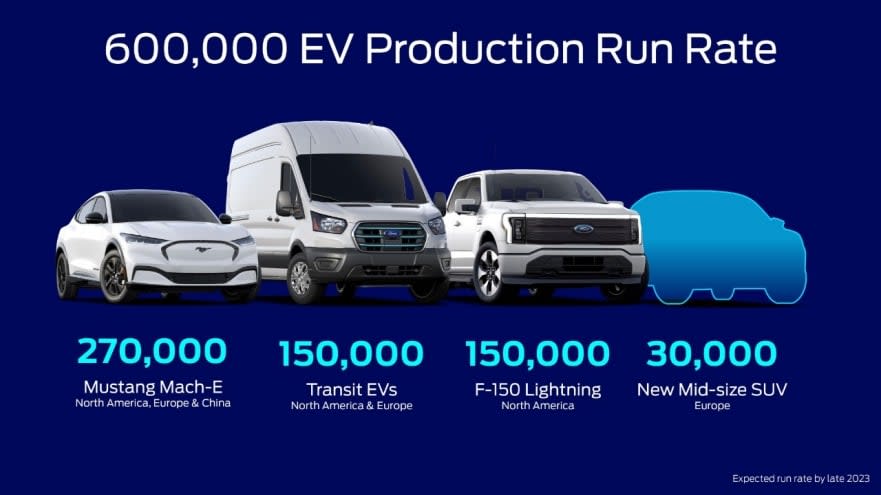
Ford plans to reach a 600,000 global EV run rate by late 2023 with the following models:
270,000 Mustang Mach-Es for North America, Europe, and China
150,000 F-150 Lightnings for North America
150,000 Transit EVs for North America and Europe
30,000 units of an all-new SUV for Europe, whose run rate will significantly ramp in 2024
Ford is adding lithium iron phosphate (LFP) cell chemistry to its portfolio, alongside its existing nickel cobalt manganese (NCM) chemistry. This creates even more capacity for high-demand products and provides customers many years of operation with minimal range loss. It also reduces the reliance on scarce critical minerals such as nickel and, at current costs, brings a 10 to 15% bill of material savings for Ford versus NCM batteries.
The company confirmed it has secured 100% of the annual battery cell capacity needed – 60 gigawatt hours (GWh) – to support this 600,000 EV run rate by working with leading battery companies around the globe.
Ford announced that Contemporary Amperex Technology Co., Ltd. (CATL) will provide full LFP battery packs for Mustang Mach-E models for North America starting next year as well as F-150 Lightnings in early 2024. Ford’s EV architecture flexibility allows efficient incorporation of CATL’s prismatic LFP cell-to-pack technology, delivering incremental capacity quickly to scale and meet customer demand.
Ford also is leveraging its long-standing connection with LG Energy Solution (LGES) and its strategic relationship with SK On to meet its battery capacity target for late 2023.
Long-time supplier LGES has scaled quickly and doubled its capacity at its Wroclaw, Poland, facility to support incremental NCM cell production for Mustang Mach-E and E-Transit models.
Plus, SK On has installed capacity to support the scaling of Ford’s high-volume F-150 Lightning and E-Transits through late 2023 – scaling NCM cell production beyond earlier-planned levels from its Atlanta facility and providing new battery cell capacity from its Hungary operation.
EV Demand
As Ford reimagines its EV supply chain, consumer praise for the Mustang Mach-e and other electric models is high for its first-generation EVs already in-market while demand signals among potential EV buyers continue strengthening.
For the first time, the majority of consumers who intend to buy a car in the next two years say they will choose an EV or hybrid vehicle – up 11% from last year and 22% from 2020, according to research published by EY. Most of that increase is for full EVs.
Among commercial owners who don’t already deploy EVs, 60% of U.S. fleet managers said in a Ford Pro survey they plan to add EVs to their operations within two years.
Market reaction to F-150 Lightning and Mustang Mach-E is strong, bringing all-new customers to Ford. Mustang Mach-E shares the top spot in its segment for in-market vehicle shoppers’ favorable opinion, according to a Q1 Ford study, while F-150 Lightning’s favorable opinion was second only to the F-150 powered by an internal combustion engine.
Topics:Environmental Social and Governance (ESG)Battery ChargingFordElectric InfrastructureElectric VehiclesVehicle Research
Originally posted on Automotive Fleet
More Electric Vehicles
EV Charging Use Is Outpacing Infrastructure Growth
ChargePoint’s 2026 Charging Forward Report points to rising charger use, higher-powered charging, commercial vehicle electrification, and energy-management technology. Here’s what fleets should know.
Read More →
EV Realty Names Henrik Holland President as Charging Platform Expands
The former Prologis Mobility and Shell executive will help expand EV Realty’s truck charging business and move its power-first infrastructure model into autonomous vehicle depots and other fleet sectors.
Read More →
GreenPower Expands New Mexico EV Pilot With Larger Buses, V2G Testing
After logging more than 17,000 electric miles in the first year, New Mexico’s statewide pilot is moving into its second phase with larger vehicles, continued charging evaluations, and more.
Read More →
Can EV-as-a-Service Help Fleets Scale Electrification?
Sustainability Partners CEO Adam Cain explains how matching EVs, charging infrastructure, and duty cycles can help fleets scale electrification.
Read More →
How EV-as-a-Service Is Moving Fleets Beyond Pilots
Adam Cain, president and CEO of Sustainability Partners, explains how EV-as-a-service can help fleets scale deployments by addressing duty-cycle requirements and charging challenges.
Read More →
PowerFlex, The Mobility House Join Forces to Advance Fleet Electrification
Two EV charging providers are joining forces to deliver a broader portfolio of energy management and fleet electrification solutions.
Read More →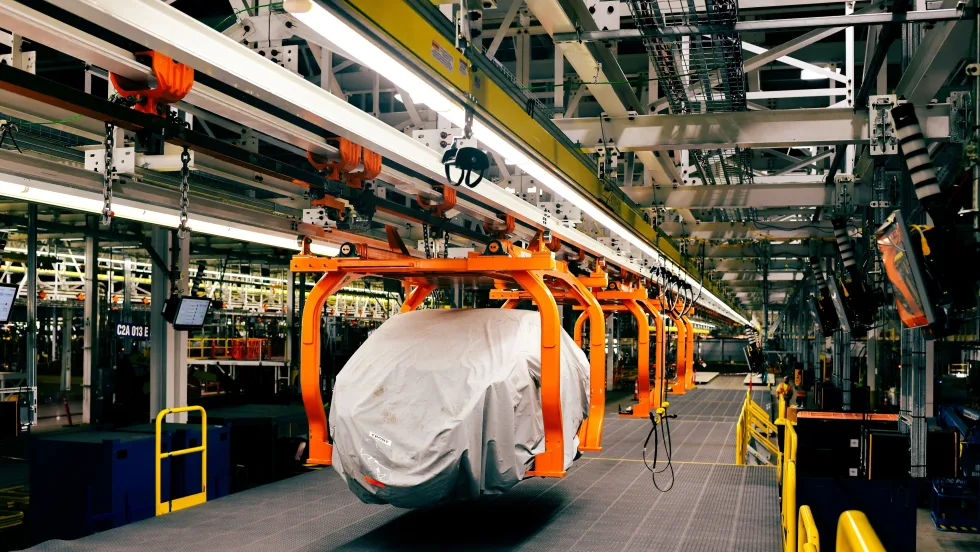
Ford Retools Louisville Plant for Fathom Electric Truck Production
Ford's $2 billion Louisville Assembly Plant overhaul introduces a three-part assembly process for the Fathom midsize electric truck, with production scheduled to begin in 2027.
Read More →
Merchants Fleet Reports 290M EV Miles as Fleets Navigate Changing Electrification Market
From millions in operating savings to hundreds of millions of EV miles, Merchants Fleet’s latest report reveals what’s working and what’s changing in fleet electrification.
Read More →
California District Commits to Electrify 25% of School Bus Fleet by 2028
One of the nation's largest school bus electrification projects to date demonstrates how grants, charging infrastructure, and public-private partnerships can help fleets transition to EVs at scale.
Read More →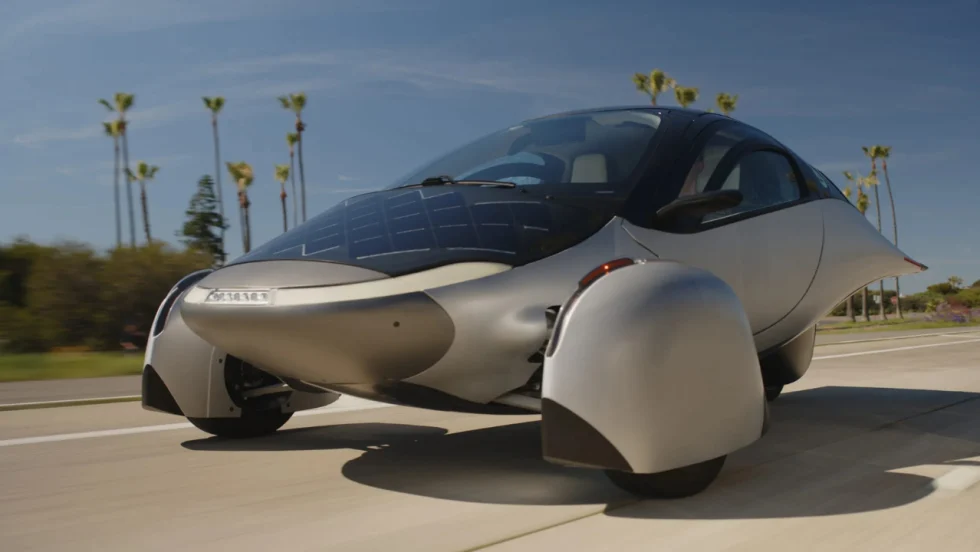
Aptera Orders Bodies and Chassis for Its First 40 Production Vehicles
Aptera Motors Corp. has issued purchase orders for the major structural components of its first 40 vehicles, and body and chassis components are expected to begin arriving in October.
Read More →