Charged Fleet Logo

Electrified Fleets Could Save 37-44% in Energy Costs

A white paper from AMPLY Power quantifies the vast cost savings in fuel, health effects, and pollution in the 25 largest U.S. metro areas.

August 4, 2021
Electrified Fleets Could Save 37-44% in Energy Costs

The environmental benefits of these efforts can fortify the economic benefits, where each fleet transition can substantially reduce carbon into the atmosphere. For each 15-vehicle fleet that transitions to electrification, AMPLY has uncovered that as many as two million kilograms of CO2 emissions can be avoided.

Graphic: AMPLY Power

3 min to read


Government agencies, school districts, and private fleet operators alike are all seeking solutions to save on fuel costs while reducing greenhouse gas emissions.

AMPLY Power, a provider of charge management services and software for fleets, on Aug. 3 released its 2021 white paper, Managed Charging Accelerates Cost and Health Benefits of EVs, assessing the cost saving potential of transitioning to an electric vehicle (EV) fleet in the top 25 U.S. metro areas.

Ad Loading...

The white paper also examines the correlation between the effects of local pollution from fossil fuel fleets and the economics of transitioning to zero emission fleets, with the potential of avoiding $72 billion in adverse health effects, according to a news release summarizing the white paper.

The white paper uses AMPLY’s proprietary dollar per gallon-equivalent (DPGe) metric, which is the dollars needed to drive an EV the same number of miles compared to an internal combustion engine (ICE) vehicle, expressed in a per gallon basis and adjusted for city-specific electricity rates structures and vehicle efficiencies.

In all of the top 25 metro areas, a charge management system (CMS) can offer EV fleets savings of up to 83% compared to diesel and unmanaged electric fleet charging operations. AMPLY developed an interactive DPGe map which directly compares these different fueling types.

Findings of the DPGe calculation across the top 25 U.S. Metros reveal the following for different fleet vehicle types:

  • In 22 metros, powering light-duty vehicles with electricity is 44% cheaper than fueling with gasoline.

  • In all 25 of the top 25 U.S. metros, electric power is 43% cheaper than gasoline for medium-duty vehicles.

  • In 24 of the Top 25 U.S. Metros, electric charging is 37% cheaper than diesel to fuel heavy-duty fleets.

  • In all 25 of the top 25 U.S. metros, switching from diesel to electricity for city bus fleets reveals a cost savings of 63%.

“In order to give a more complete picture of the costs involved for fleets considering the transition to electric, we expanded our study this year to include community health and medical expense impacts,” said Vic Shao, CEO and founder of AMPLY Power, in the news release. “The findings and implications of this assessment should influence how fleet managers, electric utilities, policymakers, and regulators think about electric vehicle fleets in their businesses, states, or regions.”

The environmental benefits of these efforts can fortify the economic benefits, where each fleet transition can substantially reduce carbon into the atmosphere. For each 15-vehicle fleet that is electrified, AMPLY has uncovered that up to two million kilograms of CO2 emissions can be avoided.

Ad Loading...

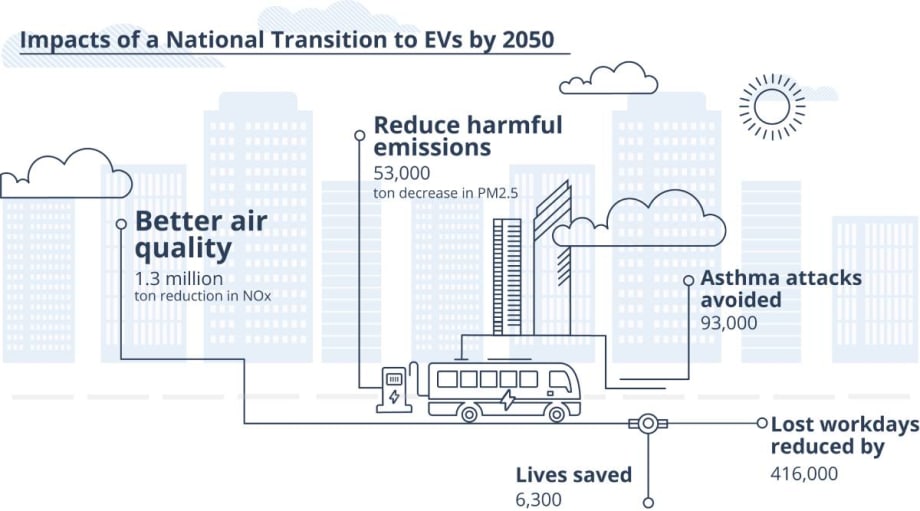
Widespread electrification has positive health impacts on frontline communities.  As an example, working with data from The Journal of Allergy and Clinical Immunology, AMPLY’s analysis indicates an economic impact of $.01 per vehicle mile travelled (VMT) in the cost of treating children affected by traffic-related asthma for Los Angeles County. Further, the white paper points out that a national transition to electric vehicles could produce emission reductions by 2050 that equate to $72 billion in avoided health effects, which can be attributed to a 1.3 million ton decrease in NOx and a 53,000 ton decrease in PM2.5.

“Our DPGe results show there is real economic value to electrifying vehicle fleets, but that value must be understood in locational- and operational-specific terms,” Shao said. “Because there is still variability due to utility rate structures and peak charging windows, fleets need to consider a managed charging approach so that energy and electric fleet operating costs can be significantly reduced.”

AMPLY Power supports fleets as they consider switching to electric vehicles. Recently, AMPLY unveiled its initiative to transition all California customers, including Tri Delta Transit, Solano County Transit, Palermo Union School District and Anaheim Transportation Network, to 100% renewable energy. Additionally, AMPLY partnered with Duke Energy earlier this year to assist in delivering clean electricity for customers using a patent-pending solar canopy mount. In 2021 alone, the company has made strides toward promoting the adoption of fleet electrification with their partnerships with UES, U.S. Gain, BYD, and CPower.


More Operations

PG&E PowerHouse demo home in San Ramon with wall-mounted EV chargers, batteries, and electric systems, showcasing all-electric home technologies and energy management solutions.
Chargingby News/Media ReleaseApril 23, 2026

All Electric Test House Could Ease Path To EV Usage

An experimental model home shows how residential charging could enable electric fleet operations by allowing drivers to take EVs home.

Read More →
Lucid electric vehicle equipped with rooftop sensors parked outside a modern building, representing expanded partnership with Uber for future robotaxi deployment.

Lucid Receives New Investments As It Expands Uber Robotaxi Venture

Lucid and Uber partner to provide at least 35,000 vehicles, backed by new investments totaling $750 million to support the deployment of autonomous fleets.

Read More →
Dan Hilson and Martin Romjue photos on the title page.
Chargingby Martin RomjueApril 14, 2026

Software Speeds Up EV Fleet Charging

Learn about a new level of energy management that helps fleets control costs while maintaining service reliability. [VIDEO]

Read More →
Ad Loading...
Two business leaders in blue suits shake hands in front of a U.S. flag and balloons, symbolizing AVILOO’s leadership transition and expansion in the North American EV market.

Brett Lippel Named CEO of AVILOO North America

AVILOO recently appointed Brett Lippel as CEO of its North American operations with the intent to drive nationwide adoption of advanced battery-testing tech.

Read More →
Person charging an electric vehicle at a public EV charging station, holding the charging connector next to a parked electric car outdoors.
Chargingby News/Media ReleaseApril 8, 2026

ChargePoint, South Coast AQMD Reach 90+ EV Chargers Across Southern California

ChargePoint deployed more than 90 EV charging ports, adding new Level 2 infrastructure and management tools to support public and employee access to charging in Southern California.

Read More →
Charged Fleet Off Peak logo thumbnail with symbolic lightning bolt.
Electric Vehiclesby Martin RomjueApril 3, 2026

OEMS Expose Overdue EV Truths

Recent announcements from two automakers underscore a significant shift in the electric vehicle market, driven by EV losses and changing strategies. [VIDEO}

Read More →
Ad Loading...
Map of the United States showing EV cost savings per mile by state, with darker shading indicating higher savings based on fuel and maintenance costs.

New Tool Helps Calculate EV Savings As Gas Prices Surge

A new online calculator from Coltura estimates how much drivers can save by switching to an EV, using real-time local fuel and electricity costs.

Read More →
Two blue large box mobile chargers parked along a row of black Tesla EV sedans in a parking lot.
ChargingApril 1, 2026

Why Off-Grid Charging is Becoming an Operational Choice, Not a Last Resort

Off-grid charging assets have proven to be much more than stopgaps. Fleets can use those tools to hedge against grid delays, capacity bottlenecks, and other uncertainties.

Read More →
Interior view of a Rivian vehicle showing steering wheel and digital display screen with vehicle interface, representing autonomous technology development.
Suppliersby News/Media ReleaseMarch 27, 2026

Uber, Rivian Aim To Deploy 50,000 Self-Driving Robotaxis

Rivian and Uber plan to put the first 10,000 autonomous R2 robotaxis into service starting in 2028 and expand to multiple cities as part of a broader push.

Read More →
Ad Loading...
Graphic used with a report on electric and hybrid vehicle collision claims, highlighting industry trends in repair frequency, costs and parts usage as EV adoption grows.

EV Collision Claims Rise 14% In U.S. Despite Slower Sales

Mitchell’s latest EV Collision Insights report found repairable claims for electrified vehicles continued to rise in 2025, even as new BEV sales declined slightly in the U.S.

Read More →