


Euro-Lessons for Electric Vehicle Fleets and Remarketers
CAR 2023: What will be the foundations of a steady and productive used market for electric vehicles? What steps must be taken to ensure a viable EV sector?

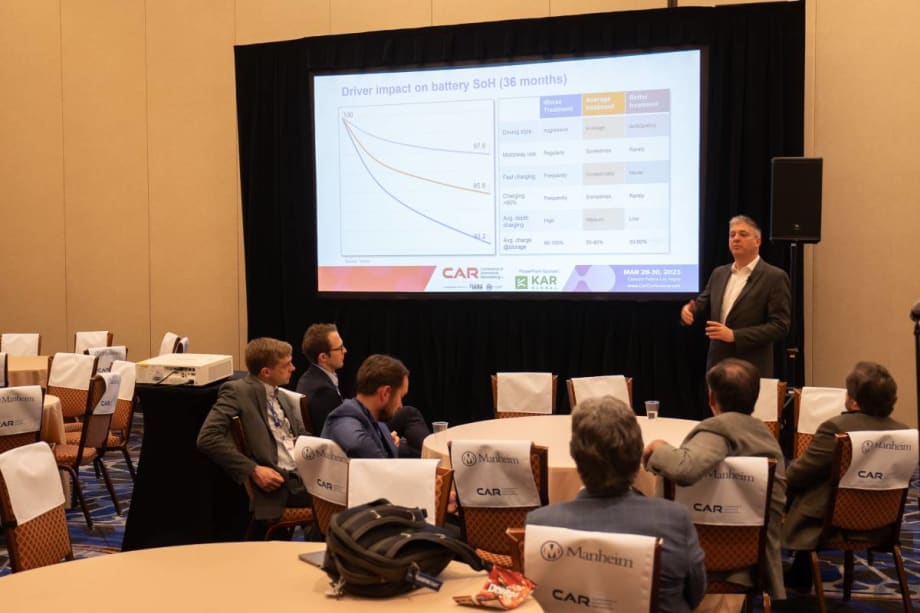
Johan Verbois, managing partner of 5s Consulting in Antwerp, Belgium details the track record of electric vehicles across Europe during his presentation March 29, 2023 at the Conference of Automotive Remarketing in Las Vegas.
Photo: Ross Stewart / Stewart Digital Media
If the electric vehicle wave builds and sweeps across transportation, it will first need strength from a deep enough sea of infrastructure, consistent battery evaluations and standards, and reliable valuations.
Those are among the many insights derived from the European electric vehicle market, which remains a few steps ahead of the U.S. one.
“I think the most dangerous thing is complacency,” said Johan Verbois, managing partner of 5s Consulting in Antwerp, Belgium during the Conference of Automotive Remarketing on March 29. “We need to be open. It's not about whether the wave will move there completely. No, it will move. But if it's 80/20, or it’s 70/30, it’s just as hard.”
Meeting the Big Electric Vehicle Challenges
Verbois presented a session, “The Realities of Electric Vehicles in Fleets & Remarketing Channels,” that covered three key and related areas, which pose specific challenges to the remarketing industry:
The customer journey, such as physical-digital formats and e-commerce channels
The powertrain transition, including how to handle and sell used electric vehicles
Changing distribution models, from dealers, to auctions, to direct sales
“When is the wave going to come?” Verbois asked. “We need to prepare and know the infrastructure; we need to know when to do what.”
Verbois previously worked as head of fleet remarketing and dealer development at Toyota Motor Europe. He also has held various positions in sales and marketing with General Motors, Opel, Peugeot, and Mercedes-Benz. He now serves on the board of the Car Remarketing Association Europe (CARA).
Verbois cited the following trends and stats from his recent research:
14% of the European vehicle market in 2022 was pure electric vehicles and another 9% were PHEVs.
In 2022, 79% of all new cars sold in Norway were 100% battery-electric powered vehicles.
In Belgium, 78% of electric vehicles are in fleets, while in the Netherlands 48% are in fleets. The share of EV fleet usage overall is higher than private use in Europe.
Electric Vehicle Battery Usage Determines Quality
After considering the price of an electric vehicle, the battery is the main element that concerns buyers, Verbois said.
Driving and charging behavior affects an EV battery. Not everyone charges in the same way, while mileage varies among drivers depending on distances driven.
Determining battery capacity and range on a used electric vehicle often depends on learning the history of the vehicle’s usage, Verbois said.
“This is not yet an exact science. Many companies know this is the case. So how do you measure this? How can you go back in history and calculate the value? How can you show that his driver has not done what he should have done? If for example, he only drove 50 miles a day and he used a fast charge every other day?” Verbois asked while illustrating the challenge.
One lesson learned is it’s better to charge an EV for one hour and drive away than charge it and not drive it for 24 hours.
“That’s because the battery is warm and has been charged. If you then start driving, it doesn't need to warm up anymore and doesn't use energy.”
Even in European countries with many electric vehicles, drivers lack adequate information and communication, Verbois said. To build confidence in EV resales for consumers, the market needs a consistent certification of the car’s condition.
“Everyone wants to prove how bad the batteries are. No one sees it from a sales perspective on how can we guarantee that this car is good for you?” Verbois said.
A used EV’s range and battery capacity can vary based on how far and often the new buyer will drive it. Some customers won’t need the maximum range. “What do we need to have to convince someone that the EV is for them?”

Determining battery capacity and range on a used electric vehicle often depends on learning the history of the vehicle’s usage, Verbois told session attendees.
Photo: Ross Stewart / Stewart Digital Media
Obstacles & Opportunities for Electric Vehicles
To keep EVs affordable, focusing on residual values is more important than ever for an OEM. There are many external factors that must be sorted out, from government regulations, taxation, inflation, depreciation, interest rates, and incentives.
The used EV market in Europe has not yet fully developed enough aggregate data for consistent assessments and valuations, Verbois said.
Meanwhile, the online environment needs to support consumers and B2B buyers in ways that can help them analyze the vehicles in searches based on consistent metrics and standards.
“In an auction environment, there's information that the buyer needs because they want to buy the correct vehicle for the one that will buy the vehicle from them,” he said. “Even in Europe, the skills and the knowledge are not where it should be.”
A recent survey showed that right after price (69%), the second most important subject for used EV buyers is the battery. Here are some hard truths about electric vehicles:
Battery deterioration is technically unavoidable
Range deteriorates according to how temperature affects it
Consumption remains relatively stable
Driving and charging behavior affects length of range
These factors all contribute to the battery state of health (SoH)
A battery considered in the best condition is one where the driver has followed these practices:
Anticipated, or scheduled driving trips
Rare use of highways and interstates
No fast charging
Rare charging of battery beyond 90% capacity
Low average depth charging
30%-50% average charge at storage
To help standardize the process, CARA Europe established a working group in April to facilitate remarketing and support residual values of used BEVs through:
Trust in the battery
Easy communication with buyers
Independent assessments and certification
The end goals are to:
Set the SoH standard
Evaluate technology and process possibilities for vehicle individual battery assessment
Review, validate and real-life test technologies for obtaining SOH data
Propose a settlement process in case of disputes
Many of the challenges and opportunities will increase the costs of electric vehicles
Among the challenges:
Transportation safety
Vehicle weight
Energy consumption
Loading capacity
Opportunities:
Compound upgrades for efficiency and safety that will improve the performance and amenities of EVs
Possibility of remote inspections
Assessing fair wear and tear leading to the battery state of health
Determining a detailed SoH report and refurbishment needs
Residual values are even more critical for BEVs based on these TCO factors: Depreciation, which comprises 62% of the residual value, financing, taxes, insurance, service, consumption, and highway usage.
Making Electric Vehicle Resales Consumer-Friendly
Verbois presented five key EV consumer needs for digital retailing and e-commerce:
Convenience: Support my online journey with an easy experience, smooth and seamless.
Security: Give me peace of mind that whenever something would go wrong, there is a safety net.
Trust seller: Support my need for reassurance that vendor can be trusted.
Trust vehicle: Help me to be confident that the vehicle is in line with expectations by a transparent view without hiding any details.
“My” car = choice: Facilitate my search to find the best choice for me personally supported by filters, favorites, and comparisons. I need to check all details to be sure.
Research of used vehicle customer websites across 240 fields found the following standards for successful EV resales:
Search: Narrow down the search to give the consumer the confidence to choose the best possible vehicle based on their preferences.
Display: Describe and display the vehicle to create confidence in the choice and increase desire of the product.
Electrification: Support the BEV customer in their purchase by adding the required information and trust.
Sales: Create a seamless consumer online flow by offering the required services while adding ancillary services sales opportunities.
Trust: Create trust in both seller and vehicle by highlighting quality, being transparent on vehicle history and consumer experiences and offering a safety net.
More Electric Vehicles
EV Charging Use Is Outpacing Infrastructure Growth
ChargePoint’s 2026 Charging Forward Report points to rising charger use, higher-powered charging, commercial vehicle electrification, and energy-management technology. Here’s what fleets should know.
Read More →
EV Realty Names Henrik Holland President as Charging Platform Expands
The former Prologis Mobility and Shell executive will help expand EV Realty’s truck charging business and move its power-first infrastructure model into autonomous vehicle depots and other fleet sectors.
Read More →
GreenPower Expands New Mexico EV Pilot With Larger Buses, V2G Testing
After logging more than 17,000 electric miles in the first year, New Mexico’s statewide pilot is moving into its second phase with larger vehicles, continued charging evaluations, and more.
Read More →
Can EV-as-a-Service Help Fleets Scale Electrification?
Sustainability Partners CEO Adam Cain explains how matching EVs, charging infrastructure, and duty cycles can help fleets scale electrification.
Read More →
How EV-as-a-Service Is Moving Fleets Beyond Pilots
Adam Cain, president and CEO of Sustainability Partners, explains how EV-as-a-service can help fleets scale deployments by addressing duty-cycle requirements and charging challenges.
Read More →
PowerFlex, The Mobility House Join Forces to Advance Fleet Electrification
Two EV charging providers are joining forces to deliver a broader portfolio of energy management and fleet electrification solutions.
Read More →
Ford Retools Louisville Plant for Fathom Electric Truck Production
Ford's $2 billion Louisville Assembly Plant overhaul introduces a three-part assembly process for the Fathom midsize electric truck, with production scheduled to begin in 2027.
Read More →
Merchants Fleet Reports 290M EV Miles as Fleets Navigate Changing Electrification Market
From millions in operating savings to hundreds of millions of EV miles, Merchants Fleet’s latest report reveals what’s working and what’s changing in fleet electrification.
Read More →
California District Commits to Electrify 25% of School Bus Fleet by 2028
One of the nation's largest school bus electrification projects to date demonstrates how grants, charging infrastructure, and public-private partnerships can help fleets transition to EVs at scale.
Read More →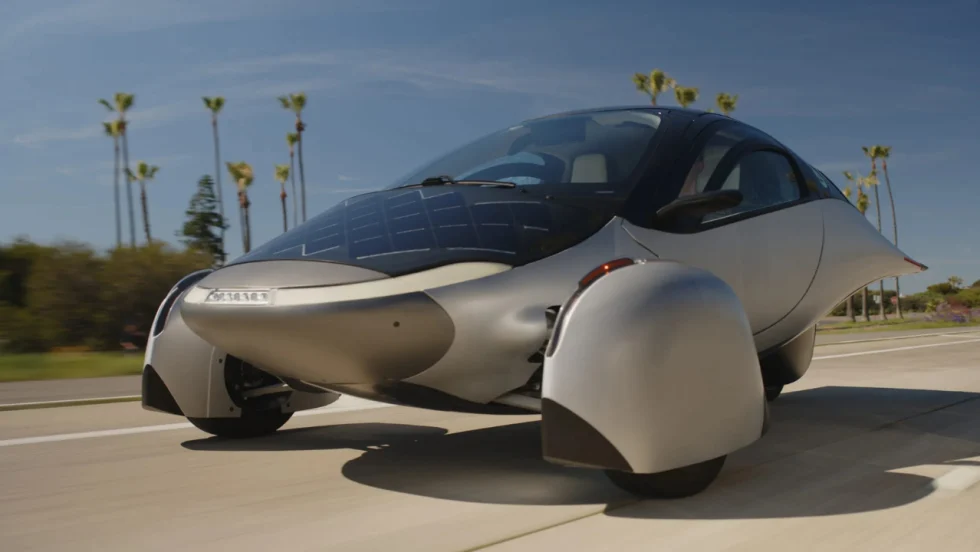
Aptera Orders Bodies and Chassis for Its First 40 Production Vehicles
Aptera Motors Corp. has issued purchase orders for the major structural components of its first 40 vehicles, and body and chassis components are expected to begin arriving in October.
Read More →