As electric buses become a more feasible option for pupil transporters, operators in the U.S. and Canada are noting various benefits, including charging efficiency, fuel savings, and the need for consistent maintenance training.
School districts across North America are making the switch to electric buses, crediting zero fuel and low maintenance costs for long-term savings.
While one of the biggest challenges for many districts has been the price tag of the buses, some operators have acquired them with grant assistance.
So far about 19 states, according to the National Renewable Energy Laboratory, have allocated a portion of their Volkswagen settlement funds for alternative-fuel buses. Other funding opportunities have included local, state, and federal grants.
As SBF previously reported, lawmakers in Nevada are pushing for legislation that would make school districts eligible for funds that would cover 75% of the cost of buying electric school buses and installing charging infrastructure.
Additionally, a recent proposal to the North Carolina Utilities Commission by electric power holding company Duke Energy would help fund the adoption of electric school buses and electric public transportation, and lead to almost 2,500 new charging stations across the state.
As electric buses become a more feasible option for pupil transporters, many are looking to see how they play out operationally. Here, SBF spoke with a number of operators in the U.S. and Canada to discuss the key advantages of going electric, from charging efficiency and anticipated fuel savings, as well as the need for consistent maintenance training for operational success.
Taking Charge
Reliable performance and reduced emissions are some of the advantages school bus operators in California, New York, and Canada are noting for electric buses.
Mark Toti, the transportation manager for Bellflower (Calif.) Unified School District (USD), says the district’s two Blue Bird Type D electric buses have been running smoothly since being delivered in September 2018.
“We’re probably running the buses about 40 miles a day, and they’re not on dedicated routes, we typically use them on field trips,” he explains. “The buses have been a great addition, but because [they] are so new for us, we’re still collecting our own data for them.”
Bellflower USD’s Type D All American Rear Engine Electric buses were among the first Blue Bird electric buses delivered.
The district received grant funding from the California Air Resources Board, which partnered with CalStart, a nonprofit working to develop clean transportation solutions, to buy the buses and install on-site charging infrastructure.
Toti says the district began working with local utility provider Southern California Edison for its charging infrastructure to see how it would create a designated electric vehicle (EV) line from one of the existing utility poles in the area.
“After careful review, [Edison] was able to drop an EV line from one of the [utility] poles right to an EV spot in our bus yard,” he adds. “Edison engineered the plant, and then we had a local contractor do the infrastructure.”
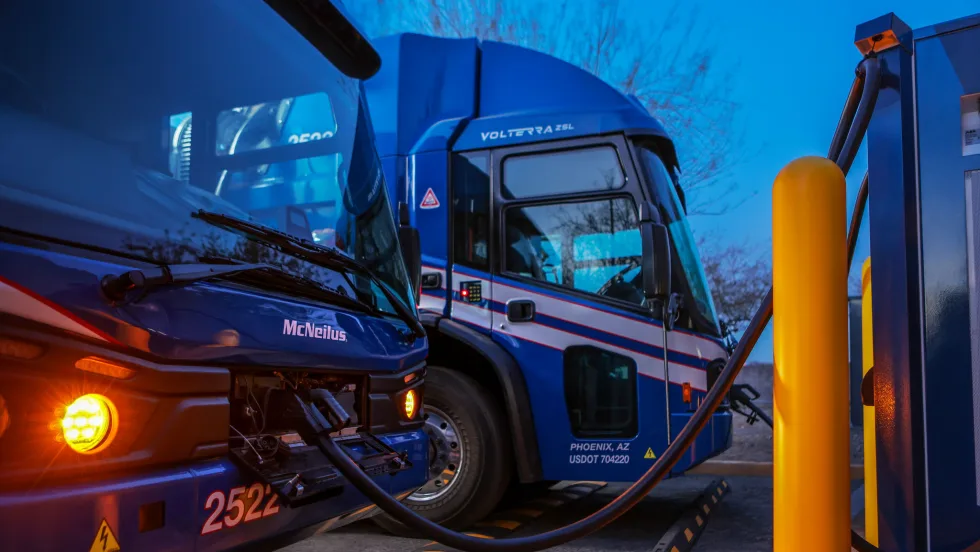
By December 2018, the district completed setup of its charging space, which included a charger for each of its buses.
Clémentine Alary Sery, the communications coordinator for school bus operator Keolis Canada, notes the convenience of an on-site charging infrastructure.
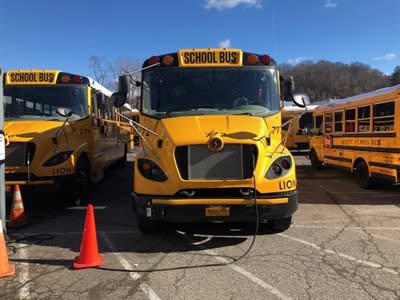
After two years of success with two Lion Electric Co. Type C buses, Keolis Canada now runs a total of 14 of the manufacturer’s buses, making it the largest operator of 100% electric Type C school buses in North America.
“Keolis Canada has been committed to sustainable mobility through enduring innovative and effective transportation solutions,” Sery adds. “Overall, these 14 buses will allow the company to cut 3,864 tons of CO2 over the vehicles’ lifetimes.”
In addition, Sery says the buses are much quieter than other buses, and can run about 90 miles per charge.
A Collaborative Effort
While some operations might fare better in running their own electric buses and charging stations, others have found power in partnering up with local utility providers and bus contractors.
Dr. Joseph Ricca, the superintendent for White Plains (N.Y.) City School District (CSD), says that obtaining his district’s five electric buses was made possible by partnering with local utility provider ConEdison, school bus contractor National Express, and bus manufacturer Lion Electric Co.
National Express and the district were in talks about the possibility of adding electric buses near the end of 2017, Ricca says, but at that time the district wasn’t sure it would be able to implement them.
“I remember when we first started discussing the [electric] buses there were concerns about whether they would be warm enough or whether or not there would be issues related to their operational capacity,” he explains.
Now, Ricca says, those concerns are long gone as the district operates one electric bus at each of its elementary schools.
“I think one of the cool things about our operation is all the collaboration that has happened to get it done,” says Joe Baker, senior vice president of National Express’s White Plains location. “It wasn’t one person or entity that was able to get the buses up and running. It was all of us.”
White Plains CSD operates its electric buses on short, regulated routes that are about 10 miles or less, he notes.
Even when running the air-conditioning or heat, Baker says that he estimates the district could get well over 100 miles per charge on the range of each bus.
Tracking Savings
Assessing maintenance and cost savings have been essential for operations in understanding the direct benefits of incorporating electric buses.
National Express utilizes local tracking systems to measure how much fuel has been saved, as well as the transportation provider’s expenditures on school bus parts.
However, Baker says they’re still working with Lion Electric Co. and ConEdison to measure the level of reduced emissions for the vehicles, and how long each bus’s battery will sustain itself over time.
“Even though we estimate that the [bus’s] battery life should probably be about 10 years,” he notes, “As we start to run these buses through the winter and summer months, using air-conditioning and heating, there’s still a lot of information being collected.”
Still, Baker says that National Express anticipates savings of about $15,000 to $20,000 a year in operating and maintenance costs due to the electric buses.
Toti, who is also the manager for Bellflower USD’s transportation repair facility, says he uses the department’s maintenance records to monitor each vehicle’s health and sustainability.
“Any electric bus repairs that take place in our facility, we monitor them closely,” he explains. “In addition to that, the dedicated EV line in our bus yard also allows us to easily monitor the [cost] of charging the buses.”
Ongoing Training
With every new bus comes training for maintenance technicians and staff. While many operators say EVs require less maintenance than a typical diesel bus, it’s still a best practice to conduct consistent training sessions.
In White Plains, New York, National Express has had Lion Electric Co. on-site various times for training on how to troubleshoot the district’s electric buses.
“We’ve been trying to be very active, and especially myself, I’ve been trying to get very active in speaking engagements,” Baker notes. “I think for our staff and members of our community to really get on board and embrace technology like this, they need to understand more about it.”
Meanwhile, in California, bus drivers and maintenance staff for Bellflower USD have been attending training sessions held by A-Z Bus Sales — the dealer that delivered the district’s electric buses.
In addition, Toti says he plans to take two of his mechanics to Blue Bird’s factory-based training in Fort Valley, Georgia, to discuss the application of various fuel types, including EVs.
Positive Feedback
Overall, operators say the community feedback for their electric buses has largely been positive.
“Our staff members have come in saying how quiet [the buses] are, and how it’s unusual to see a bus take off and no kind of smoke is coming out the tailpipe,” Baker says.
Keolis Canada’s Sery says the operator tested out Lion Electric’s buses before adding them to their fleet, and found that 92% of the community in Quebec reportedly wanted school boards and schools to increase their use of electric buses.
The educational component of the buses, White Plains CSD’s Ricca says, is also a plus, since sustainability is a topic that students and staff often discuss within their schools.
Aside from his district, Ricca says he hopes there will be more opportunities for other operations to incorporate electric buses within their fleets.
“I want the technology to become more attainable,” he explains. “Certainly, the buses right now are cost-prohibitive for a lot of school districts, but as the technology progresses and as the market is in more alignment for what can be attained, my hope is that we’ll see more of this out there for our kids.”
Originally appeared in School Bus Fleet Magazine