


EV Prices: Up for Used, Down for New in May
The electric vehicle market looked like a grab bag of trends as industry pressures and market dynamics shift.

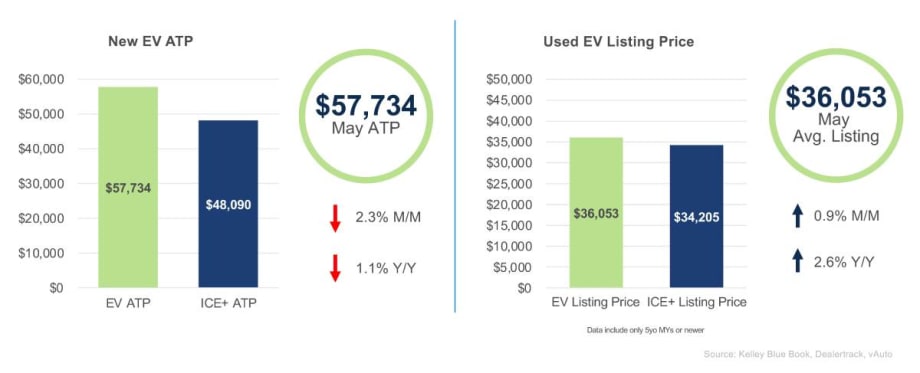
The used EV market saw a modest price increase, with the average price rising to $36,053, up 0.9% from the previous month and 2.6% year over year.
Graphic: Cox Automotive
The used EV market moved upward in May, driven by affordability and consumer confidence, according to Cox Automotive numbers released June 19.
Inventory levels, pricing trends, and incentive strategies reflected a transition market.
Overall, the electric vehicle market displayed a complex mix of growth and challenges in May, with year-over-year declines pointing to broad industry pressures.
New and Used EV Prices
The average transaction price (ATP) for new EVs in May fell to $57,734, marking a 2.3% decline from April and a 1.1% year-over-year decrease. The price gap between EVs and ICE+ vehicles narrowed to $9,644, down from $11,108 the previous month. Meanwhile, EV incentives increased by 19.4% to an average of $8,226, now accounting for 14.2% of ATP, the highest share in the post-2018 modern EV era. These incentives remain at least twice as high as those for ICE+ vehicles, underscoring the continued push to make EVs more accessible.
Among the most affordable options, the Nissan Leaf maintained its position with an ATP of $32,581. Additionally, several models – including the Acura ZDX, Ford Mustang Mach-E, Hyundai Ioniq 6, Kia EV6, Nissan Ariya, Toyota BZ4X, and VW ID.4 – had effective prices under $40,000, calculated by subtracting model-specific average incentives from their ATPs. The Chevrolet Equinox EV stood out by remaining under $40,000 even without incentives, reinforcing its strong value proposition in today’s competitive EV market. As EV adoption accelerates, ensuring a growing supply of affordable models is essential. For many consumers, price remains one of the most main barriers to switching to electric.
The used EV market saw a modest price increase, with the average price rising to $36,053, up 0.9% from the previous month and 2.6% year over year. The price gap between used EVs and ICE+ vehicles remained narrow, staying below $2,000. The Tesla Model 3 was the top-selling used EV in May, averaging $23,160, a 1.6% decrease from April. As the used EV market matures, price trends are often shaped by brand dynamics and shifting consumer priorities around value, range, and long-term ownership costs.
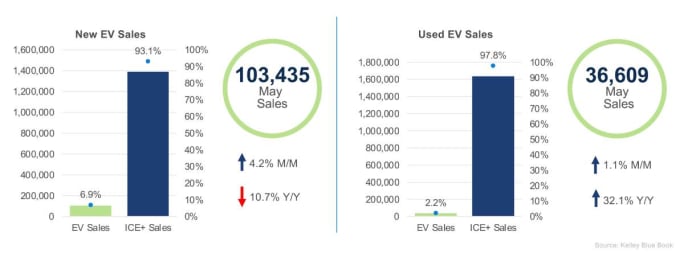
The used EV market saw modest growth in May, with sales increasing 1.1% month over month to 36,609 vehicles, maintaining a 2.2% share of the overall used-vehicle market.
Graphic: Cox Automotive
New and Used EV Sales
New EV sales rose 4.2% month over month in May, reaching 103,435 vehicles and maintaining a 6.9% market share. However, sales were down 10.7% year over year, underscoring industry challenges and the dynamic nature of an emerging market. May estimates suggest Tesla remained the market leader with 46,150 vehicles sold, a 0.6% month-over-month increase, followed by General Motors, Hyundai Motor Group, and Ford. Honda, which launched its first EV in the spring of last year, rounded out the top five.
The used EV market saw modest growth in May, with sales increasing 1.1% month over month to 36,609 vehicles, maintaining a 2.2% share of the overall used-vehicle market. Year over year, sales surged 32.1%, reflecting sustained momentum. Tesla led with a 49.6% share. The best-selling used EVs last month were the Tesla Model 3, Model Y, Model S, Model X, and Chevrolet Bolt EV, according to Cox estimates. The used EV market continues to be dominated by Tesla-brand products, which still dominate the EV market, but Cox analysts expect that to shift in the coming years.
New And Used EV Days' Supply
In May, new EV days’ supply rose 8% month over month to 111 days, although it remains 11.6% lower than last year. New EV days’ supply exceeds that of ICE+ models by more than a whole month. Supply levels varied much by brand, reflecting the dynamic nature of the EV market, driven by production shifts, evolving consumer demand, and strategic inventory management. Most automotive brands saw increased EV days’ supply, signaling improved inventory availability.
The days’ supply of used electric vehicles declined by 3.4% month over month to 40, an 11% year-over-year decline, reaching its lowest level since June 2022. The gap between used EVs and ICE+ vehicles has narrowed to less than five days. As with the new EV market, days’ supply for used EVs varies a lot by make. Tesla recorded the lowest level at 28 days. This tightening supply landscape suggests growing consumer interest in used EVs, signaling a potential shift in demand dynamics that could reshape pricing and remarketing strategies in the months ahead.
Originally posted on Automotive Fleet
More Electric Vehicles

EV Charging Use Is Outpacing Infrastructure Growth
ChargePoint’s 2026 Charging Forward Report points to rising charger use, higher-powered charging, commercial vehicle electrification, and energy-management technology. Here’s what fleets should know.
Read More →
EV Realty Names Henrik Holland President as Charging Platform Expands
The former Prologis Mobility and Shell executive will help expand EV Realty’s truck charging business and move its power-first infrastructure model into autonomous vehicle depots and other fleet sectors.
Read More →
GreenPower Expands New Mexico EV Pilot With Larger Buses, V2G Testing
After logging more than 17,000 electric miles in the first year, New Mexico’s statewide pilot is moving into its second phase with larger vehicles, continued charging evaluations, and more.
Read More →
Can EV-as-a-Service Help Fleets Scale Electrification?
Sustainability Partners CEO Adam Cain explains how matching EVs, charging infrastructure, and duty cycles can help fleets scale electrification.
Read More →
How EV-as-a-Service Is Moving Fleets Beyond Pilots
Adam Cain, president and CEO of Sustainability Partners, explains how EV-as-a-service can help fleets scale deployments by addressing duty-cycle requirements and charging challenges.
Read More →
PowerFlex, The Mobility House Join Forces to Advance Fleet Electrification
Two EV charging providers are joining forces to deliver a broader portfolio of energy management and fleet electrification solutions.
Read More →
Ford Retools Louisville Plant for Fathom Electric Truck Production
Ford's $2 billion Louisville Assembly Plant overhaul introduces a three-part assembly process for the Fathom midsize electric truck, with production scheduled to begin in 2027.
Read More →
Merchants Fleet Reports 290M EV Miles as Fleets Navigate Changing Electrification Market
From millions in operating savings to hundreds of millions of EV miles, Merchants Fleet’s latest report reveals what’s working and what’s changing in fleet electrification.
Read More →
California District Commits to Electrify 25% of School Bus Fleet by 2028
One of the nation's largest school bus electrification projects to date demonstrates how grants, charging infrastructure, and public-private partnerships can help fleets transition to EVs at scale.
Read More →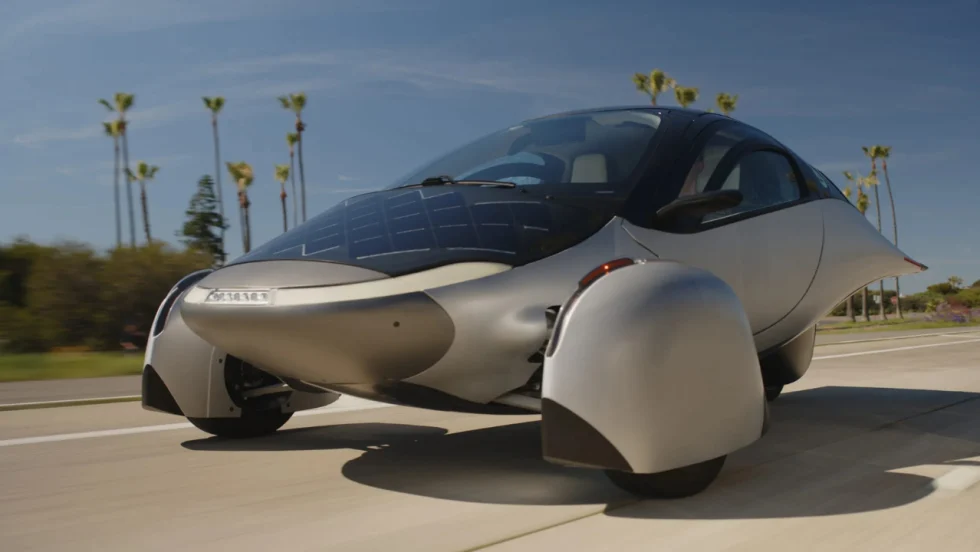
Aptera Orders Bodies and Chassis for Its First 40 Production Vehicles
Aptera Motors Corp. has issued purchase orders for the major structural components of its first 40 vehicles, and body and chassis components are expected to begin arriving in October.
Read More →