



Added Insights:Why EVs Will Succeed Long Term
New EV Sales Decline But Used EV Market Grows
April figures show an electric vehicle market facing several challenges that reflect broader economic trends.
May 22, 2025
Uncertainty in the market and tariffs will continue to affect EV sales. A recent consumer survey conducted by Cox Automotive indicates that nearly half of the respondents believe tariffs will affect their decision to buy an EV.
Graphic: Cox Automotive
4 min to read
New electric vehicle sales experienced a decline month-over-month and year-over-year, although the market share in April saw a slight increase compared to March, according to Cox Automotive figures released May 22.
Meanwhile, the used EV market continued to expand, driven by many affordable models.
Manufacturers had mixed results, with some reporting growth and others facing significant decreases.
Inventory levels varied and were influenced by factors such as production adjustments and consumer demand.
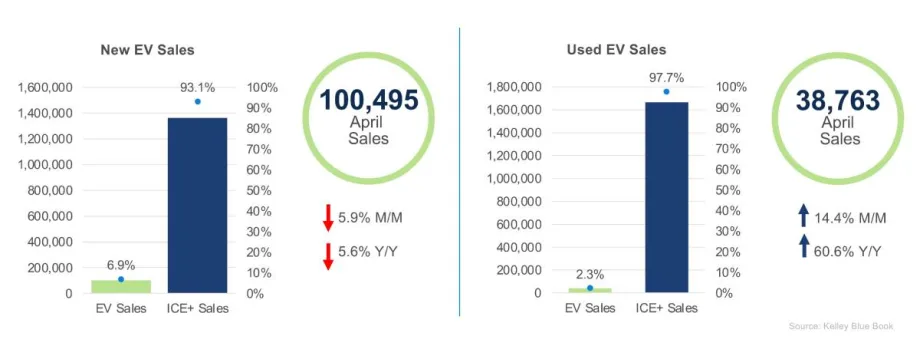
New EV Sales: The new EV market faced several challenges in April, reflecting broader economic trends. The volume of new EV sales declined by 5.9% month over month to 100,495 units, while the EV market share rose slightly to 6.9%. Year over year, the EV sales volume decreased by 5.6%.
While most manufacturers saw a month-over-month decline in volume, GM, Tesla, and Nissan reported notable growth in EV sales; Ford, Hyundai Group, and VW Group experienced declines. Tesla’s market share remained below 50%, but it increased by 3.7 percentage points in April, driven by the success of the Model Y, which sold 25,231 units and held a 25.1% market share. GM brands also had a strong month, achieving a combined market share of 14.4%, a 2-percentage-point increase from the previous period. However, uncertainty in the market and tariffs will continue to affect EV sales. A recent consumer survey conducted by Cox Automotive indicates that nearly half of the respondents believe tariffs will affect their decision to buy an EV.
Used EV Sales: The used EV market saw sizable growth in April, driven by strong sales across several key models. Used EV sales grew by 14.4%, reaching 38,763 units and increasing market share to 2.3%, the highest volume and share to date. Year-over-year growth was 60.6%. Tesla continued to dominate the used EV market, with a 27% increase in volume monthly, boosting its market share by 4.7 percentage points to 47%. Chevrolet and Ford followed, holding market shares of 8.9% and 6.0%, respectively, with both brands seeing modest growth in sales volume. This growth in used EV sales comes as new EV sales face challenges due to affordability and availability, making used EVs an option for many buyers.
The price gap between used EVs and internal combustion engine (ICE) vehicles moved below $2,000, the lowest it’s been since July 2024.
Graphic: Cox Automotive
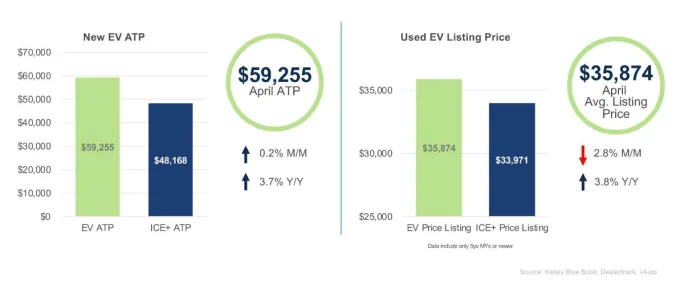
New EV Average Transaction Price: In April, the average transaction price (ATP) for new electric vehicles was $59,255, showing a 0.2% increase from the previous month and a 3.7% increase from the previous year. The price difference between EVs and ICE+ dropped to $11,087, driven by a 2.6% month-over-month increase in ICE+ ATP. Tesla’s ATP increased by 2.6% monthly to $56,120, the highest this year. EV incentives declined by 14% to $6,886, which is 11.6% of the ATP and the lowest dollar amount since June 2024. Despite this decline, EV incentives still exceed the ICE+ average.
Used EV Average Listing Price: In April 2025, the average listing price for used electric vehicles (EVs) was $35,874, showing a 2.8% decline from the previous month but a 3.8% increase compared to the same period last year. The price gap between used EVs and internal combustion engine (ICE) vehicles moved below $2,000, the lowest it’s been since July 2024. Tesla’s prices also saw a decrease, with a month-over-month decline of 1.8%. However, some brands experienced month-over-month price increases, with Volvo leading at a significant 9.6%, followed by Toyota at 4.4%. Affordable options remain available, with 41% of units sold priced below $25,000. Now is the time to get those used EVs under that threshold while the used EV tax credit is still in place.
New EV Days’ Supply: In April, the new EV days’ supply increased by six days, up 4.2%, month over month, rising to 99 days. Year over year, the new EV days’ supply is down nearly nine days (19.9%), marking the widest gap between EV and ICE+ days’ supply since July 2024. Days’ supply varied a lot by make. Lexus and Genesis had some of the tightest inventory, while Ford, Audi and VW saw stocks increase in April. Days’ supply has shifted of late, which is the dynamic nature of the EV market influenced by factors such as production adjustments, consumer demand, and inventory management strategies.
Used EV Days’ Supply: In April, the days’ supply of used electric vehicles declined by 0.2% month over month and year over year. Last month, used EVs had a six-day higher supply than ICE+ vehicles. Now, with ICE+ supply flat and used EV supply declining, the average supply of used EVs is two days lower. Similar to the new EV market, the days’ supply for used EVs varies by make. As used EVs remain an attractive option, inventory will continue to tighten.
Topics:New Vehicle SalesUsed Vehicle SalesNew Vehicle PricesUsed Vehicle PricesDays SupplyElectric VehiclesVehicle Research
Originally posted on Automotive Fleet
More Electric Vehicles

Who You Gonna Call? Rivian Turns Electric Vehicles Into Ghostbusters Rides
Rivian teams up with Sony Pictures for a Ghostbusters-inspired Halloween software update, complete with custom sounds, lighting effects, and a special Ecto-R1.
Read More →
Einride Electric Driverless Trucks Begin Daily Freight Operations in Ohio
Two cabless electric trucks are now moving freight between EASE Logistics facilities, putting autonomous EV technology into daily commercial operations.
Read More →
FedEx Orders 2,000 Harbinger Electric Trucks in $300 Million Deal
The Class 5 and 6 electric trucks are planned for delivery by the end of 2027 and will be deployed in FedEx pickup and delivery operations across the U.S. and Canada.
Read More →
Volvo Trucks’ Electric Range Named International Truck of the Year 2027
The award recognizes Volvo’s global heavy-duty electric lineup, while more than 750 VNR Electric trucks have accumulated nearly 37 million miles in U.S. and Canadian fleet operations.
Read More →
How Republic Services Decides Where Its Next Electric Trucks Can Go
With 250 electric collection trucks now in service, Republic Services is learning that scaling electrification depends less on proving the vehicle and more on whether each site can support what comes next.
Read More →
EV Charging Use Is Outpacing Infrastructure Growth
ChargePoint’s 2026 Charging Forward Report points to rising charger use, higher-powered charging, commercial vehicle electrification, and energy-management technology. Here’s what fleets should know.
Read More →
EV Realty Names Henrik Holland President as Charging Platform Expands
The former Prologis Mobility and Shell executive will help expand EV Realty’s truck charging business and move its power-first infrastructure model into autonomous vehicle depots and other fleet sectors.
Read More →
GreenPower Expands New Mexico EV Pilot With Larger Buses, V2G Testing
After logging more than 17,000 electric miles in the first year, New Mexico’s statewide pilot is moving into its second phase with larger vehicles, continued charging evaluations, and more.
Read More →
Can EV-as-a-Service Help Fleets Scale Electrification?
Sustainability Partners CEO Adam Cain explains how matching EVs, charging infrastructure, and duty cycles can help fleets scale electrification.
Read More →
How EV-as-a-Service Is Moving Fleets Beyond Pilots
Adam Cain, president and CEO of Sustainability Partners, explains how EV-as-a-service can help fleets scale deployments by addressing duty-cycle requirements and charging challenges.
Read More →