


EV Sales Spike for Second Month in a Row
Consumers are buying up electric vehicles ahead of the Inflation Reduction Act’s tax credit expiration amid strong demand and tight inventory.

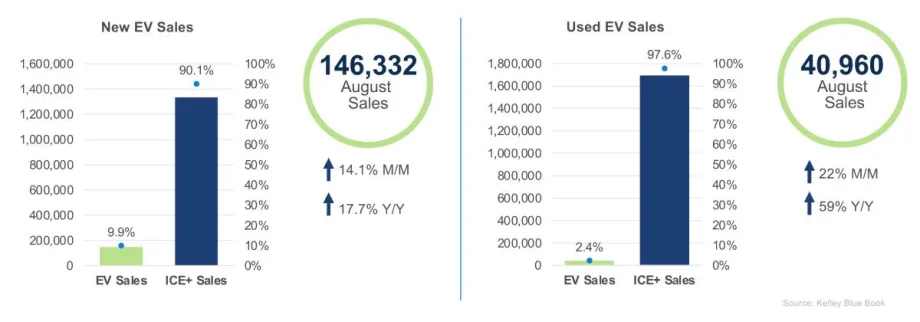
August new EV sales climbed to a record 146,332 units, up 14.1% month over month and 17.7% year over year.
Graphic: Cox Automotive
August marked a second consecutive strong month for the electric vehicle (EV) market, with record sales and rising market share in both the new and used segments.
As consumers acted quickly ahead of the Inflation Reduction Act’s tax credit expiration, Cox Automotive saw demand stay strong, inventory tighten, and incentives remain influential. These shifts signal a market on the verge of change, as government-backed sales incentives are set to expire at the end of September.
New EV Sales: August new EV sales climbed to a record 146,332 units, up 14.1% month over month and 17.7% year over year, lifting market share to an all-time high of 9.9%. Thirteen brands posted their best EV sales of the year.
The top five by volume – Tesla (55,500 units), Chevrolet (12,191), Ford (10,414), Hyundai (10,186), and Honda (9,347) – continued to lead the market. While Tesla grew modestly (3.1%), its market share declined by 4 points to 37.9%. Honda, with only the Prologue in the market, surged 47.9% month over month to reach 6.4% share. Among luxury brands, Audi posted the strongest growth, up 65.1% to 7,326 units, capturing 5% market share.
Used EV Sales: Used EV sales reached a record 40,960 units in August, up 22% month over month and 59% year over year, pushing market share to a new high of 2.4%. The top five makes by volume showed double-digit month-over-month growth: Tesla (17,164 units, 17.6%), Chevrolet (3,801 units, 17.3%), Ford (2,456 units, 39.6%), BMW (2,031 units, 38%), and Nissan (1,888 units, 21.6%). While Tesla remained dominant, its share of the used EV market dipped to 41.9%, down 1.6 percentage points from July. Ford and Volkswagen posted the largest share gains among major brands, each up 0.8 percentage points.
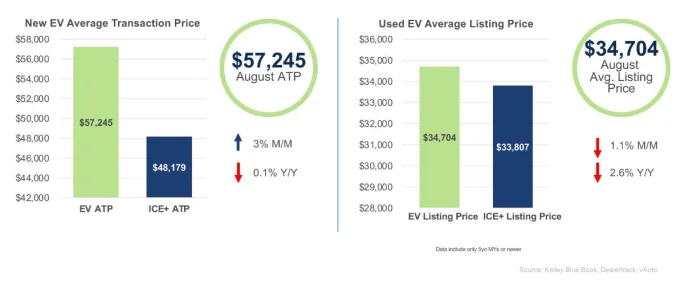
The price premium of EVs over ICE+ vehicles increased to $9,066, reversing a three-month decline.
Graphic: Cox Automotive
New EV ATP: In August, the average transaction price (ATP) for new electric vehicles increased to $57,245, up 3% from July and down 0.1% year-over-year. The price premium over ICE+ vehicles increased to $9,066, reversing a three-month decline. EV incentives dipped to 16% of ATP, though this remained the second-highest level of the year.
Among brands, Mercedes-Benz posted one of the largest ATP increases at 11.1%, followed by Nissan at 7.1%. While Tesla’s ATP rose 2.9%, its dominant sales volume played a key role in lifting the overall average. Of the top six selling EVs – Tesla Model Y, Tesla Model 3, Honda Prologue, Chevrolet Equinox EV, Hyundai Ioniq 5, and the Mustang Mach-E – nearly all saw strong incentives play a role in driving higher volume. The Hyundai Ioniq 5 and Honda Prologue offered the most aggressive incentives, while the Chevrolet Equinox EV had the lowest ATP among the group and received very little incentive support, underscoring its price-driven appeal and competitive market positioning.
Used EV Listing Price: In August, the average listing price for used electric vehicles decreased to $34,704, down 1.1% from July and 2.6% year-over-year. The price premium over used ICE+ vehicles narrowed to just $897, the lowest gap on record. Importantly, 14 makes had a lower average EV price than their ICE+ counterparts, highlighting the growing affordability and accessibility of used EVs. The top-selling models – Tesla Model 3, Tesla Model Y, Chevrolet Bolt EV, Tesla Model S, and Ford Mustang Mach-E – were all priced below the market average, reinforcing their appeal to budget-conscious buyers. The Model 3, which led in volume, averaged $23,278, while the Chevrolet Bolt EV remained one of the most affordable options at $14,705. The Nissan Leaf, another high-volume model, was priced even lower at $12,890, further emphasizing the value proposition of used EVs.
New EV Days’ Supply: In August, driven in part by strong sales, new EV days’ supply fell sharply to 62 days, down 32.1% month over month and 42.8% year over year, the lowest level recorded in 2025. Supply dropped 71 days from the June peak of 133 days. Most brands saw notable declines. GMC had the highest days’ supply at 139, while Toyota had the lowest at just 14 days. Audi posted the largest drop, falling 104 days to end the month at 67 days.
Used EV Days’ Supply: In August 2025, the days’ supply of used electric vehicles fell to 36 days, the lowest level of the year, and remained below ICE+ levels for the sixth time this year. As with the new EV market, supply levels vary significantly by make. Tesla had the lowest days’ supply at 26 days, with Chevrolet (32 days) and Nissan (32 days) also showing low levels. In contrast, Rivian (65 days), Ford (62 days) and GMC (58 days) had the highest levels, each hovering around a two-month supply. (Note: Tesla and Rivian days’ supply measures reflect only vehicles available through traditional dealerships, NOT models offered directly by the company.)
As we approach the sunset of the IRA tax credit, Cox Automotive expects September to mirror August’s elevated sales activity, driven by time-sensitive purchase and lease offers. This final stretch of policy-driven urgency will likely sustain momentum across both the new and used EV segments. The market’s ability to respond to real-time demand and pricing dynamics will be crucial as incentives taper and inventory remains tight, shaping performance through the remainder of the year.
More Electric Vehicles

EV Charging Use Is Outpacing Infrastructure Growth
ChargePoint’s 2026 Charging Forward Report points to rising charger use, higher-powered charging, commercial vehicle electrification, and energy-management technology. Here’s what fleets should know.
Read More →
EV Realty Names Henrik Holland President as Charging Platform Expands
The former Prologis Mobility and Shell executive will help expand EV Realty’s truck charging business and move its power-first infrastructure model into autonomous vehicle depots and other fleet sectors.
Read More →
GreenPower Expands New Mexico EV Pilot With Larger Buses, V2G Testing
After logging more than 17,000 electric miles in the first year, New Mexico’s statewide pilot is moving into its second phase with larger vehicles, continued charging evaluations, and more.
Read More →
Can EV-as-a-Service Help Fleets Scale Electrification?
Sustainability Partners CEO Adam Cain explains how matching EVs, charging infrastructure, and duty cycles can help fleets scale electrification.
Read More →
How EV-as-a-Service Is Moving Fleets Beyond Pilots
Adam Cain, president and CEO of Sustainability Partners, explains how EV-as-a-service can help fleets scale deployments by addressing duty-cycle requirements and charging challenges.
Read More →
PowerFlex, The Mobility House Join Forces to Advance Fleet Electrification
Two EV charging providers are joining forces to deliver a broader portfolio of energy management and fleet electrification solutions.
Read More →
Ford Retools Louisville Plant for Fathom Electric Truck Production
Ford's $2 billion Louisville Assembly Plant overhaul introduces a three-part assembly process for the Fathom midsize electric truck, with production scheduled to begin in 2027.
Read More →
Merchants Fleet Reports 290M EV Miles as Fleets Navigate Changing Electrification Market
From millions in operating savings to hundreds of millions of EV miles, Merchants Fleet’s latest report reveals what’s working and what’s changing in fleet electrification.
Read More →
California District Commits to Electrify 25% of School Bus Fleet by 2028
One of the nation's largest school bus electrification projects to date demonstrates how grants, charging infrastructure, and public-private partnerships can help fleets transition to EVs at scale.
Read More →
Aptera Orders Bodies and Chassis for Its First 40 Production Vehicles
Aptera Motors Corp. has issued purchase orders for the major structural components of its first 40 vehicles, and body and chassis components are expected to begin arriving in October.
Read More →