



Want More? Designing the Right Electric Vehicle Charging Depot
Report Reveals Most, Least EV-Friendly Places in America
iSeeCars analyzed charger data to determine which cities have the most chargers available to retail and fleet customers alike.
March 20, 2024
According to 2023 data analyzed by iSeeCars, there is a national average of one EV charger for every 1,848 residents in the U.S. That's a nearly 19% improvement year-over-year compared to 2022, where there were 2,277 residents per charger.
Photo: Canva/Automotive Fleet
4 min to read
A recent report reveals an improvement in the number of electric vehicle (EV) chargers available to U.S. drivers.
According to 2023 data analyzed by iSeeCars, there is a national average of one EV charger for every 1,848 residents in the U.S. That's a nearly 19% improvement year-over-year compared to 2022, where there were 2,277 residents per charger.
In 2022, there were 146,337 total chargers, while 2023 showed an increase of nearly 24%, with 181,270 chargers.
While the report was based on residential numbers, it can be gleaned from the report which cities are more likely to have public charging, for fleet drivers who rely on publicly available chargers to power their vehicles.
Where the Data Comes From
iSeeCars analyzed the number of Level 2 and Level 3/DC Fast Chargers from data published by the U.S. Department of Energy’s Alternative Fuels Data Center.
In addition to comparing charger totals between 2022 and 2023, the analysis also ranked cities and states based on the availability of their EV charging infrastructure, as well as their improvement over the last year.
Here are some fast facts on the rankings:
San Francisco is the most EV-friendly city in the U.S. and Milwaukee, Wisconsin is the least EV friendly.
Vermont is the most EV-friendly state, while Mississippi is the least EV friendly.
The most improved city for EV friendliness is Hartford, Connecticut, and the least improved is Oklahoma City.
The most improved state for EV friendliness is Connecticut, while the least improved is Alaska.
Which Cities are the Most EV-Friendly?
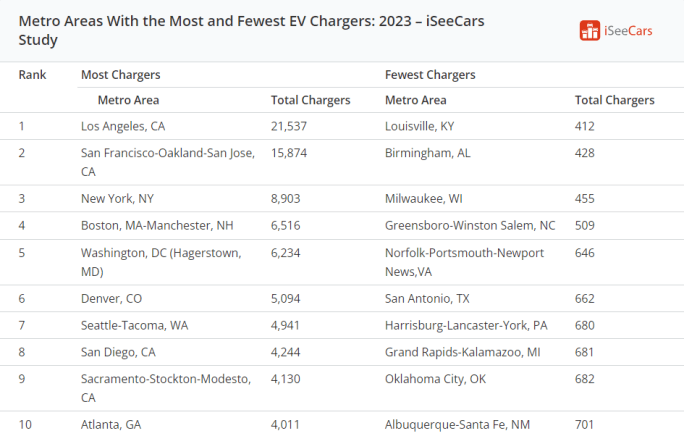
California remains the state with the most EV chargers, with five of the top 10 metro areas with the most chargers being California cities.
Photo: iSeeCars
When ranked by total number of EV chargers, Los Angeles leads the way with over 21,000 chargers. San Francisco comes in second at nearly 16,000 chargers, followed by a big drop to New York City at 8,903 chargers and Boston at 6,516 chargers.
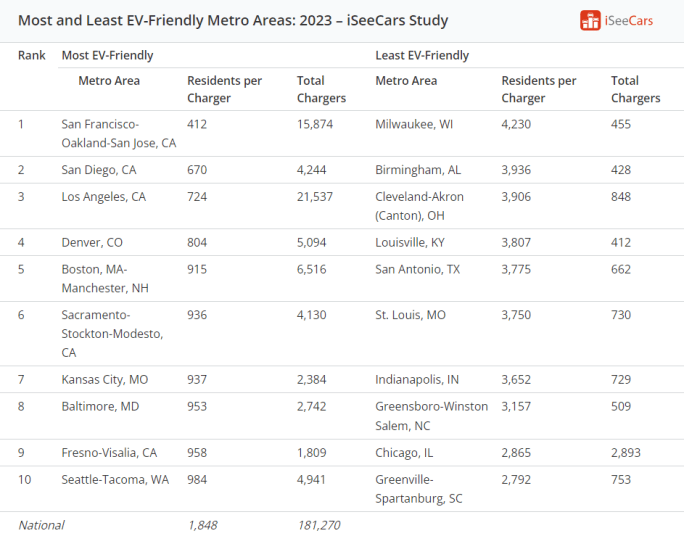
To determine the most EV-friendly cities, iSeeCars calculated the number of residents per charger. That put San Francisco on top, moving Los Angeles to number three, with San Diego sliding in between them.
The San Francisco metro area, which stretches to Oakland and San Jose, has 412 residents per charger, with 15,874 total chargers.
California remains the best state for driving an EV, with the most charging options, with five of the top 10 most EV-friendly metro areas being in the Golden State.
To determine the most EV-friendly cities, iSeeCars calculated the number of residents per charger. That put San Francisco on top, moving Los Angeles to number three, with San Diego sliding in between them.
Photo: iSeeCars
The weakest EV charging network among the 50 largest metro areas belongs to Louisville, Kentucky, with only 412 chargers, followed by Birmingham, Alabama, at 428 and Milwaukee, Wisconsin, at 455.
When ranked by the number of residents per charger, Milwaukee ranked as the least friendly, with 4,230 residents per charger. The city only has a total of 455 chargers.
Cities See Charger Growth Despite Poor Rankings
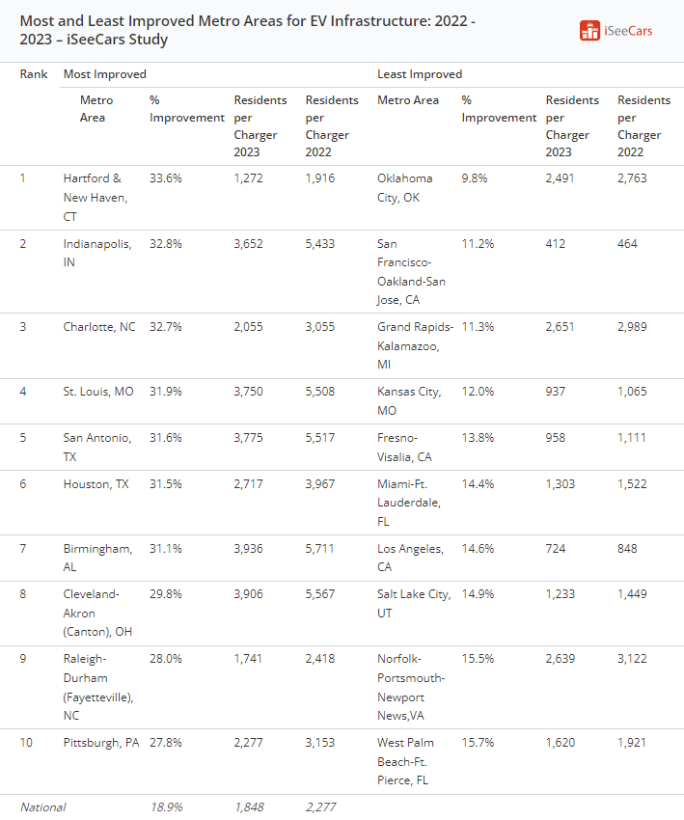
While Birmingham, Cleveland, San Antonio, St. Louis, and Indianapolis rank poorly in the number of residents per EV charger, they are also among the top 10 cities growing their charging infrastructure the fastest.
Photo: iSeeCars
“It’s worth noting that several of the least-friendly EV cities saw some of the highest growth rates in EV infrastructure last year,” iSeeCars Executive Analyst Karl Brauer said.
While Birmingham, Cleveland, San Antonio, St. Louis, and Indianapolis rank poorly in the number of residents per EV charger, they are also among the top 10 cities growing their charging infrastructure the fastest, Brauer pointed out.
He also noted that at the same time, while cities like San Francisco and Los Angeles rank well for residents per charger, they were in the top 10 for least improved cities last year.
What are the Most and Least EV-Friendly States?
When determining which states are the best for EV drivers, it depends on how you're analyzing the data. While California has the greatest amount of EV chargers, Vermont has fewer residents per charger, indicating greater access to chargers.
The least-friendly EV states are mostly in the south, with Mississippi, Louisiana, Alaska, Kentucky, and Alabama ranking as the five least EV-friendly states.
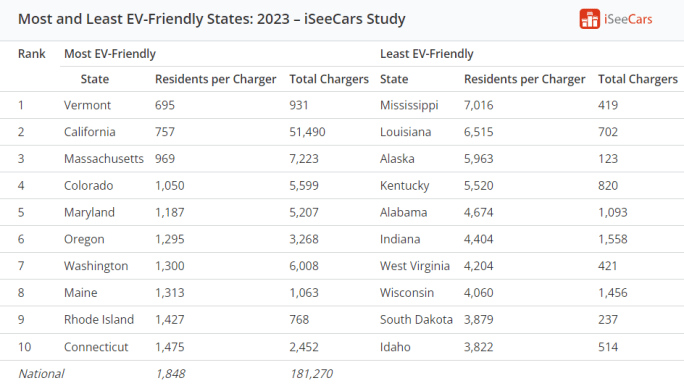
When determining which states are the best for EV drivers, it depends on how you're analyzing the data.
Photo: iSeeCars
Breaking Down Charger Growth by Type
iSeeCars also identified the growth in chargers by charger type. In 2022, there were 2,826 residents per Level 2 charger. That's compared to 2,355 in 2023. The total of Level 2 chargers grew in 2023 from 117,949 to 142,241.
The number of residents per Level 3/DC fast charger grew from 28,388 to 39,029 in 2023. That's roughly 8,581 residents per charger, compared to 11,740 per charger in 2022.
iSeeCars determined that the expansion of America’s charging infrastructure is growing at a healthy pace. However, this year’s 23.9% growth rate is less than half the 52.1% growth rate seen between 2020 and 2021.
The increase in OEMs partnering with Tesla to provide adapters for the automaker's Supercharger network will help open up charging options for EV drivers.
Originally posted on Automotive Fleet
More Electric Vehicles

EV Charging Use Is Outpacing Infrastructure Growth
ChargePoint’s 2026 Charging Forward Report points to rising charger use, higher-powered charging, commercial vehicle electrification, and energy-management technology. Here’s what fleets should know.
Read More →
EV Realty Names Henrik Holland President as Charging Platform Expands
The former Prologis Mobility and Shell executive will help expand EV Realty’s truck charging business and move its power-first infrastructure model into autonomous vehicle depots and other fleet sectors.
Read More →
GreenPower Expands New Mexico EV Pilot With Larger Buses, V2G Testing
After logging more than 17,000 electric miles in the first year, New Mexico’s statewide pilot is moving into its second phase with larger vehicles, continued charging evaluations, and more.
Read More →
Can EV-as-a-Service Help Fleets Scale Electrification?
Sustainability Partners CEO Adam Cain explains how matching EVs, charging infrastructure, and duty cycles can help fleets scale electrification.
Read More →
How EV-as-a-Service Is Moving Fleets Beyond Pilots
Adam Cain, president and CEO of Sustainability Partners, explains how EV-as-a-service can help fleets scale deployments by addressing duty-cycle requirements and charging challenges.
Read More →
PowerFlex, The Mobility House Join Forces to Advance Fleet Electrification
Two EV charging providers are joining forces to deliver a broader portfolio of energy management and fleet electrification solutions.
Read More →
Ford Retools Louisville Plant for Fathom Electric Truck Production
Ford's $2 billion Louisville Assembly Plant overhaul introduces a three-part assembly process for the Fathom midsize electric truck, with production scheduled to begin in 2027.
Read More →
Merchants Fleet Reports 290M EV Miles as Fleets Navigate Changing Electrification Market
From millions in operating savings to hundreds of millions of EV miles, Merchants Fleet’s latest report reveals what’s working and what’s changing in fleet electrification.
Read More →
California District Commits to Electrify 25% of School Bus Fleet by 2028
One of the nation's largest school bus electrification projects to date demonstrates how grants, charging infrastructure, and public-private partnerships can help fleets transition to EVs at scale.
Read More →
Aptera Orders Bodies and Chassis for Its First 40 Production Vehicles
Aptera Motors Corp. has issued purchase orders for the major structural components of its first 40 vehicles, and body and chassis components are expected to begin arriving in October.
Read More →