


Related: Electrify America Offers Volkswagen ID.4 Owners 3 Years of Free EV Charging
VW Launches Electric ID.4 SUV: $379 Lease, Free Charging
Volkswagen plans to offer the ID.4 electric vehicle across all 50 states, and throughout its network of more than 600 dealers.
by Staff
September 24, 2020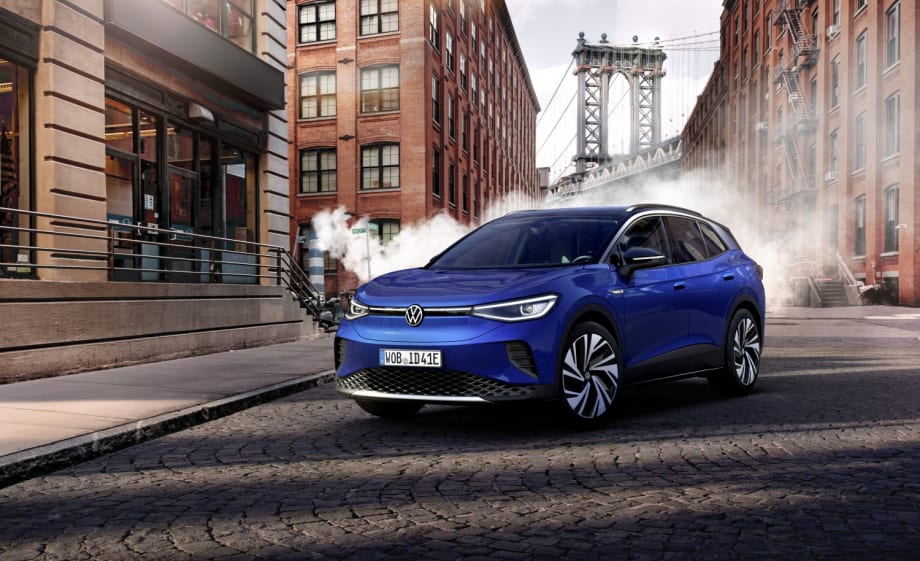
The compact SUV will offer all the features of Volkswagen’s current lineup along with long-range EV capability and three years of fast charging with Electrify America for no additional cost.
Photo via Volkswagen.
5 min to read
Volkswagen of America revealed the all-new ID.4 electric SUV yesterday — the brand’s first long-range EV to be sold stateside.
The compact SUV will offer all the features of Volkswagen’s current lineup along with long-range EV capability and three years of fast charging with Electrify America for no additional cost. The 11 kW onboard charger allows the ID.4 to charge the battery 33 miles in about one hour, and charges to full in around seven and a half hours at a home or public Level 2 charger. At a DC fast-charging station, with 125 kW charging, the ID.4 can go from five to 80% charged in about 38 minutes.
The ID.4 electric compact SUV is based on the modular electric drive architecture. While it is the brand’s newest platform, it also represents a return to Volkswagen’s roots, with the electric motor located at the rear, just like the original Beetle.
The heart of the ID.4 is a battery pack comprised of 288 pouch cells in 12 modules, positioned in the underbody to create a low center of gravity for optimal driving dynamics as well as extremely well-balanced weight distribution. It is housed in a lightweight aluminum structure that is bolted to the frame, helping to improve rigidity.
At launch, the vehicle will be offered with an 82kWh (gross) battery and a rear-mounted AC permanent-magnet synchronous motor with 201 horsepower and 228 pound-feet of torque. Volkswagen estimates that the ID.4 82kWh RWD 1st Edition models will have a range of 250 miles with a full charge on the EPA cycle.
An electric all-wheel-drive variant with 302 hp will follow later in 2021.
To help protect occupants, the ID.4 provides a combination of both passive and active safety systems. It features six airbags as standard—front and side airbags for front passengers, and side curtain airbags for outboard seating positions. Additionally there are a number of electronic safety systems, such as an Anti-lock Braking System and Electronic Stability Control .
With regards to the battery, an extruded aluminum frame protects the battery system against damage in the event of a crash, and a replaceable aluminum underbody panel protects the battery against the road. Additionally, the battery is also disabled if the vehicle is involved in a serious accident.
The chassis and body are made from steel and the front suspension is a strut-type with lower control arms, coil springs, telescopic dampers, and anti-roll bar. In the rear, the ID.4 uses a multi-link rear axle with coil springs, telescopic dampers, and an anti-roll bar. With 3.5 turns lock-to-lock and a stellar curb-to-curb turning radius of 33.5 feet, the ID.4 feels nimble, especially among other compact SUVs.
A combination of brake types is used on ID.4. It features disc brakes on the front wheels and drum brakes on the rear — the difference being specific to electric vehicle needs. As EVs rely on regenerative braking, disc brakes on the rear can be less effective than drums after long periods of not being put to heavy use.
At the front, the Volkswagen logo is able to be positioned centrally because there is no radiator grille, as it was on the Beetle. Large LED headlights flow backwards, hinting at the aerodynamic nature of the car, while a sculpted front bumper with large intake-like scoops and honeycomb accents give the car a powerful presence. Models fitted with the Statement package add an illuminated Volkswagen logo and an illuminated light line that stretches outward from it, creating a striking light signature.
Volkswagen’s first fully-electric SUV features ample space and a modern design. Passenger volume is similar to the Tiguan despite the overall smaller footprint, with 99.9 cubic feet total. Legroom is a comfortable 41.1 inches for front passengers and 37.6 inches in the rear seat. Cargo volume is 30.3 cubic feet behind the second row, and 64.2 cubic feet with the seats folded.
The interior of the ID.4 mirrors the futuristic look of the exterior, with functionality almost completely controlled by touch or voice control. The 5.3-inch ID.Cockpit replaces the traditional instrument cluster and is operated with touch-sensitive controls on the leather-wrapped multifunction heated steering wheel. Three tiles show the most important information, with the display for battery status and range underneath. The traditional gearshift is replaced by a large rocker switch on the right of the ID.Cockpit, and a control panel to the left of the steering wheel integrates the lighting functions, including automatic headlights.
To complete the high-tech package, ID.4 offers standard wireless mobile charging, wireless App-Connect, and Volkswagen Car-Net with in-car WiFi capability when you subscribe to a data plan. Car-Net Hotspot allows passengers to access the internet with up to four connected devices simultaneously, including tablets, smartphones, laptops, gaming devices, and more — all at 4G LTE-enabled speed.
With the standard IQ.DRIVE advanced driver assistance technology, all ID.4 models include:
Forward Collision Warning and Autonomous Emergency Braking with Pedestrian Monitoring (Front Assist)
Blind Spot Monitor (Side Assist)
Rear Traffic Alert
Adaptive Cruise Control
Lane Keeping System (Lane Assist)
Travel Assist
Emergency Assist
In addition to IQ.DRIVE features, the ID.4 includes Dynamic Road Sign Display; Park Distance Control; and High Beam Control (Light Assist).
Pricing for the ID.4 starts at $39,995, for the rear-wheel-drive ID.4 Pro, before a potential Federal tax credit of up to $7,500 is applied.
Volkswagen plans to offer the ID.4 electric vehicle across all 50 states, and throughout its network of more than 600 dealers.
Volkswagen has made a commitment to be carbon neutral by 2050, in line with the Paris climate accord. With that goal in mind, the ID.4 is being produced at the Zwickau factory with a net carbon-neutral balance.
The Zwickau factory uses electricity that is sourced using renewable energy. The site includes a highly-efficient combined heat and power plant, which, long term, is planned to use carbon-neutral natural gas.
Beginning in 2022, the ID.4 will be produced locally in the U.S. at the Volkswagen Chattanooga Assembly Plant in Tennessee. Volkswagen anticipates investing a further $800 million in the Chattanooga factory for the production of electric vehicles, in addition to the more than $2.6 billion that VW has invested in the area.
Originally posted on Automotive Fleet
More Electric Vehicles
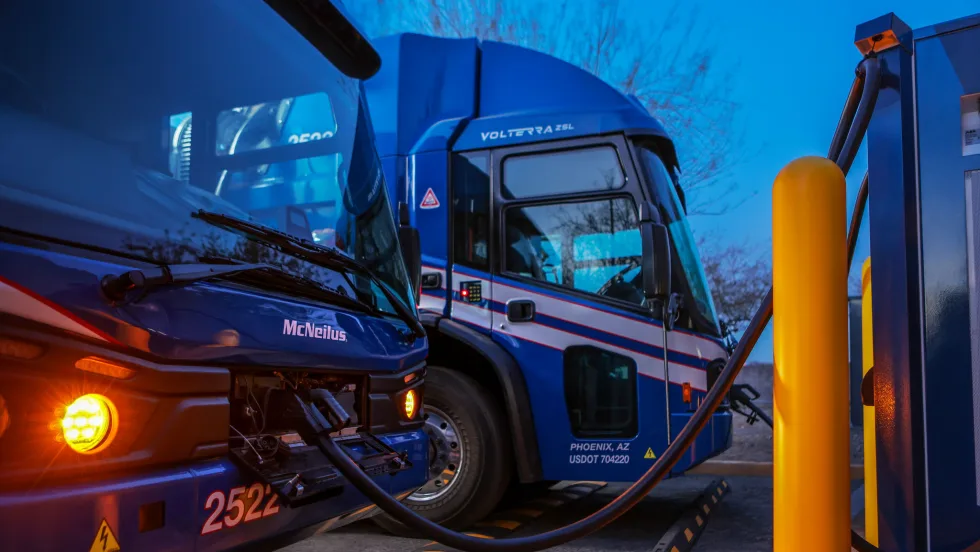
How Republic Services Decides Where Its Next Electric Trucks Can Go
With 250 electric collection trucks now in service, Republic Services is learning that scaling electrification depends less on proving the vehicle and more on whether each site can support what comes next.
Read More →
EV Charging Use Is Outpacing Infrastructure Growth
ChargePoint’s 2026 Charging Forward Report points to rising charger use, higher-powered charging, commercial vehicle electrification, and energy-management technology. Here’s what fleets should know.
Read More →
EV Realty Names Henrik Holland President as Charging Platform Expands
The former Prologis Mobility and Shell executive will help expand EV Realty’s truck charging business and move its power-first infrastructure model into autonomous vehicle depots and other fleet sectors.
Read More →
GreenPower Expands New Mexico EV Pilot With Larger Buses, V2G Testing
After logging more than 17,000 electric miles in the first year, New Mexico’s statewide pilot is moving into its second phase with larger vehicles, continued charging evaluations, and more.
Read More →
Can EV-as-a-Service Help Fleets Scale Electrification?
Sustainability Partners CEO Adam Cain explains how matching EVs, charging infrastructure, and duty cycles can help fleets scale electrification.
Read More →
How EV-as-a-Service Is Moving Fleets Beyond Pilots
Adam Cain, president and CEO of Sustainability Partners, explains how EV-as-a-service can help fleets scale deployments by addressing duty-cycle requirements and charging challenges.
Read More →
PowerFlex, The Mobility House Join Forces to Advance Fleet Electrification
Two EV charging providers are joining forces to deliver a broader portfolio of energy management and fleet electrification solutions.
Read More →
Ford Retools Louisville Plant for Fathom Electric Truck Production
Ford's $2 billion Louisville Assembly Plant overhaul introduces a three-part assembly process for the Fathom midsize electric truck, with production scheduled to begin in 2027.
Read More →
Merchants Fleet Reports 290M EV Miles as Fleets Navigate Changing Electrification Market
From millions in operating savings to hundreds of millions of EV miles, Merchants Fleet’s latest report reveals what’s working and what’s changing in fleet electrification.
Read More →
California District Commits to Electrify 25% of School Bus Fleet by 2028
One of the nation's largest school bus electrification projects to date demonstrates how grants, charging infrastructure, and public-private partnerships can help fleets transition to EVs at scale.
Read More →