


EVs Meet the Real World
Five Nissan LEAF users share their driving experiences. Is reality matching expectations?
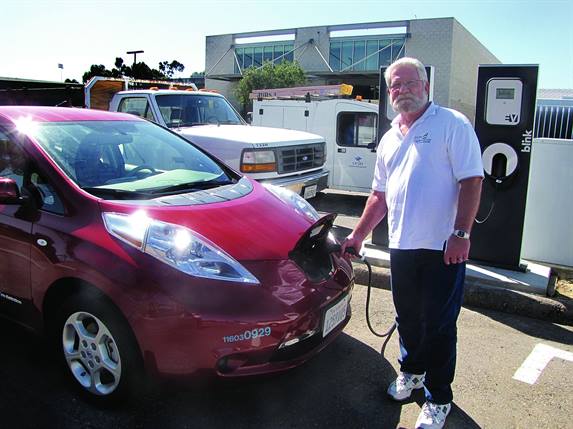
Jim Ruby, facilities management fleet director for the University of California, San Diego, charges one of the school’s five Nissan LEAFs, acquired as part of the University’s “Tailpipe Endgame” sustainability initiative.
In this comprehensive look at the real-world electric-vehicle experience, Green Fleet asked five users of the Nissan LEAF to share their stories on the initial buying process, charging challenges, operating costs, and driving experience. We also asked them whether “range anxiety” is an ongoing factor or a relic of the pre-EV era.
Frustrations in Ordering
Nissan LEAF sales passed the 50,000-milestone mark on Feb. 14, 2013 — 19,500 of which can be found on the road in the U.S. Today, the 2013 model comes with a broader range of trim levels, starting with the lower-priced S grade, moving up to the SV model, and graduating with the SL. Availability is a non-issue, since the LEAF can be purchased at Nissan dealerships across the globe.
But, this wasn’t the case for the first six to nine months of the 2011-model rollout, when demand outstripped supply and caused delays. Looking back to 2010, for many, the ordering process was fraught with delays and hiccups due, in part, to a reservation process that went live April 20, 2010. Potential buyers plunked down $99 to get in line. On Aug. 31, 2010, buyers were able to start placing orders and track the process online via their personal “dashboard.” Four- to seven-month waits for delivery were common.
Overseas, Japan’s LEAF buyers took advantage of a rebate, diverting orders to production there. The rebate was set to expire in March 2011, but it was extended, further hampering American allocation. Then, the March 2011 tsunami hit.
Things went from bad to worse for some buyers. A computer programming mix-up from order-to-delivery resulted in some cars being delivered out of order.
“For some, the ordering process was a nightmare and spoiled it for a lot of people,” said George Whiteside, an acupuncturist and massage therapist in Seattle. He was able to circumvent the process by purchasing an “orphan,” that is, a LEAF that was ordered and produced, but ultimately not acquired by the original requester. Whiteside said some orphans were marked up $5,000 to $7,000 above MSRP for the luxury of shortening the acquisition process, though Whiteside said he found a dealer who “sold it not too much over MSRP.”
Regarding price, buyers chose a dealer and sent a “request for quotation” (RFQ), which they then accepted or rejected. When a quote is accepted, the manufacturing order is placed and Nissan assigns a delivery date.
Tom Tweed of La Jolla, Calif., reached out to a local dealer before the RFQ process and had sewn up a price on his own. As a retiree, Tweed was able to price shop between two local dealers and ended up with $1,000 off MSRP. That’s a good deal for an in-demand vehicle, but Tweed said he saw discounts as high as $1,500 to $1,800.
Kirk Gebb, who works for the facilities department for the school district in Eugene, Ore., paid less than $33,000 out the door for his first LEAF. He said his buying experience “was no worse than anyone else’s,” though, like the others, he “would’ve liked to have the car in October instead of April.” Gebb traded his first LEAF for a newer 2011 model with seat heaters. As of press time, Gebb said he’s put 8,000 miles on the second LEAF. The first had accumulated 15,000 miles before trade-in.
At the University of California, San Diego (UC San Diego), Facilities Management Fleet Manager Jim Ruby and Director of Building Commissions and Sustainability Dave Weil acquired five 2011-MY LEAFs as part of the University’s “Tailpipe Endgame” sustainability initiative. Ruby wrote a “letter of intent” to Nissan and got the University on a wait list. He solicited bids from three dealers and picked the dealer who offered the lowest price.
UC San Diego leased its 2011 LEAFs on a 36-month contract. Nissan sweetened the deal by passing along the federal $7,500 tax credit, which the university, a state entity, couldn’t get. UC San Diego leases vehicles internally to its departments and, with the price break, could do it at the same rate as a Toyota Prius. All other interviewees were able to take advantage of the $7,500 federal tax credit directly, along with various forms of state credits and rebates.
Cost Per Mile: 2 Cents?
In terms of operational costs, LEAF buyers are enjoying immediate savings in fuel costs. And, with fewer moving parts and fluids along with regenerative braking to prolong brake life, EVs enjoy minimal maintenance costs.
Jim Hamilton, an air traffic controller from Oceanside, Calif., pays $45 to $55 a month in electricity to power his LEAF — and that’s for a hefty 1,500 miles of driving per month. He calculates that his BMW 330 was burning $300 to $400 a month, or about 20 cents a mile. “We’re now down to almost a tenth of the cost,” he said.
Whiteside calculates 2.2 cents per mile and a fuel savings of $2,000 a year. “I’ve heard plenty of concerns from skeptics about electric cars,” Whiteside said. “But, 2.2 cents per mile? That’s real. That’s a hard-core reality that just about anyone can appreciate.”
None of these LEAF drivers have reported a serious maintenance issue, though there were scattered reports of a parking brake controller problem early on. Tweed took the car into the dealer to update the firmware, which corrected an air-conditioning controller fault, among other minor issues.
Gebb has been quite happy in terms of maintenance — or lack of it — and fuel. “The ‘fuel’ costs for the LEAF are a quarter of that for our Toyota Prius. Add the maintenance piece into the equation and the LEAF is looking stellar,” he said.
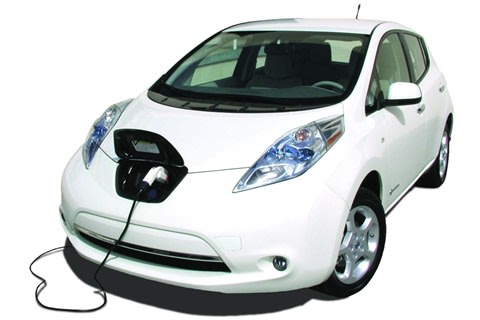
The first-generation 2011 Nissan LEAF came with two types of charging outlets, one for the Level 2 (220v/240v) and another (inset photo) is an outlet for the “DC Fast Charger,” or Level 3 outlet that can charge in about 25 minutes using 480 volts or more.
What About the Battery?
Certainly, the biggest maintenance fear surrounds the (very expensive) battery. However, the latest generation of lithium-ion batteries has one major advantage: Individual battery cells can be replaced, which relieves the cost of replacing the entire battery.
Hamilton, who uses the LEAF for his 61-mile round-trip commute to work, leased the vehicle as a safety net to battery degradation. “If there isn’t degradation, I’ll buy the car,” he said. Hamilton has put more than 35,000 miles on his LEAF so far.
“I drive around 60 mph and always make it home with one or two battery bars remaining,” he noted.
To date, battery degradation in hot climates has been more accelerated than expected for some users in Arizona, Texas, and inland California desert locations. Nissan now offers a retroactive capacity warranty for the battery pack for anyone who experiences 30-percent reduction in capacity in less than five years or 60,000 miles.
Gebb sees the bright side of technological progress. “If my battery wore out in five years, it would be a good thing,” he said. “I could put in a new battery that could go twice as far, and (that battery) will last longer because you won’t be pushing its limits as hard.”
The Charging Infrastructure Scramble
The first-generation LEAF comes with a 120v (commonly referred to as 110v) Level 1 charger that plugs into a standard home outlet. Charging from dead zero to 100 percent could take up to 18 hours on a standard 120v wall outlet.
The Level 2 home charger takes about five-and-a-half to six hours from near empty to 80-percent charge. For some, the basic Level 1 charger may be sufficient, especially for shorter commutes. The new 2013 LEAF has an optional 6.6kW onboard charger replacing the original 3.3kW unit, which cuts charging times for 220v L2 charging almost in half (less than four hours to 100 percent from empty).
Commercial-grade Level 3/fast chargers (480v or more) can charge from zero to 80 percent in about 25 minutes and are just beginning to be installed in publicly accessible locations.
Gebb has been using the Level 3 chargers and raved about the technology. “Level 3 is a game changer — we have several around the state now and one nearby that I use on days when I do a bunch of driving. They’re great! You can get a zero to 80-percent charge in 20 minutes. Often, I hit it for just 10 or so. That’s all it takes to get enough kW to finish out the day and get home.”
Gebb also uses a Level 2 charger at home, which provides an average charge time of about 2.5 hours. That rounds out to about $25 per month, he estimated. He also said he has the luxury of Level 1 charging at work to help cut down on charge time at home.
The Drive: From Spirited to Zen
In terms of drivability of an electric vehicle, “I had all the assumptions a lot of people had,” said Whiteside, who, at 6 foot 3 inches, was surprised at the LEAF’s roominess. “Will it have enough pickup? Is it practical? It blows me away how much pickup it has. I didn’t know what ‘instant torque’ was, and that’s fun. It’s out of the chute before everyone at the stop light.”
Gebb said he had to ease off the accelerator for safety’s sake when traveling through a local highway cloverleaf. He also has taken coworkers for test drives, and they, too, have been impressed. “I work with guys that drive big diesel trucks and when they get out of this car they say, ‘Damn, it’s a sweet deal,’ ” he said.
Tweed, owner of two Porsches that he races, comes from a different perspective. “It’s not the most exciting or high-performance car, but it gets the job done,” he said. Tweed took the LEAF to his Porsche club’s autocross track, and while he found it “underpowered,” he said the battery’s weight and low position kept the vehicle stable on the road. He said Nissan could have been more aggressive on the brake regeneration to recapture energy, “but, that would’ve gotten people freaked out when they took their foot off the accelerator and really slowed down more than a (gasoline-powered) car,” he said.
Hamilton has “no complaints” about the drive. He praises the pickup and braking, though he admits the LEAF can’t match the cornering of his BMW 330. However, “I get in the gasoline-powered car and it feels like an antique,” he said. “The vibration and looking at the gasoline tank gauge drives me crazy. I will never own another gas car again if I can avoid it.”
LEAF owners said the driving limitations — along with the desire to conserve power — is having unexpected consequences. “The driving induces a ‘Zen’ approach,” said Tweed, who now leaves the performance driving for the track. “You get in and you calm down.”
What Range Anxiety?
Now that the LEAF has been out for two years, range anxiety has proven to be a non-issue. With the first models, though, it did present some concerns.
“Range anxiety is mostly a matter of the unknown,” Whiteside said. “It’s something I had before we bought the car and a little in the break-in phase. The reality is, in a given week or month, I do the same 10 things.” Whiteside added that he thought he was driving 70 to 80 miles a day when it turned out to be only 50. “It’s amazing how adequate the LEAF’s range is,” he said. “We rarely have to charge anywhere else but home. For what the car is designed to do — a commuter car — it covers about 80 to 90 percent of our driving.”
Generally, the LEAF users interviewed reported average ranges of 70 to 90 miles with a charge to 80 percent. Hilly terrain, using the HVAC system, a lead foot, and a higher mix of highway driving will negatively affect range.
LEAF users said the air conditioner is relatively efficient, though the heater is notoriously inefficient on the first-generation models, with a 10-percent loss of range when using the heater and a 3- to 5-percent loss using the air conditioner, according to Hamilton. This can be addressed with “preconditioning.” The 2012 LEAF models offer a cold weather package that includes heated seats and steering wheel. A smartphone app allows users to heat or cool the car remotely while it is charging. Gebb said preheating the car keeps him comfortable for his entire commute.
Hamilton added aftermarket seat covers with an integrated seat heater that keeps him “comfortably warm” and hardly affects energy use, he said. In addition, the 2013 model LEAF has replaced the original low-efficiency resistive heater with a higher efficiency heat-pump model.
UC San Diego’s LEAFs cover a network of extension facilities in the San Diego area and are used by mail services and other campus departments — incurring about one thousand miles per vehicle per month. Weil admits the biggest concern for UC San Diego users, who include the assistant vice chancellor and the university’s vice chancellor for resource management and planning, Gary Matthews, had been the vehicle’s range, though it’s no longer an issue. Weil reports that UC San Diego’s LEAF drivers achieve an average range of 60 to 80 miles. “The ones who are getting only 60 miles are pretty aggressive drivers,” he said.
The LEAF has a mileage range gauge that recalculates constantly based on immediate driving conditions, allowing drivers to proactively manage their range. With about five miles of range left, the car enters “turtle mode,” which limits the car to about 35 mph while the navigation system directs the driver to the nearest charging station. Gebb has experienced turtle mode once about a half-mile from his driveway. The car eases into turtle mode, he said, and gives plenty of warning beforehand.
Having driven two Nissan LEAFs now, Gebb said range anxiety is not an issue, referring to it as a “bunch of hype.”
Hamilton calculated that slowing down to 55 mph increases his range by 10 percent. “I’ve slowed down my drive to and from work because I needed to relieve my range anxiety,” he said. “But, I’ve found I no longer have road rage.”
Originally posted on Automotive Fleet
More Suppliers

Slate Debuts Colorful, Unique EV Models
A recent media and client event, studded with electric vehicles dressed up on platforms, planted a new position for the manufacturer in the wider EV market. Fleets will find cost-saving advantages.
Read More →
Slate Electric SUV, Pickup Switchable Model Aims For Light-Duty Fleets
Everything about this EV is counterintuitive and understated, making it stand out from the crowd.
Read More →
Polestar Barred from U.S. Market Under Connected Vehicle Rule
The automaker loses its authorization to sell new vehicles in the U.S., starting with the 2027 model year. Polestar owners will retain access to the brand's service network.
Read More →
Uber, Nuro and Lucid Plan Houston Robotaxi Service in 2027
The tripartite venture brings out the combined advantages of electric vehicles, mobility, and autonomy into ground transportation.
Read More →
Electrify America Opens EV Fast Charging Station in Southern California
The large-format depot features 20 hyper-fast chargers capable of delivering 350 kilowatts and is backed by a powerful battery energy storage system.
Read More →
Inspiration Mobility Acquires Key Electrada Assets
Inspiration Mobility Group has acquired select assets of Electrada, adding the fleet electrification provider's team, technology, and charging infrastructure development capabilities to its energy management business.
Read More →
Lucid Adds Hands-Free Highway Driving, Software Updates To Gravity SUV
Hands-free drive assist makes highway driving more comfortable while keeping drivers attentive to the road.
Read More →
Harbinger Creates Hybrid-Electric Unmanned Vehicle Platform for Defense Use
The platform is based on the company's medium-duty plug-in hybrid chassis, which is also used in commercial vehicles.
Read More →
Mitsubishi To Debut All-Electric Eclipse Subcompact For North American Market
The 2027 Mitsubishi Eclipse Sportback is a small SUV that will go on sale by this fall.
Read More →
Stellantis To Build Smaller, Affordable EVs For European Market
Stellantis aims to expand access to urban EV mobility in Europe and address the decline in the smaller-vehicle segment.
Read More →